
On the agenda: School zones, Buffalo Crossing, rec centres
This week, councillors meet for committee meetings before launching budget deliberations the following week. They are set to discuss school zones, a new name for the Government Centre LRT Station, and potential policies to prioritize Edmontonians' access to recreation centres.
There is a community and public services committee meeting on Nov. 16 and an urban planning committee meeting on Nov. 17. On Nov. 20, there is an emergency advisory committee meeting at 9:30am and a council services committee meeting at 1:30pm.
Here are some key items on the agenda:
- Administration proposes reintroducing school zones to the speed zones bylaw to target select locations along arterial roads. In 2017, Edmonton consolidated playground zones and school zones, enforcing a 30 km/h speed limit from 7:30am to 9:00pm, seven days a week, but arterial roads next to schools were generally left out of the program. In fall 2025, administration piloted a school zone along 118 Avenue next to Highlands School, and expanded the pilot to two more schools in fall 2026. Urban planning committee will review bylaw amendments that would formalize the three existing school zones and add the definition to the bylaw so future school zones can be added more easily. Committee will also contemplate reducing the speed limit to the city's default speed limit of 40 km/h along arterial roads in business improvement areas that have high pedestrian volumes, such as a section of 124 Street, Gateway Boulevard and Calgary Trail near Whyte Avenue, and a section of 107 Avenue. The changes require council approval.
- Edmonton's naming committee has proposed changing the name of Government Centre LRT Station to Buffalo Crossing LRT Station. The change was put in motion more than five years ago, at the height of a national reckoning about the deaths of Indigenous children at residential schools. At the time, the station name referred to Vital Grandin, the first Roman Catholic bishop of St. Albert and an architect of the residential school system. Council directed administration to remove references to Grandin at the station and asked the Naming Committee to collaborate with a group called the Grandin Working Circle to come up with a new name that contributes to reconciliation. Buffalo Crossing recognizes the river's relative shallowness in that area, which made it an attractive place for bison to cross, says a report that will be presented to urban planning committee. The final decision will be made by city council.
- People who don't live in Edmonton account for 7% of facility booking hours, 14% of general facility visits, and 21% of registered program participants at recreation centres, says a report that will be presented to community and public services committee. A jurisdictional scan found that other municipalities that prioritize residents with a tiered pricing approach experience operational friction and software constraints. Many municipalities, including Edmonton, prioritize locals for booking spaces such as turf and arenas. Administration said council could introduce a priority registration window for Edmontonians or pilot a surcharge for non-residents on admissions and memberships.
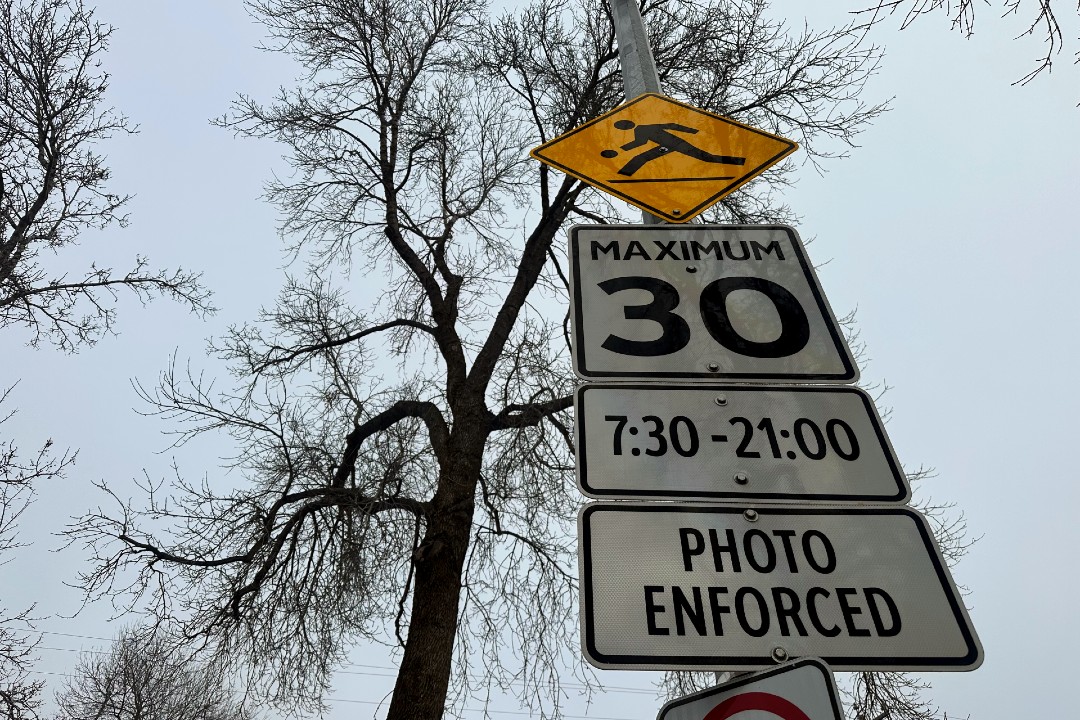
Council will consider reintroducing school zones into the speed zone bylaw. (Stephanie Swensrude)
Here are more key items:
- Councillors will discuss the framework that dictates what investments the city makes into community safety and well-being. The first option is to refocus the framework around council's strategic priorities — specifically, the priority of safety. The second option is to use the city's Blueprint for Violence Prevention as the plan. The third is to proceed with the status quo.
- Councillors have requested $105,600 toward travel to conferences and the Calgary Stampede in 2027, which is more than $30,000 over the recommended budget and about double what was requested in 2026. Administration estimates it will cost $52,000 to send council to the Federation of Canadian Municipalities annual conference in Halifax.
- Administration has sketched out a work plan for updating the City Plan, as Edmonton is expected to reach the 1.25-million population threshold in 2026. A report set to be presented at urban planning committee said the plan's core choices would remain unchanged, but select targets, strategic measures, policies, and maps may be refined. Council will debate a $1.2-million service package in the 2027-2030 operating budget to advance the plan.
- Administration said the numerous storms in June and July showcased the recent modernization work done to the emergency management program. Council's emergency advisory committee will be asked to approve the 2027 emergency management program.
- EPCOR and the city have created a collaborative response framework outlining what would happen during a significant water supply disruption requiring an emergency offline supply of potable water.
- Urban planning committee will review amendments to the business licence bylaw that would require short-term rental platforms, such as Airbnb and Vrbo, to acquire a business licence. The changes would also require such platforms to provide a monthly list of active listings in Edmonton, establish a policy to prevent rentals from causing excessive noise or disturbances, and remove listings that no longer have a valid licence. Coun. Michael Janz said he will put forward a motion calling for a requirement that the owner be required to live on the property, similar to British Columbia's restrictions.
And here are updates on some of the items we told you about before council's fall break:
- Councillors didn't make a recommendation on the future of the downtown district energy system. Administration asked council to choose between three options: continuing with the status quo and completing Phase 1A; looking for alternative ways to expand with a minimal amount of city funding; or stopping the expansion. Coun. Ashley Salvador introduced a motion calling for Phase 1A to proceed; for the city to work with EPCOR to find options to expand the utility through partnerships; and to proceed with a request for information for connections to the Exhibition Lands, Edmonton City Centre, River Crossing, Village at ICE District, and Station Lands developments. However, councillors on the committee eventually requisitioned the decision to the Nov. 25 city council meeting without making a recommendation.
- Councillors on the infrastructure committee directed administration to continue working on a business-friendly construction policy but to exclude any direct financial support. Coun. Erin Rutherford, who made the motion, said there are other ways that the city can support businesses impacted by construction, such as better communication. "Clear is kind," she said of the decision to refrain from including financial support as an option in the policy. "There is absolutely no budget line that we have for that right now, so I think even entertaining that as a dialogue in this engagement is not good practice or a good relational approach."
- Council voted unanimously to postpone a public hearing for a lot in Pleasantview because the developer wants to lower the height of its proposed development.
- Without debate, council approved an application for a lot at 103 Avenue and 106 Street NW to allow a surface parking lot to continue operating, and for a multiplex at 7120 77 Avenue NW to be rezoned to the business employment zone.
Meetings stream live on YouTube on the Chamber channel and River Valley Room channel.
For more on civic affairs, including the downtown district energy system, the new name for Government Centre LRT Station, and the launch of the transit merch store, check out Episode 380 of Speaking Municipally.
Share