
The Pulse
Nov. 28, 2025
Here's what you need to know about Edmonton today.
Essentials
- -10°C: Periods of snow ending in the morning then cloudy. 30% chance of flurries late in the afternoon. Wind north 20 km/h becoming light in the morning. Temperature steady near minus 10. Wind chill near minus 18. (forecast)
- Magenta: The High Level Bridge will be lit magenta for Family Violence Prevention Month. (details)
- 2pm, Nov. 29: The Edmonton Oilers (10-10-5) play the Seattle Kraken (11-6-6) at Climate Pledge Arena. (details)
RAM calls for artifacts of queer life
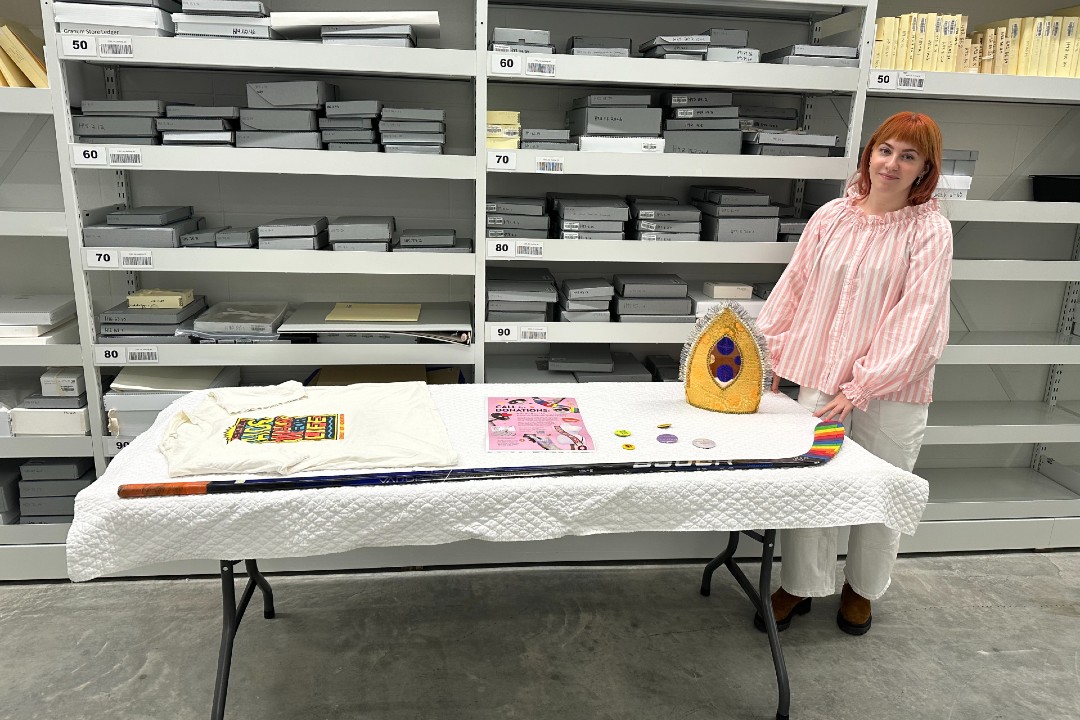
A trans man's first chest binder. A pair of platforms used in a drag performance. A Polaroid of a gaggle of lesbians at a queer dance party. All of these could be items that tell the story of queer history in Alberta, said Julia Rudko, assistant curator of daily life and leisure at the Royal Alberta Museum.
The museum is now seeking donations of items that reflect 2SLGBTQIA+ lives, both past and present, to address a gap in queer history.
Rudko told Taproot the museum is looking for both contemporary and historic items. "Often when we get a donation, it's someone who's clearing out a grandparent's attic, or it's something that they were given many years ago, and they don't necessarily have a story attached," Rudko said. "What's really exciting about the contemporary collecting aspect of that is, if I was collecting a piece from someone that they used recently, they remember the story. They can tell us about it, and we get a much better picture of what that artifact means both to them, but to the broader queer history that we're trying to tell."
Rudko said that, historically, queer people have been seen as less important. "Consciously or unconsciously, that means less of those histories are going to appear (in the museum). So it's our responsibility to the people here in Alberta — queer people, and the broader province — to tell the whole story, and that includes the queer stories," she said. "By collecting them now, we're hoping that, moving forward, we can always tell that full story, including queer people who've been here since time immemorial, and whose stories have been neglected and shouldn't be as we go forward."
The collection project is not related to the three anti-transgender bills that the provincial government recently passed, Rudko said. The legislation limits access for trans youth to gender-affirming care, bans trans women and girls from participating in women's sports, and requires parental consent for kids to use different pronouns at school. The Alberta government has also invoked the notwithstanding clause to protect the trio of laws from legal challenge.
The RAM's collection related to queer history currently includes a shirt from Bill Lee, a gay man who photographed many queer events in Edmonton in the 1990s and 2000s, and handmade buttons from his sister Laura Lee, a labour activist and lesbian. The collection also includes a hat that Edmonton's first openly gay city councillor, Michael Phair, wore to Cariwest, and a more recent acquisition of a hockey stick wrapped in Pride Tape, which was created in Edmonton in collaboration with now Senator Kris Wells.
Rudko said the donated objects hold a person's story. "It might not be something really grand. It could be the coffee mug, a pair of socks, something little, but it's a vehicle for telling their story, and I think that's something that we're really trying to do here," she said.
Those interested in donating items can contact Rudko to begin a conversation. The RAM said it has particular gaps in its collection regarding lesbian and transgender history. "I am happy to speak to anyone that thinks they might have something big or small, because people don't always look at that pair of shoes in their closet or that backpack and (think that it) is of historical significance," she said. "Even if you don't feel like you're the biggest, most important person in that community, even if you think, 'You know, I have a fun story about a Polaroid,' or something like that — just call me."
Correction: This story has been updated to reflect that Bill and Laura Lee are indeed related.
Headlines: Nov. 28, 2025
- The Edmonton region remained under a yellow warning for air quality throughout Nov. 27 due to elevated pollution levels. Environment Canada said conditions were expected to improve by morning on Nov. 28.
- A new Zoocasa analysis using the 2025 Leger Happiness Index finds Edmonton ranks seventh in Canada for happiness (score 66.3) and offers one of the lowest housing costs per "happiness point," at about $6,289 on an average home price of $417,000. This places Edmonton ahead of markets like Montreal and Calgary in terms of happiness value for money.
- A new cohort of 19 Community Peace Officers has graduated at Edmonton City Hall, with several joining the city as Transit Peace Officers to bolster safety on transit and downtown while others fan out to partner agencies across Alberta.
- After a second fatal collision this year at the Highways 28 and 624 intersection east of Morinville, Sturgeon County residents and Mayor Alanna Hnatiw are renewing calls for safety upgrades such as lights and twinning on this busy route north of Edmonton. Alberta Transportation has promised an open house on the highway, but locals say they want to see concrete funding and near-term fixes at what they describe as a "super dangerous" intersection.
- Edmonton police say a charter bus company, fined $108,000 for 223 safety violations and stripped of its operating certificates, has resurfaced under a new name and continued running trips, including for school groups, without required safety approvals. The Edmonton Police Service and Alberta Transportation have seized at least one bus and describe the firm, reopened as "Northern Alberta Transportation," as a "chameleon" carrier.
- Edmonton Elks players spent a day helping the Strathcona Christmas Bureau wrap gifts and build hampers for local families, as part of the team's push to "give back in any way possible" during the off-season. The Bureau says donations are down, and it is especially seeking gifts for girls aged 10–11, infants aged 0–12 months, and $25 gift cards for teens. New, unwrapped items and cash are accepted at its Broadview Drive depot and other drop-off sites through Nov. 29, and hamper applications are open until Nov. 30.
- Alberta is now forecasting a $6.4-billion deficit for 2025-26, up from the $5.2-billion shortfall in Budget 2025, as weaker oil prices, U.S. tariffs, and higher program costs push non-renewable resource revenues down to about $15.4 billion from a $25.2-billion peak in 2022-23. Finance Minister Nate Horner says the province will "turn over every rock" on spending, while relying on record oil production, an $8.8-billion capital plan, and still-strong GDP and population growth to support jobs and services even as manufacturing and private-sector hiring softens.
- Prime Minister Mark Carney and Premier Danielle Smith have struck a deal to fast-track a new, privately financed bitumen pipeline to the B.C. coast, with the goal of getting shovels in the ground by 2029, and potential Indigenous co-ownership. In exchange, Alberta will raise its industrial carbon price and back a major carbon-capture project. Smith framed the agreement as "a new relationship, a new starting point" with Ottawa, as the federal government will suspend its proposed oil and gas emissions cap and some clean electricity requirements. Longtime climate advocate and Liberal MP Steven Guilbeault has quit cabinet in protest over what he calls a rollback of key climate measures, but he will remain in the Liberal caucus.
A moment in history: Nov. 28, 1898
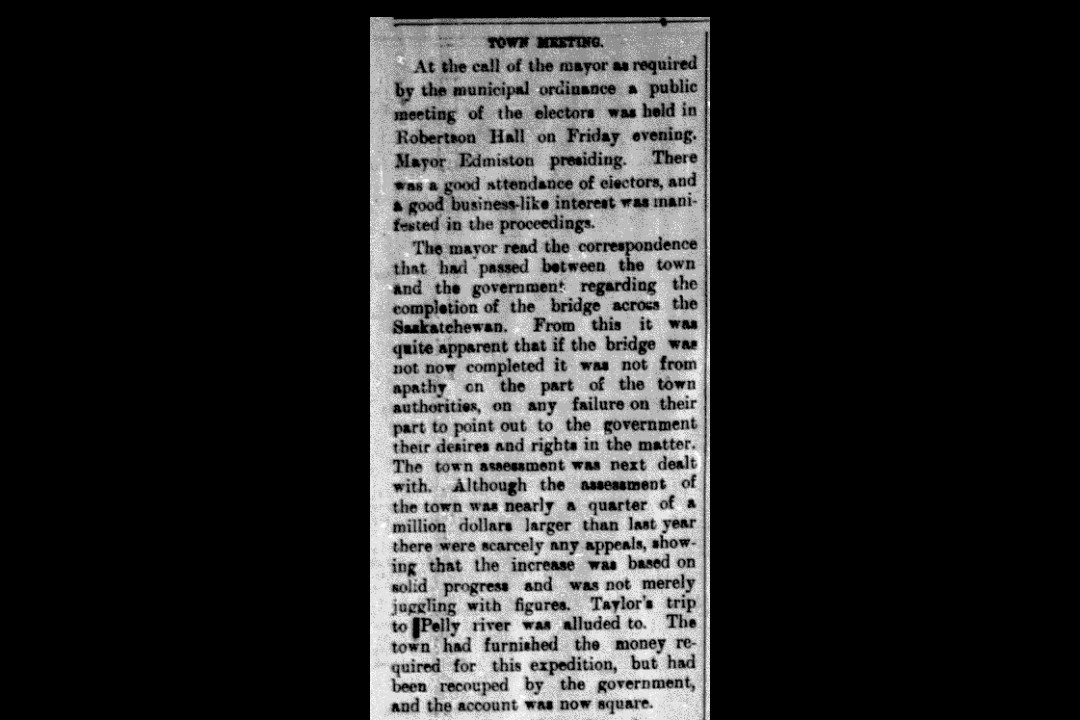
On this day in 1898, Edmonton's town council was discussing the construction of the first bridge across the North Saskatchewan River.
During the meeting, the mayor read out correspondence regarding the bridge between the town and Ottawa, noting the fact it remained unbuilt "was not from apathy" on the part of Edmonton's leaders.

At the time, both Edmonton and Strathcona were rapidly growing but separated by the North Saskatchewan River. Crossing the river was slow and limited to options like the cable ferry set up by John Walter in the 1880s. Demand for something more convenient and faster was high.
Construction began on the Edmonton Bridge the following year. The bridge is now known as the Low Level Bridge, but that name is somewhat misleading: The Low Level Bridge is actually two different bridges, each built half a century apart.
The original half opened in 1900, allowing wagons and pedestrians to cross. Two years later, railway tracks were added, connecting Edmonton to Strathcona (and the rest of Canada) by rail via the Edmonton, Yukon and Pacific Railway. Without a rail connection, many worried that Edmonton would wither away and Stratchona would continued to grow. Tracks were added in 1908 for the city's radial railway streetcars.
The Low Level got its current name when the High Level Bridge opened in 1913. The fact that it is low and close to the water became a pointed concern in 1915. After days of heavy rain, the river's waters rose by 10 metres, washing away many buildings within the river valley. Worried that the flood would destroy a vital link for the city, rail crews parked heavy train cars filled with sand on the Low Leel Bridge to weigh it down. It was a desperate measure, with engines sat on either side, ready to pull the cars away if it failed. Luckily, the bridge survived.
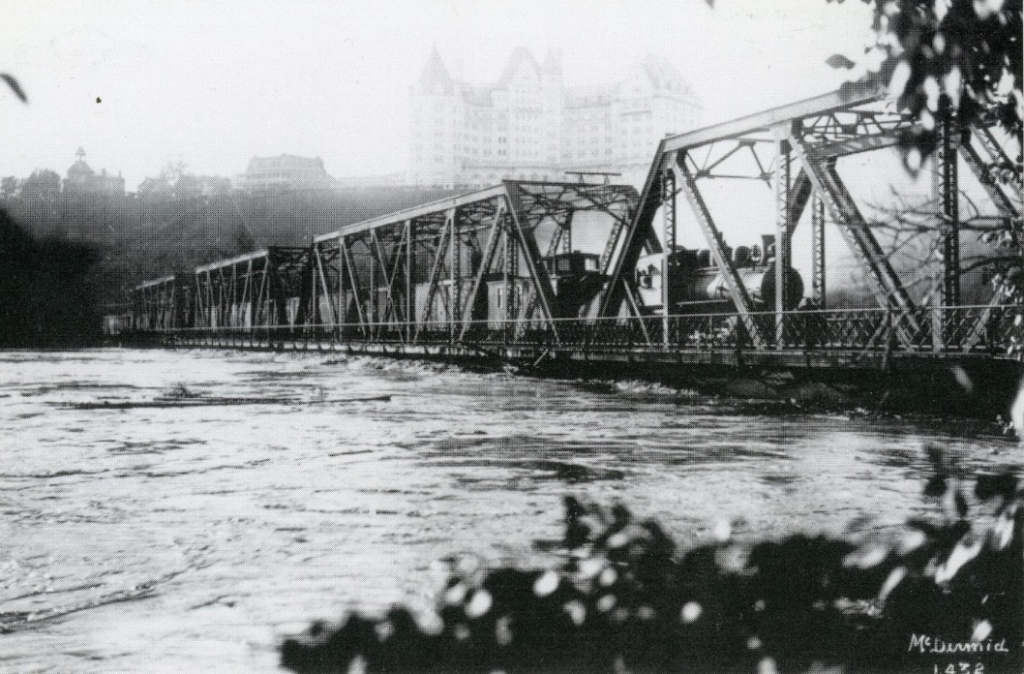
Eventually, a deck was added to allow vehicles to use the bridge. In 1949, the city built a second bridge, parallel to the first, designed to resemble the original. A year later, the railway tracks were removed. The bridge has been dedicated to vehicle and pedestrian traffic ever since.
Though the Low Level Bridge has connected the north and south banks of the North Saskatchewan for 125 years, its future remains uncertain. The bridge is currently partially closed for rehabilitation, as the newer half is nearing the end of its lifespan. But that rehabilitation is only a temporary measure that will extend its use for another decade. The future plan could be to remove that section of the bridge entirely.
This clipping was found on Vintage Edmonton, a daily look at Edmonton's history from armchair archivist Rev Recluse of Vintage Edmonton.
Happenings: Nov. 28, 2025
Here are some events happening this weekend in the Edmonton area.
- Nov. 28: Seniors' Tour | Temporal starting at 2pm at Art Gallery of Alberta
- Nov. 28: Table d'Hôte starting at 6pm at Café Bicyclette
- Nov. 28: Kaifi Khalil Live In Concert Moujza starting at 6pm at Pakistan Canada Association of Edmonton
- Nov. 28: Blatchford Boogie Woogie starting at 7pm at Alberta Aviation Museum
- Nov. 28: Irrational Cabaret Pint of Science: Distilling the Unfiltered Truth starting at 7:30pm at Irrational Brewing Company
- Nov. 29: Stuff A Bus starting at 9am at Save-On-Foods locations
- Nov. 29: Storytime with Charlene Tolentino starting at 11am at Audreys Books
- Nov. 29: Winter Whyte Light Up starting at 4pm at Dr. Wilbert McIntyre Park
- Nov. 29: Warren MIller's SNO-CIETY starting at 6pm at Horowitz Theatre
- Nov. 29: 80s Silent Disco starting at 7pm at Art Gallery of Alberta
- Nov. 29: An Evening with Dan Davidson & Clayton Bellamy Live starting at 8pm at Capitol Theatre
- Nov. 30: Stroll of Poets Haven Reading Series starting at 2pm at Audreys Books
And here are some upcoming events to keep in mind:
- Dec. 7: Script Salon: The Gertrude Project at Holy Trinity Anglican Church
- Dec. 10: I'm Still Hungry at TELUS World of Science - Edmonton
- Dec. 14: Christmas Bird Count Walk at Whitemud Park and Ravine
Visit the Taproot Edmonton Calendar for many more events in the Edmonton region.

The Taproot Mini - No. 103
Test your crossword prowess and deploy a little of your Edmonton knowledge. Complete the puzzle.
Did you know that Taproot sells memberships? Might be a great way to show how much you love the Mini!
The Taproot Mini is brought to you by ATB, your homegrown source of good advice to help conquer life's tougher puzzles. Learn how.
