
The Pulse
Feb. 18, 2026

Help us better serve you by filling out the Taproot audience survey!
Essentials
- -22°C: Cloudy. Becoming a mix of sun and cloud in the morning. Wind up to 15 km/h. High minus 22. Wind chill minus 34 in the morning and minus 27 in the afternoon. Risk of frostbite. UV index 1 or low. (forecast)
- Green/Red/Yellow: The High Level Bridge will be lit green, red, and yellow for the celebration of Lithuanian independence in 1918. (details)
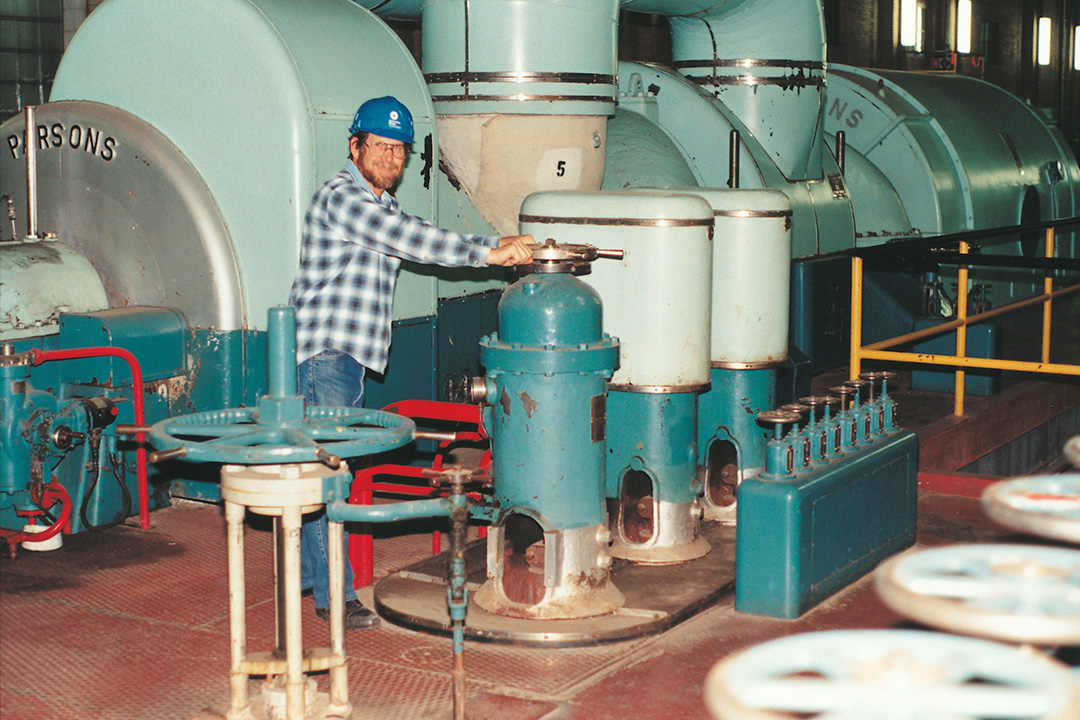
Inside the Rossdale Power Plant
A look at the past and present of a River Valley icon as the city seeks pitches for the future
Paul Collis remembers a time when the Rossdale Power Plant was filled with steam, noise, and life.
"Rossdale was a family," Collis told Taproot, describing his job as "putting in time" instead of work. "I don't like that four-letter word with a W."
Nearly 40 km away from Rossdale sits the Edmonton Power Historical Foundation, a museum and archival centre in Leduc County that preserves the history of electricity in Edmonton. Collis, who worked at the plant for 30 years, is among the people who keep the foundation running and the memory of the plant alive.
Since the 1930s, the Rossdale Power Plant has been a landmark in the river valley. This was once the place that kept Edmonton's lights on, or, on at least one memorable occasion, needed some quick repairs to put them back on.
Collis, who worked as a power engineer, was there in 1973 when an explosion at Edmonton Power's Hardisty substation set off a chain reaction that blew out the transformers in Rossdale and knocked out the entire city's electricity for more than an hour.
"It was March the 17th, and I was at home, and I phoned down to the plant, and they said, 'Yeah, you get down here right now,'" Collis remembered. "So I spent my Saturday off down there, getting the lights back on."
Since the plant was decommissioned in 2012, it has sat gutted and empty.
In January, the City of Edmonton renewed its call for submissions for adaptive reuse of the building. Applications are open until April 30, and the decision-makers want to see a clear vision, secured funding, and a willingness to work with Indigenous communities.
Taproot went on a media tour of the facility in January, then asked Collis to share what used to be there.

Let's Find Out about the Whale Society of Edmonton
Did you know Edmonton once had a save-the-whales club, and it made a big splash? Learn more at a live recording of Let's Find Out, a podcast about history. Chris Chang-Yen Phillips will speak to Candas Jane Dorsey and Kathryn Ivany about this moment in Edmonton's past and other treasures in the city archives. Join us on March 3!
Headlines: Feb. 18, 2026
- Edmonton city council voted 8-4 to maintain the maximum number of units for new infill developments at eight dwellings, rejecting a motion from Coun. Karen Principe to reduce it to six. Council also voted 10-3 to direct administration to prepare bylaw amendments that would limit new infill to 9.5 metres in total height, and voted 11-2 to instruct administration to draft a private tree protection bylaw. The bylaws will be debated and voted on at a public hearing. A feasibility study found that approximately 292 homes were issued permits to be redeveloped into six- to eight-unit buildings, amounting to 0.5% of the city's housing inventory.
- The City of Edmonton has declared a Phase 1 parking ban starting Feb. 18 at 7am, and has enlisted 100 private graders to assist with snow clearing as about 15 to 30 centimetres of snow has fallen across the region since Monday night. Spokesperson Valerie Dacyk said bringing in private contractors before the snow stops will help clear the roads faster. "As always, we just ask for residents to have patience and give our crews room to work," Dacyk said. "We want to get those roads clear and ready for use as soon as possible."
- An Edmonton Public Schools review of the school resource officer program found mostly positive feedback from staff, students, and families after the program returned to some schools last year. Officers have returned to 13 schools across Edmonton, with seven more schools getting SROs this month. Students surveyed generally appreciated the approachable, friendly, and visible presence of the SRO, though some community members expressed concerns about ensuring marginalized communities and youth are properly supported.
- Edmonton faces a $10-billion gap in funding for renewing roads, recreation centres, and other infrastructure over the next decade, according to a recent presentation. Even if the city allocates every unconstrained dollar toward refurbishment during this period, it will still be $10 billion short of what's needed. "There needs to be a dramatic rebalancing of infrastructure spending between new and old, understanding that there is painfully little room to add to the city's asset base," columnist Keith Gerein wrote.
- Chandos Construction said in a news release that okimaw peyesew kamik (King Thunderbird Centre), which opened in December, has achieved Zero Carbon Building Design v3 certification and features on-site renewable power generation through 360 solar photovoltaic panels and a geothermal energy system. The centre "is a space deeply rooted in Indigenous culture and practice," Diana Elniski, executive advisor at Boyle Street Community Services, said. "That means being good caretakers of the land we live on and honouring it as Treaty 6 people. The solar and geothermal energy systems allow us to provide a place for healing, dignity, and safety to everyone who enters while minimizing our environmental footprint."
- Olivia and Noah remained the most popular baby names in Alberta for 2025, with Olivia holding the top spot for 13 consecutive years, and Noah for seven years. More than 52,000 births were registered in Alberta in 2025, with parents choosing more than 14,500 unique names.
- Edmonton Oilers centre Josh Samanski received rave reviews at the 2026 Olympics, scoring a goal and an assist as Germany beat France 5-1 to advance to the quarter-final against Slovakia. The 23-year-old has turned himself into a two-way force and proved to be a capable third-line centre, columnist David Staples wrote.
Correction: This file has been updated to more accurately reflect what council decided on the height of infill developments and where bylaw amendments are in the legislative process.

The strategic rise of Lakeview Business District
A message from the City of St. Albert:
On the west side of St. Albert, strategic growth is taking physical form in Lakeview Business District, a $1.5-billion vision that is shaping 600 acres into a new economic engine for the Edmonton Metropolitan Region. The Business District is strategically located along the Ray Gibbon Drive corridor, providing direct links to Anthony Henday Drive and Yellowhead Trail. This connectivity is designed to support a specific cluster of high-growth industries, with a focus on:
- Advanced Manufacturing
- Health and Life Sciences
- Transportation and Logistics
From vision to groundbreaking
While Lakeview has been in the planning stages for over a decade, 2025 marked the start of its transition from paper to pavement with the official groundbreaking ceremony. This event signalled to investors and developers that opportunities like Lakeview do not wait, and with momentum building, now is the time to act.
Infrastructure is often the invisible backbone of regional growth; the City is currently in the design phase of its $62.7-million investment to front-end the district's essential services. Construction of roads and services is scheduled to begin in early 2027, paving the way for the first wave of private-sector investment. Additionally, a city-led neighbourhood plan is underway, furthering the City's commitment to reducing barriers for developer investment in Lakeview.
A targeted incentive to spur early development
To lower the barrier of entry for development, St. Albert recently introduced the Development Acceleration Program (DAP). Launched in January 2026, this $8-million initiative provides targeted incentives of up to $110,000 per acre. The goal is simple: to help reduce land development costs and to accelerate the construction that will enable businesses who want to pioneer their own future to control their destiny in Lakeview Business District.
Regional impact
Beyond the immediate boundaries of St. Albert, Lakeview is expected to have a ripple effect across the region. At full build-out, the district is projected to attract up to 5,000 jobs, offering high-value career opportunities closer to home for the region's skilled workforce.
For Taproot readers, Lakeview represents more than just new industrial inventory; it is a case study in how mid-sized cities are evolving to meet the demands of a global economy. By focusing on specialized sectors and offering competitive development frameworks, the district is positioning itself as a cornerstone of the region's long-term fiscal sustainability.
Take the next step
Learn how The Future Works Here! Gain access to resources, including our developer toolkit, contact details, and the Development Acceleration Program application at LakeviewBusinessDistrict.ca.

Happenings: Feb. 18, 2026
Here are some events happening today in the Edmonton area.
- Tours for Tots | 20 Artists 1 Love starting at 10am at Art Gallery of Alberta
- The Rainforest Survey: Insights & Next Steps starting at 12pm online
- ASTech Awards Information/Office Hours Sessions starting at 1:30pm online
- Makerspace Cart starting at 3:30pm at Stony Plain Public Library
- Lunar New Year Wontons starting at 6pm at Edmonton Public Library (Stanley A. Milner)
- Audreys Genre Book Club starting at 7pm at Audreys Books
- Writers' Guild of Alberta Pub Night starting at 7pm at Rooster Cafe & Kitchen
And here are some upcoming events to keep in mind:
- Feb. 25: Roots & Routes at Fox Burger
- Feb. 28: Brunch For Ben at Matrix Hotel
- March 3: Let's Find Out: About The Whale Society of Edmonton at City of Edmonton Archives
Visit the Taproot Edmonton Calendar for many more events in the Edmonton region.

The Taproot Mini - No. 150
Test your crossword prowess and deploy a little of your Edmonton knowledge. Complete the puzzle.
Know someone who would love the Mini? Encourage them to subscribe to The Pulse. You've got your own referral code at the bottom of this email.
The Taproot Mini is brought to you by ATB, your homegrown source of good advice to help conquer life's tougher puzzles. Learn how.
