
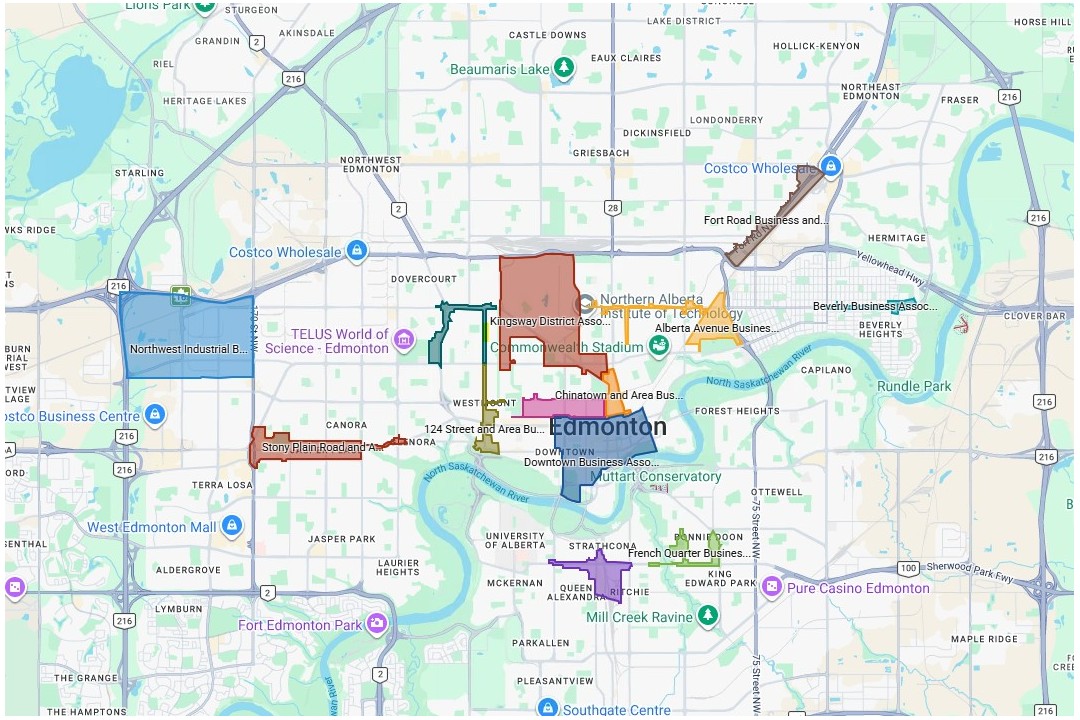
The boundaries of Edmonton's 13 business improvement areas. (City of Edmonton)
City pledges deeper coordination with BIAs ahead of budget
By Stephanie Swensrude and Colin Gallant
City councillors have directed administration to work with Business Improvement Areas to address maintenance, cleaning, and a strategic realignment.
Following engagement with the city's 13 BIAs, the City of Edmonton administration is pursuing immediate actions that will be funded under the current budget. These include enhancing efforts to raise internal awareness of BIAs and the impacts of municipal work on businesses; initiating working groups with representatives of BIAs and city administration; assisting businesses to find the right administrative contacts; and including BIAs in appropriate initiatives and policy development.
A report that was presented to council's executive committee on Oct. 21 also outlined the action items that will be included in a service package that will be discussed during budget deliberations in November, and further actions that require more analysis. Councillors directed administration to do that analysis and return to committee next fall.
They also directed administration to develop options for a cost-sharing program to support infrastructure maintenance, and they approved a motion from Mayor Andrew Knack that allows BIAs to use their budgets to hire contractors for enhanced maintenance and beautification of city-owned assets within their boundaries. "This is just one piece to the ongoing puzzle that we need to keep working on," Knack said. "I'm feeling very hopeful because I think we're making progress every step of the way."
The discussion followed a Sept. 28 letter from the Business Improvement Area Council that called for three priorities during budget deliberations:
- Ensure economic development is a core municipal priority;
- Public safety and social disorder management is community economic infrastructure;
- Leverage city investment to support BIA district vitality.
"Part of our letter was not an ask for new money, but a strategic realignment of some priorities and initiatives to make the investment go further and to have a greater return on that investment," said Todd Janes, executive director of the Stony Plain Road Business Association and chair of the Business Improvement Area Council.
The city has an opportunity to employ BIA expertise to consider how city decisions affect businesses, from major construction projects to social disorder mitigation, Janes told Taproot in an interview before the matter came to executive committee. Better data is also needed to measure more than whether a major infrastructure project is on time and on budget, added Laurene Viarobo, executive director of the North Edge Business Association, soon to be renamed Midtown.
"You want to make sure that the people that are going to benefit from (an investment) are going to benefit from it to the fullest extent," she said.
The boundaries of Edmonton's 13 business improvement areas. (City of Edmonton)
BIAs would like to be seen as "co-investors in economic growth" rather than as lobbyists or special interest groups, administration heard. After all, "every BIA is unique," Viarobo told Taproot, meaning that each has diverse expertise from working with businesses who face varied challenges.
In North Edge/Midtown, which covers an area north of downtown in the neighbourhoods of Queen Mary Park and Central McDougall, Viarobo has often worked with newcomer entrepreneurs on adapting to Edmonton's business ecosystem. In the Stony Plain Road area, which covers much of the former town of Jasper Place in the west end, Janes has different challenges, going so far as to create an Outreach Navigation team led by experienced street team workers to help businesses deal with social disorder compassionately.
Janes sees more institutional support for attracting outside investment to the city than there is for businesses that are already here. Explore Edmonton seeks to attract visitors, and Edmonton Global is there to bring in foreign direct investment, but there is no body dedicated to looking after homegrown businesses, other than the BIAs. Even though they don't cover every part of their city, they represent around 4,600 businesses, more than twice the membership that the Edmonton Chamber of Commerce lists.
"There are a lot of efforts on attracting and competing on the international stage as a mid-sized Canadian city, but there is no specific local economic development agency," Janes said. "I think a lot of that falls to minuscule programs or small investments, whether it's a shop-local campaign that runs on less than $100,000, or a lot of individual (spends)."
Established businesses are feeling the strains of construction, social disorder, and even the lingering effects of the COVID-19 pandemic, which not only changed shopping habits but also resulted in increased social disorder. The latter is a highly complex issue, Viarobo said, but she'd like the city to better understand how much disorder is costing businesses, with more data to track the results of current and future mitigation efforts.
"The broken windows, the back lanes with dumpsters that could be put on fire — those are really critical problems that have to be addressed," she said. "We want to measure how we reduce those pieces. The other component is just measuring what it costs — what it costs to everyone."
Janes noted the consequences of vacant and derelict commercial properties. He pointed to the fire at the empty Jasper Place Hotel this year as a disaster that could have been avoided, or at least been less severe, had the building been dealt with. He's in favour of the city's work to increase taxes for derelict commercial properties, but he thinks it could go one step further.
"The biggest killers to vibrancy in our city are vacant main-floor spaces," he said, "So why doesn't the city incentivize (filling those) a little bit, or create some programs on actually measuring the impact of it?"
Alberta is one of only two provinces where BIAs collect levies from business owners only, not property owners, making vacant properties a black hole where funding could be. Leaders of BIAs called on the province to change that when the Ministry of Municipal Affairs updated the relevant section of the Municipal Government Act, but that particular change didn't happen.
Janes said he thinks the province may reconsider the matter in a few years, but for now, BIAs will have to make do with the status quo.
Taproot holds members-only livestreams every second Friday, where guests such as Janes and Viarobo go deep on issues of interest to Edmontonians. Become a member for access to future livestreams.
Share