Explainer: The role of parties and slates in the 2025 election
Municipal elections in Edmonton and Calgary have often featured candidates for council and mayor who lean somewhat toward existing provincial or federal parties, even though those parties have not been formally allowed. As one scholar points out, it's impossible to stop candidates from working together as they would in a formal party. But what's shifting for the 2025 election in October, now that the United Conservative Party government has changed the Local Authorities Election Act, is that parties are allowed this time around.
As part of Taproot's ongoing election analysis and coverage, today we examine parties and slates in the coming election and what that might mean for voters.
New rules allow parties
"You can't prevent people from coordinating with each other in the way that parties do," Jack Lucas, a professor of political science at the University of Calgary and a co-director of the Canadian Municipal Barometer research partnership, told Taproot in an interview. He added that the UCP government's bills 20 and 50 have changed policies around parties, and these changes also affect fundraising rules and what a ballot looks like.
Why did the province make these changes? Municipal Affairs Minister Dan Williams told Taproot via email that partisan politics are already happening at the municipal level, so these changes just make it clearer. "Local political parties and slates will make municipal candidate affiliations transparent and accountable, helping Albertans make informed decisions on election day," Williams said.
Under the new rules, parties are allowed to fundraise collectively, and their candidates can also fundraise individually. The pooled funds can support the campaigns of any candidate in addition to their solo funds. Coun. Andrew Knack, who, like the majority of Edmonton's mayoral candidates, is running as an independent for mayor, previously told Taproot that parties have an unfair financial advantage compared to independents and that party discipline raises questions about whether party candidates are loyal to the voter or the party.
Alberta's history with municipal parties
Lucas said there is a history of parties in municipal politics in Alberta. Party-like campaigning was common in Edmonton and Calgary roughly between the First World War and the early 1970s, he said. "In Edmonton and Calgary, in the past, organizations would take out a newspaper advertisement and say, 'Labour endorses these candidates, and this is your Labour slate for 1937."
Lucas has studied voter attitudes on municipal political parties in Canada and said the decline of parties at the municipal level is due to multiple factors. Those factors, Lucas said, included voter concerns that elected officials be loyal to their parties instead of their wards, and candidates, who preferred to govern without party oversight.
Today the municipal structures in Vancouver, Burnaby, Surrey, Montreal, and Quebec City all use a party system for their elections. Lucas said there's a logic behind the system in Vancouver, especially. There, the city has no electoral wards. Vancouver voters, therefore, want a greater understanding of who's on their ballot. "It's just really hard to imagine a totally non-partisan system in (Vancouver), where there might be 80 candidates," Lucas said. "How do you keep track of which of these 80 candidates you want to cast your 10 votes for? It's very confusing."
In Edmonton, as of Aug. 7, only two parties have registered for the 2025 election. One is the Better Edmonton party, which includes mayoral candidate and current councillor Tim Cartmell. The party has a total of 13 candidates. Among its roster are Cartmell's fellow councillor, Karen Principe, as well as Reed Clarke, who is leaving his post as the CEO of Sport Edmonton, a city-affiliated nonprofit, to run. The other party is the Principled Accountable Coalition for Edmonton, or PACE, which has eight councillor candidates but no candidate for mayor.
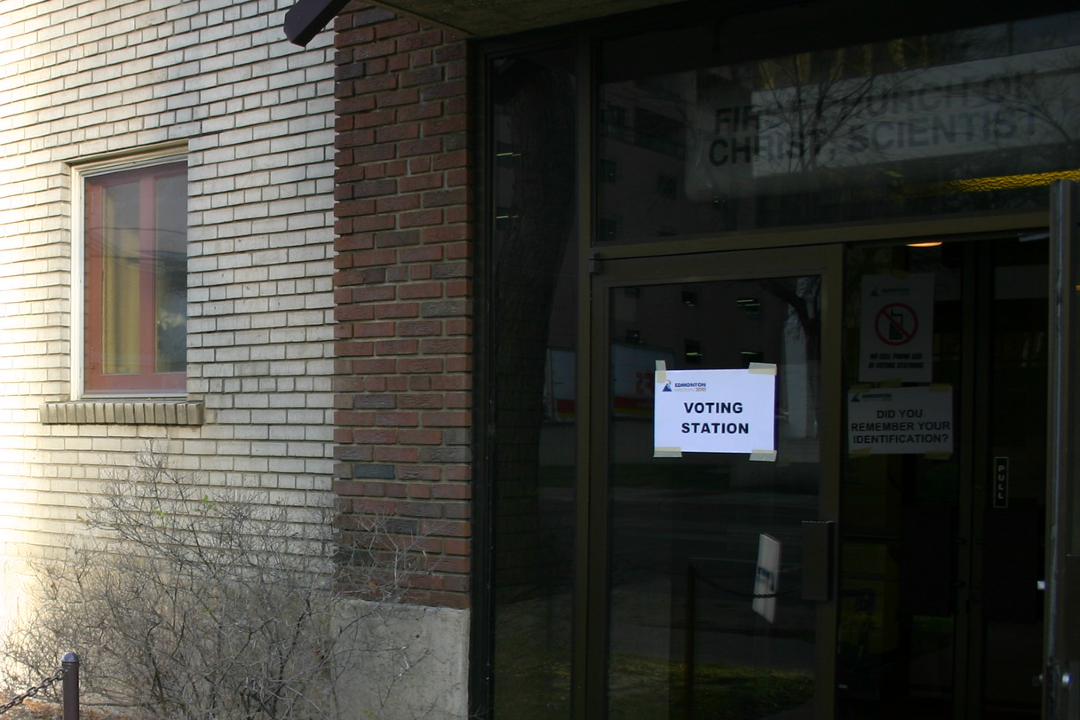
Even though Alberta has always had unofficial municipal political parties, party names will appear on the ballots in Edmonton and Calgary for the first time this year. Perhaps the biggest change this entails is that parties are allowed to fundraise collectively in addition to doing so individually. (Mack Male/Flickr)
Alberta's history with municipal slates
Slates are slightly different than parties in municipal politics. Where a party may be an organization of people with shared ideological leanings, a slate is a list (or slate) of people who are running and agree on certain core issues important to voters. Slates are sometimes one-off affiliations for a single election. But like parties, they have always been allowed on an informal basis in Alberta.
Lucas said slates are used to show alignment during campaigns, and are sometimes issue-specific in their purpose — they could be for or against transit projects or new sports infrastructure like an arena, for example. Candidates have little incentive to organize using a slate in 2025, Lucas said, because slates lack the fundraising perks that parties now offer, thanks to the UCP's Bill 20.
Edmonton has one slate so far in 2025, called Edmonton First (or sometimes Yeg1st). The slate has two candidates, Fahad Mughal and Noman Ahmed.
A notable past slate in Edmonton was the Urban Renewal Group Edmonton, or URGE, which existed in municipal politics back in the 1980s and 1990s. That slate convinced Jan Reimer to run as a candidate in 1980. Reimer won, and served as a councillor from 1980 to 1989. She then ran for mayor and won, serving as Edmonton's first (and only) female mayor from 1989 to 1995.
Calgary, the only other city in Alberta permitted to register parties and slates for this election, has three parties and zero slates.
Decision to change the rules
As for how we got here, Williams said that consultation for slates and parties took place through a public survey and direct consultations with municipalities and municipal associations.
The survey showed that more than 70% of respondents were against adding parties to ballots. Alberta Municipalities vocally opposed the addition of parties, as did both Edmonton Mayor Amarjeet Sohi and Calgary Mayor Jyoti Gondek.
Lucas said he thinks the Government of Alberta may have a misperception that Calgary unintentionally elects left-leaning politicians, and that the government hopes more conservative voters can find the candidates they're aligned with now that it has added parties.
"I think, actually, Edmonton and Calgary both have residents with relatively progressive policy attitudes on municipal issues," Lucas said. "It's not a coincidence that they keep electing these centre and centre-left mayors and councillors, because that's where their policy preferences are on municipal issues."
Share