Warehouse Park, other incentives spur up to 1,800 housing units downtown
Several developers say the "black hole" created by the many surface parking lots that surround Warehouse Park downtown is finally set to change, with up to 1,800 housing units proposed.
"Whenever you have that swath of land, everybody looks at it every day, saying, 'There's such an opportunity there,'" Ian O'Donnell, development manager at Westrich Pacific, told Taproot. "Most cities in Canada don't have that size of land, or areas around a park that are just sitting vacant, and so the opportunity is incredible, and it's wonderful to see that the private sector has responded."
Instead of skyscrapers towering over the future downtown park, however, developers are rezoning lots to build smaller. Autograph Group, the developer of The Shift at 10157 106 Street just east of the park, had initially proposed to build two towers, at 38 and 35 storeys, with 780 units. But in September, Autograph successfully applied to rezone the lot to allow for much shorter buildings. Autograph president Henry Edgar told Taproot the company now plans to construct buildings between six- and seven-storeys with up to 250 units.
"We were seeing the progress on Warehouse Park and on the LRT being built along 102 Avenue, and just felt the timing was right to restart the engines," Edgar said. "And right now, towers are just too expensive."
Kelowna-based Faction, the developer that owns the Massey Ferguson building and adjacent surface parking lot near the park, at 10609 104 Avenue, also rezoned its lot that same day to reduce the maximum height from 18 to 14 storeys. The building was recently designated a municipal historic resource. The new development will incorporate the historic building, according to a city report about the rezoning application.
Meanwhile, MHA Properties, developer of the BLVD building at 10163 108 Street that will directly abut the park, received a development permit in February to construct the six-storey, 54-unit building. The developer plans to include a restaurant or cafe on the ground floor with a patio facing Warehouse Park.
Westrich is midway through constructing Lotus Park, a six-storey, 152-unit building at 10164 108 Street. On Sept. 2, the developer visited the Edmonton Design Committee with its plans for two more six-storey buildings, one south of Lotus Park and one on the other side of Warehouse Park on 106 Street. Those buildings are expected to have 204 units and 171 units, respectively. The committee did not support either of the developments.
City administration has introduced a per-door incentive for student housing and will facilitate electricity upgrades, in the hope of spurring development, particularly around Warehouse Park. This will allow hundreds, if not thousands, of downtown housing units to move closer to completion, O'Donnell said. Combine that with the Valley Line West LRT, set to open in 2028, the upcoming completion of Warehouse Park in the fall, and new developments on NorQuest College's campus, and downtown's warehouse district is set to look remarkably different in a few years than it does now, provided the proposed developments are actually built.
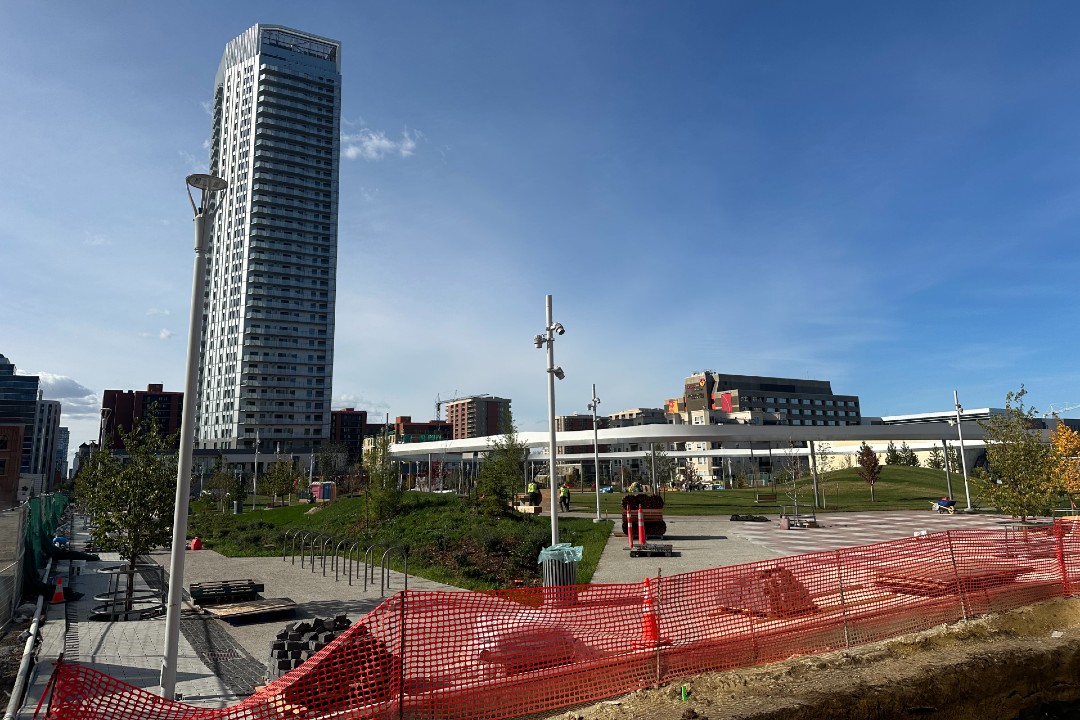
Warehouse Park is nearing completion, and the first new housing project abutting the site, The Parks, is leasing to tenants now. (Stephanie Swensrude)
Council recently approved the downtown student housing incentive, funded by the federal Canadian Mortgage and Housing Corporation, which offers developers $30,000 per unit to those who build student housing downtown. The priority zone is concentrated around Warehouse Park, close to MacEwan University and NorQuest College. Projects must include between 10 and 150 student units, and they must offer below-market rents and be reserved for students for at least 10 years. The units must be "clearly intended for student housing, demonstrated through unit design and amenities," according to the eligibility requirements. Applications for the first round of funding close on Sept. 30. More than 47,000 students visit downtown's post-secondary institutions every day, and 80% of these students are paying more than 30% of their income on housing, according to a city news release.
O'Donnell said Westrich plans to apply for the incentive program for its 106 Street development.
Meanwhile, Edgar said Autograph had already been reconsidering the Shift site, but was motivated further when the incentive was introduced. "We'd been looking at the feasibility of the project, but I'll be honest, the market is still challenging for redevelopment," Edgar said. "Performers need help, and that grant is a substantive grant." Autograph applied for the grant, and Edgar said he expects to hear back from the city in October.
But O'Donnell said the most important catalyst for private sector development downtown is the $48-million Warehouse Park. "This is really a park that can be enjoyed by many people in the area — visitors, people staying here at hotels, families coming downtown for events. It's big enough to host events, which we're really excited about," he said.
O'Donnell said building density without amenities can make neighbourhoods unsuccessful. Urbanism's patron saint, Jane Jacobs, believed that the success of a park was determined by the liveliness and vibrancy of the surrounding neighbourhood, not the other way around. For a while, it looked like Warehouse Park would be partly surrounded by gravel parking lots. But if the developments are completed, O'Donnell said it will be an essential amenity for residents.
"It has so many elements that are going to be attractive to families, to couples, to people who just want to go chill out in the sun and really create a much more civil downtown."
Perhaps indicated by its name, Maclab Development Group has said its multi-phase development The Parks was partially spurred by Warehouse Park. Its 36-storey north tower is open now, and the developer said it plans to also build a 45-storey south tower and a 12-storey complex between the two towers.

The Parks, left, and Lotus Park, right, are just two of the many developments proposed for the warehouse district.
Edmonton funded Warehouse Park through the downtown community revitalization levy, which was recently extended to invest in a new event park to be constructed by the Oilers Entertainment Group. The city borrows money to fund CRL projects, which are supposed to spark new private sector projects and lift property values on existing developments. The growth in taxes is then used to pay back the borrowed funds.
Another mechanism that was funded by the CMHC is the infill infrastructure fund. In September, council's executive committee was asked to approve a sole-source agreement with EPCOR to allow the utility provider to upgrade the downtown electrical system to help facilitate seven developments, which include several of the aforementioned housing developments.
"I cannot stress enough the importance of funds like that infill infrastructure fund — not only that, but the people behind it as a city, who are really looking to help support us as developers to say, 'What are the roadblocks and where are those costs that could kill a project?'" O'Donnell said.
Of course, real estate development is risky, and it's not certain that all the proposed housing will end up materializing downtown. If Westrich's three buildings, MHA's BLVD, Autograph's building, and the three towers for The Parks are all completed as planned, there will be up to 1,831 new housing units surrounding the park. Plus, there's the Faction development on the Massey Ferguson site, with a currently unknown number of units.
Edgar and O'Donnell both said they're optimistic about the direction downtown is heading.
"There's a lot of students in downtown Edmonton, and I think right now, they're not really being serviced with any purpose-built, dedicated student housing. NorQuest is growing rapidly, MacEwan University is growing rapidly with their school of business," Edgar said. "The combination of the Warehouse Park, the LRT, and a collection of new developments is going to really create a centre of gravity that I think is going to really change the face of downtown."
O'Donnell said the smaller developments are simply less risky to build, and that the planned projects are proceeding in a smart, aligned way.
"It's not just the development community, not just the city, not just post-secondary. Everybody is rowing together and pulling together to really uplift the area and make strategic investments of their own," he said. "As a collective investment and collective push, it's really going to transform an area that was that black hole into something beautiful, green, into something safe and welcoming and really active."
Share