Acclamations up across region in 2025
Two municipalities in the Edmonton region have now elected mayors through acclamation in 2025, compared to one in 2021.
The trend appears to be headed in a different direction across the province, where at least 19 other municipalities have done the same, compared to 35 in 2021. A full list of acclaimed mayors and councillors will be available when the Alberta government publishes its official election results after they are due from municipalities on Oct. 24.
Election through acclamation is the result of a lone candidate running without an opponent. To understand why such acclamations happen in municipal politics, Taproot looked at academic studies. That research suggests links between population and acclamations, as well as candidates running as incumbents.
Nomination day in Alberta was Sept. 22, and the withdrawal period for candidates was Sept. 23. That means any candidate running unopposed has now been acclaimed, per the Local Authorities Election Act.
Acclamations across the region
One newly acclaimed mayor is William Choy of Stony Plain. Choy was elected to council in 2007, elected mayor in 2012, acclaimed mayor in 2013, and elected mayor in 2017 and 2021. Choy is now the longest-serving current mayor in the region.
Simon Boersma has similarly been acclaimed mayor in Morinville. Boersma beat the incumbent, Barry Turner, in 2021. Before that, Turner was acclaimed as mayor in 2017.
Tanni Doblanko has been acclaimed as councillor in Leduc County, just as she was in 2021. Doblanko was first elected to council in 2013 and was reelected in 2017, ahead of her two later acclamations. In 2017 and 2021, Doblanko was chosen by her fellow councillors to serve as mayor. Leduc County is the lone municipality in the region where voters don't directly elect a mayor.
In Strathcona County, Aaron Nelson has been acclaimed as the councillor for Ward 5.
In 2021, Mayor Alanna Hnatiw of Sturgeon County was the only acclaimed mayor in the region. This year, she faces one challenger: Patrick Tighe, who was a Sturgeon County councillor from 2013 to 2021. He did not run for council or mayor in 2021.
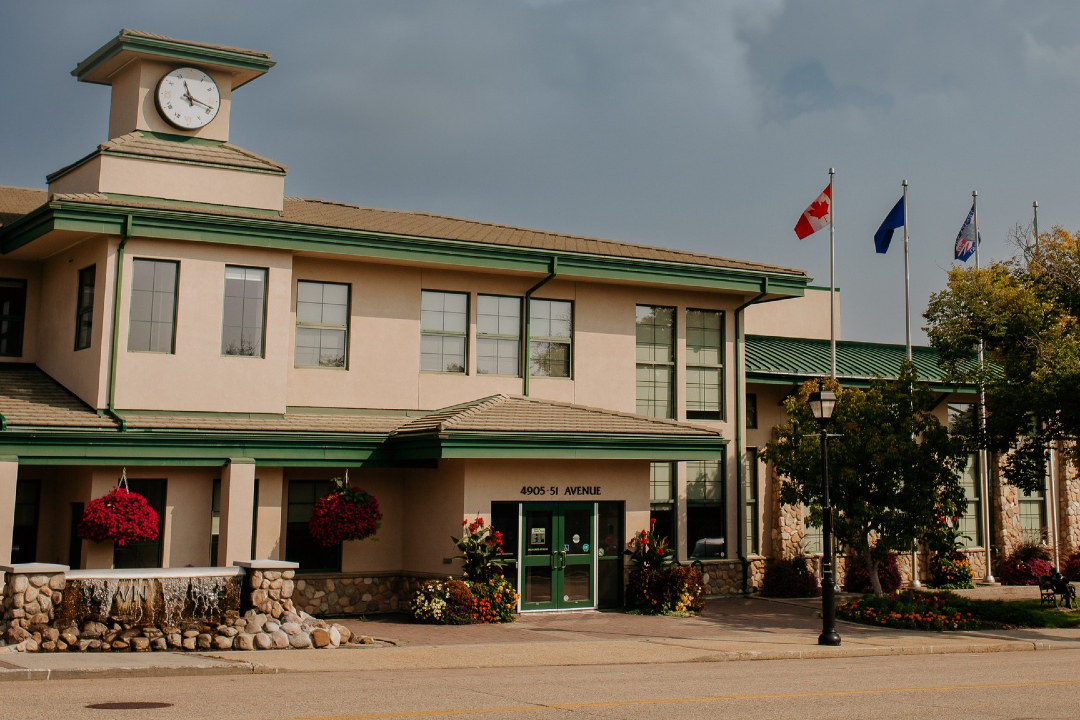
The town office for Stony Plain. Acclamations are up across the Edmonton region in 2025. (Facebook)
Research on acclamations
Reed Merrill, who works at the Canadian Municipal Barometer, a national research partnership that aims to understand local democracy in Canada, has studied where incumbents are most often acclaimed (though his research does not analyze where non-incumbents have been acclaimed).
Merrill compared the likelihood of municipal incumbent acclamations to population size in Canada for his 2022 master's thesis at the University of Calgary. He found that acclamations for incumbent candidates are more likely in municipalities with small populations, and most likely in municipalities of 999 people or less.
None of the regional municipalities has a population that small. Stony Plain, where Choy was elected through acclamation, has a population of 17,993, while Morinville, where Boersma was acclaimed, has a population of 10,385. The region's smallest municipality is Gibbons, with a population of 3,218. In 2025, Gibbons will have a contested election for mayor.
Outside the region, the town of Vulcan, with just 1,769 residents, has acclaimed its entire incumbent council.
Merrill told Taproot in an email that his findings indicate some incumbents may be so popular that other potential candidates do not want to run against them. He also cautioned that this is not "the whole story" on acclamations, but instead just one piece.
Why don't more people run for municipal office?
Sheena Earl, the city clerk in Brockville, ON, examined why a municipal candidate might go uncontested in Canada for her 2020 graduate thesis at Western University. Earl found 22 news articles that discussed reasons for acclamations in municipal elections in Canada and identified eight themes: Apathy/lack of interest, incumbency advantage, poor pay, demanding workloads, damage to reputation/criticism, shrinking populations, low prestige/power, and term length. (Earl wrote that her methodology is inherently limited because it's not possible to identify and speak with everyone who considered a run but ultimately did not become a candidate.)
Apathy or lack of interest was mentioned the most in the articles. The demanding workload and poor pay of municipal positions were mentioned the second most.
For context, Choy's average salary in Stony Plain from 2021 to 2025 was nearly $77,000 and he did not receive a raise during the period. The town's councillors made an average of nearly $39,000 during the same period, again with no raises. For comparison, Edmonton Mayor Amarjeet Sohi was paid nearly $207,000 in 2021, which gradually increased to just more than $223,000 in 2025. Council salaries were almost $117,000 in 2021 and just more than $126,000 in 2025.
Do uncontested races hurt democracy?
Earl's thesis also examined the attitudes toward acclamations in municipal politics, using a blend of news articles and interviews. The two attitudes were opposites — that acclamations are acceptable, and that they are harmful. "Some past and current local politicians, representatives from municipal associations, various chief electoral officers, and political science experts argue acclamations are a sign of public satisfaction, while others noted uncontested elections contribute to low voter turnout and a democracy which lacks accountability, the diverse exchange of ideas, and participation," Earl wrote.
Earl assessed 29 news articles and found many presented both the acceptable and harmful arguments for acclamations. Of them, 22 included the harmful argument and 13 included the accepted argument. Among the 13, the overwhelming reasoning acclamations are acceptable is that they show a satisfied public.
But things get more complex with Earl's findings on why acclamations are considered harmful. Of the 22 articles, 18 noted that acclamations lead to limited or no exchange of diverse ideas, eight noted they have a negative impact on voter turnout, six noted they engender a lack of formal accountability, and three noted that having an election rather than an acclamation can increase participation in democracy.
Here in the region, there are still many chances to participate ahead of the Oct. 20 election. Voters in Edmonton can take Taproot's survey to see which candidates best match their positions. Our election coverage also includes ward profiles, voter-driven stories, candidate comparisons based on issues, explainers, and more.
Share