
Robot-made trusses among pilot projects in new program
A robotics company aiming to make the modular building industry more efficient is among the first pilots supported by the new Venture Pilots program at Edmonton Unlimited.
RoBIM Technologies will pre-fabricate a form of truss for Honomobo, which makes modular homes and other structures. The pilot is a way to get a foothold in a realm that has a significant market, said Bruce Alton, CEO and co-founder of RoBIM.
"It gives us a reference customer to work with and an opportunity to work here in Edmonton," Alton told Taproot ahead of a March 18 showcase for RoBIM and four other companies. "But there are 1,100 modular builders in Canada, so they're all potential candidates for this."
Alton's company makes a manufacturing system called RoBIM HIVE that combines a robotic arm, software, and "end-effectors," which are attachments such as vacuum grippers, drilling routers, or nail guns. It shipped its first products from HIVE in the summer of 2025, and Alton said HIVE's functionality will grow during the Honomobo pilot, which is slated to run until June.
"We're building up this library of 25 different capabilities that we can combine together in different ways," Alton said. "We've developed some of the capabilities needed for Honomobo, but this project allows us to build a few new capabilities that will solve the problem for Honomobo, and then go into our library so we can then sell to other customers who have a similar need."
RoBIM was established in 2021 and closed an oversubscribed angel investment round in June 2025. Its customers include Connects Pre-Fab Wall Panels, which makes wall panels for multi-unit dwellings, and Alta-Fab, which makes dwellings and offices for worksites.
Customer acquisition and technology development go hand in robotic hand for Edmonton Unlimited's Venture Pilots program, which kicked off with its Built World Tech stream earlier this year. A key goal for the program is to help participants find customers beyond Edmonton, as RoBIM's pilot could do, given that the Edmonton-founded Honomobo has clients throughout North America.
"There are definitely significant advantages for our startups if they partner with corporations that are operating beyond our shores," program lead Zack Storms told Taproot. "We really want the startups to use these pilots to land more sales and grow their customer base beyond just the local region."
The first built-world cohort is expected to lead to 10 pilots, including RoBIM's. Others include the following:
- Aqtiva, which is using a cold plasma microbubble-activated water to maximize crop yield for FreshPal Farms in Olds;
- Candle Lithium, which is deploying a direct lithium extraction technology based on ion-exchange to a large natural gas producer;
- CityScan Technologies, whose AI-powered infrastructure assessment software will be used by Tetra Tech;
- Elementiam, which is providing a vision-enabled software layer for industrial robots to Fusion Production Systems.
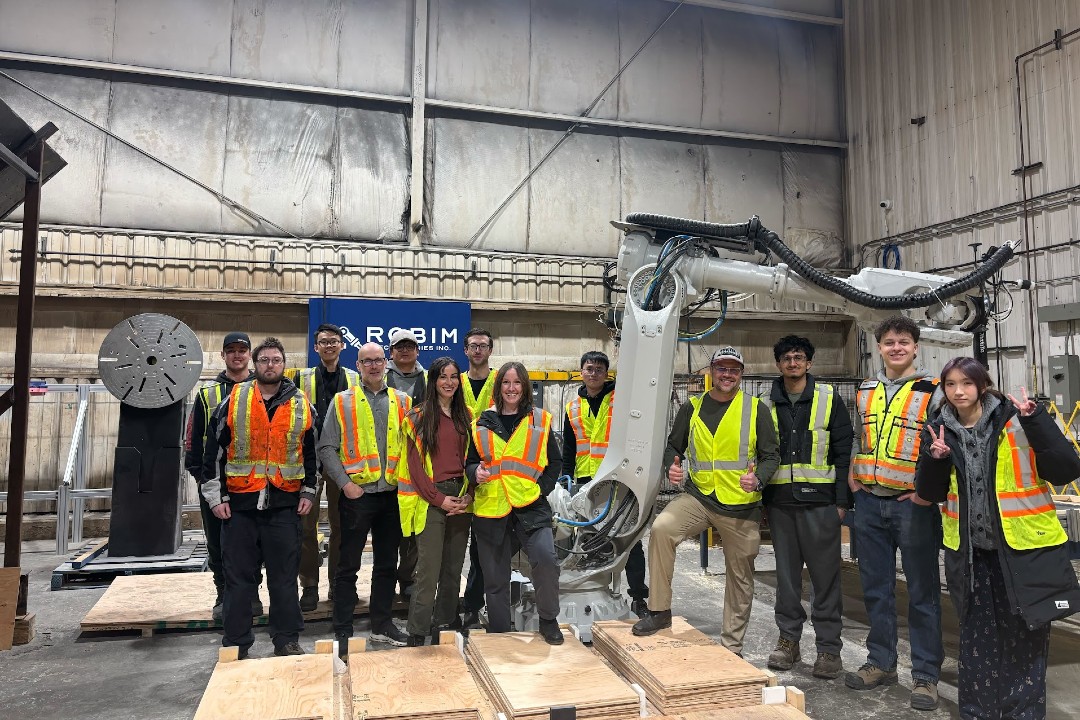
RoBIM Technologies CEO Bruce Alton (fourth from left) and Edmonton Unlimited's Zack Storms (fourth from right) alongside other members of the organizations. (Lauren McMaster/Edmonton Unlimited)
Companies like Honomobo have signed up to be pilot participants because they get value, too. It's expensive to acquire the tech for robotic manufacturing, and construction companies may not have the skill set required to operate it.
"We decided to fabricate on behalf of our customers, at least to start with," Alton said. "We take on all the risk. We have all the technical skills, the simulation software, all these things, and we'll just send you the product. That's really what they want, and hopefully it's a gateway drug to them doing more and more things (using automation)."
Alton, who spoke about the potential of AI in construction at last year's Upper Bound conference, is a strong choice to advance robotics adoption in the construction industry. Edmonton is keen on leading in that area, with initiatives such as the Construction Innovation Centre at the University of Alberta and the artificial intelligence and construction engineering strategy championed by the Edmonton Chamber of Commerce.
In addition to the pilot with Honomobo, Alton said RoBIM plans to secure further funding and continue to expand the company's manufacturing capabilities.
"We've got some very aggressive plans to grow our own capabilities," Alton said. "We have a massive housing shortage in Canada right now, and we generate 250,000 housing starts a year. We probably need to double, triple, quadruple that, and the industry is almost at capacity. Pre-fabrication technologies like this are going to be critical to solving those problems."
Storms had already received 45 applications for the Built World Tech stream as of March 9. More details on the pilot projects will be shared at the March 18 event, which will include an address from Technology and Innovation Minister Nate Glubish. Also in the house will be members of the program's 11-person investment committee, which includes Peter Keith of the eHUB Entrepreneurship Centre, Yasmine Al-Hussein of Yaletown Partners, Tiffany Linke-Boyko of Flying Fish Partners, and Kristina Milke of Sprout Fund.
"I'm really excited about this program because it is doing this fundamental job of supporting founders, closing sales, and getting traction in billion-dollar companies," Storms said. "I think when people attend the event, they'll see that in action, and I hope that they will want to get more involved."
Share