
Windsor Park plots renovation of historic green space
A south-central Edmonton community is nearing the end of a fundraising push connected to the designation of its park as a municipal historic resource, aligning with upcoming city policy that aims to widen the definition of heritage.
"People really care about this park," said Kyrstie Green, president of the Windsor Park Community League. "I think this project has shown how it's really positive."
The league's North Park enhancement committee launched the Love Our Park campaign on Valentine's Day, and donations quickly brought it close to its target of $53,000. "We just kind of held our breath, and I had no doubt that we would raise the money, but I didn't think we'd get it in a month," committee chair Elaine Solez told Taproot.
The park is listed on the city's inventory of historic resources, meaning it's recognized as worth conserving but has no legal protection. A municipal historic resource designation would add legal safeguards against demolition or major alterations, and would make the project eligible for up to $75,000 in rehabilitation funding.
While the park has historic value, it's also used by a wide range of people — not just Windsor Park residents, but university students and other visitors who play spikeball and badminton, ride bikes, and have picnics on the great lawn, Green said. "Given the number of units coming into Windsor Park and all that conversation that's going on at the moment, this is a really great space for everybody in the community to use," she said.
The proposed upgrades aim to repair heritage-defining elements while making the park more friendly for seniors, gardeners, and people using strollers or mobility devices. Solez said the most costly change is repairing the retaining wall, which is described as one of the park's defining architectural elements. The terra cotta I-XL Roman bricks were shaped and fired in Alberta, and the same bricks were used to build some of the original homes in the Windsor Park neighbourhood.
Edmonton city council is expected to vote on designating the park as a municipal historic resource in May.
Meanwhile, the city is updating the heritage places strategy to broaden the definition of heritage beyond just buildings. Even though the new strategy has yet to be finalized, some non-buildings have already been recognized — the city designated Alexander Circle as a municipal historic resource in 2024, and added the Strathcona Rail Garden to the inventory in late 2025. Solez said the North Park was the first green space to be added to the inventory.
Administration is accepting feedback on the final draft of the strategy until April 19, and the update is scheduled to be presented to council for approval this summer.
The Windsor Park neighbourhood and the North Park mark an important chapter in how Edmonton developed. Windsor Park was virtually untouched until the post-war housing boom, when the city purchased dozens of lots. Windsor Park was redesigned from its original grid pattern into the more curvilinear style that was used in Edmonton's next generation of neighbourhoods.
Windsor Park is also linked with some of Edmonton's most prominent architects and city-builders.
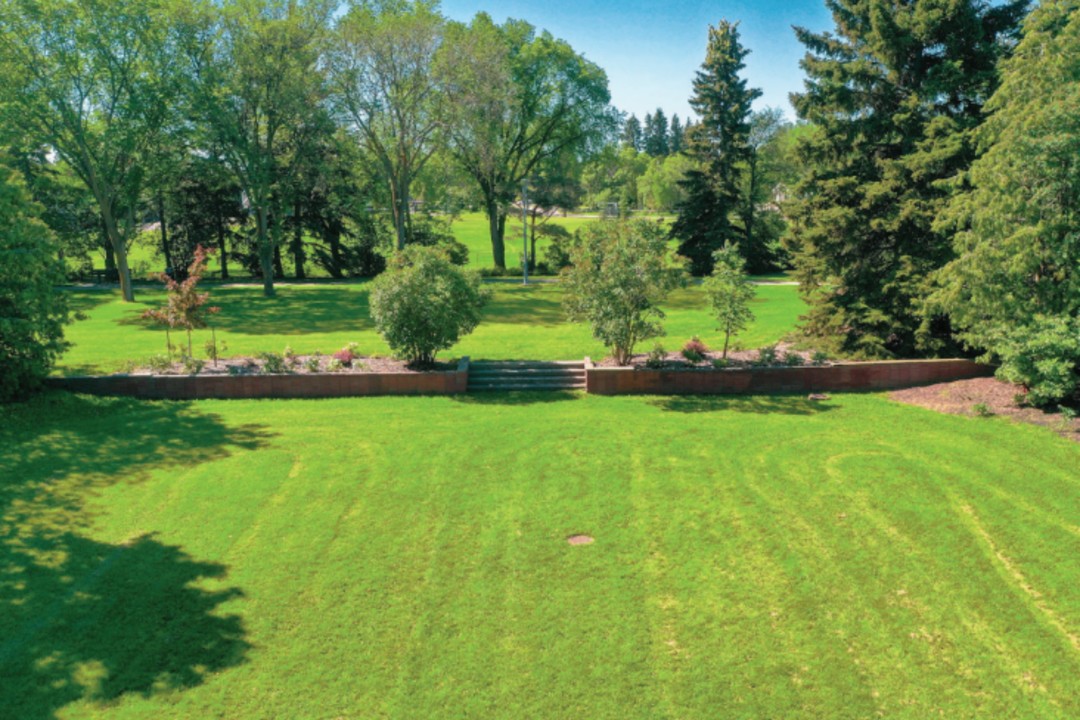
The retaining wall and sunken garden are key architectural features of the North Park, which will undergo repairs as community members work to get it on the register of municipal historic resources. (City of Edmonton)
Cecil Burgess, the first professor in the University of Alberta's short-lived department of architecture, was instrumental in setting aside green space in Windsor Park more than a decade before it was built. Burgess, who lived to the age of 101, designed several buildings on the university campus, including the Arts and Sciences Building, the Medical Building, Pembina Hall, and the Ring Houses. He taught several other architects who would grow to be influential in their own right, including John Rule, Peter Rule, and Gordon Wynn, designers of the Varscona Theatre and Alberta Government Telephone Building.
He also taught Mary Imrie and Jean Wallbridge, two trailblazing Edmontonians who were among the first women in Canada to register as architects. Wallbridge was a city architect in 1948 when she was part of the Windsor Park neighbourhood redesign to orient around what would become the North Park a few years later.
Former mayor William Hawrelak lived a block away from the North Park, which was constructed during his first stint as mayor, starting in 1951.
Robert Falconer Duke was ultimately responsible for the design of the park. He also designed modernist buildings such as the Rossdale Water Treatment Plant, the Borden Park swimming pool and bandshell, the Westwood Transit Garage, and other municipal buildings. He also oversaw the construction of the Queen Elizabeth II Planetarium in Coronation Park.
Edmonton's first city planner, Noel Dant, came on board as Windsor Park was being redesigned. He introduced the city to the "town planned" approach that focused on curved streets leading to schools, community leagues, and green spaces in the heart of the neighbourhood. The design is meant to keep vehicles from short-cutting through.
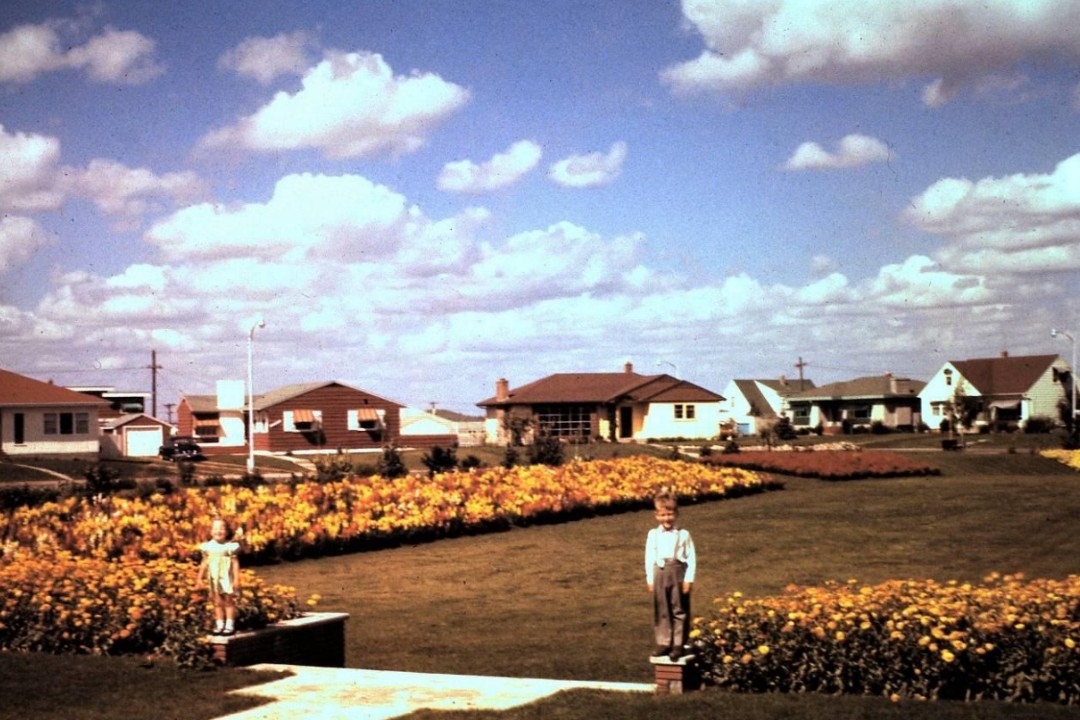
Two children pose in the North Park two years after its construction, amid tiny saplings that would grow to become beloved community trees. (Windsor Park Community League)
The North Park renovation includes adding water access near newly expanded garden beds, as gardeners currently have to lug water from the community league building. The league will also install paved pathways to make it more accessible for people with bikes, strollers, or wheeled mobility devices.
"There's a large contingent of seniors in the neighbourhood, and there's a sense that we have more than just children in the neighbourhood," Solez said. "We need to provide things for other demographics as well, and the park is one of them."
Solez said the construction should be finished this summer.
The proposed new heritage places strategy includes four pillars: natural heritage, Indigenous heritage, community and cultural heritage, and built heritage. Its guiding principles are to be inclusive, integrated, community-led, living and evolving, visible and accessible, and collaborative.
Key action items in the strategy include building relationships with partners to recognize Indigenous history, both pre- and post-contact. The strategy also calls for partnerships with diverse communities and cultural groups who are traditionally underrepresented in heritage recognition. The strategy says the city will continue to support financial incentives for heritage preservation and will be a leader in preserving historic resources that it owns.
As history enthusiast Dan Rose has noted, many of Edmonton's historic buildings are at risk. His annual Arch Madness bracket challenge ended on March 30, with voters deeming the old Royal Alberta Museum in Glenora the most important building to save.
Share