
Study measures housing insecurity among Black youth in Edmonton
A study of the housing experiences of Black youth in Edmonton has found some alarming vulnerabilities and a need for further research.
"Often in … underrepresented groups, we have to rely on evidence that has been maybe done in good faith, but often doesn't centre the voices that matter the most," said Funke Olokude of Hexagon Wellness, which conducted the study with the support of the Colbourne Institute for Inclusive Leadership at NorQuest College.
The study, called Navigating Home: Illuminating the Experiences of Black Youth in Edmonton, is based on 57 survey responses and 30 in-depth interviews with African, Caribbean, and Black Edmontonians between the ages of 18 and 29.
The study calculated housing security scores by asking participants a mixture of analytical and perception-based questions. Women and trans or non-binary respondents reported significantly less housing security than men, and 2SLGBTQIA+ respondents had lower scores than straight respondents.
One data point that stood out to researchers was that Black women living with their partners reported an average score of 39, not much higher than the score of 33 for women living in shelters.
"I was kind of shocked," Olokude told Taproot. "This is why I love research — now we've figured out something else that we need to untangle."
Lead researcher Brooke Leifso of the Colbourne Institute was surprised to find that Black youth had lower housing security scores the longer they had been in Canada.
"I thought that was an interesting determinant of health and approach," Leifso told Taproot. "(It's) something that needs to be looked at."
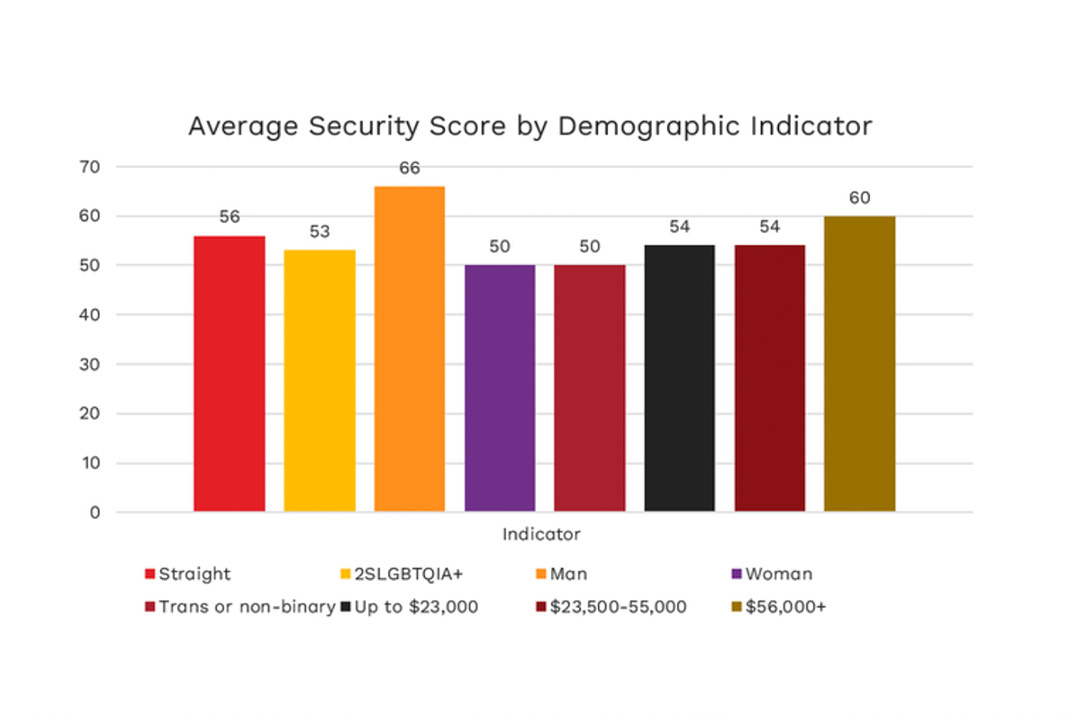
A study from Hexagon Wellness and the Colbourne Institute at NorQuest College compared housing security scores among various demographic groups within a sample of African, Caribbean, and Black youth. (Navigating Home: Illuminating the Experiences of Black Youth in Edmonton)
A large proportion of the study's subjects were international students and tended to be in their late 20s. Researchers said the study wasn't meant to focus on newcomers, but hearing from that group offered a different perspective from that which often gets studied.
"Black youth can succeed," Leifso said. "So when most of our data and literature is about high-risk youth, that's different, and that doesn't represent the whole population."
Olokude and Leifso identified a couple of blind spots revealed by the study that they would like to research further.
"I think there's a wealth of other research data points that could be dug into," Leifso said. "For example, religion — the fact that African Christian males had a higher than average feeling of security, there's a myriad of ways that we could look at (that)."
Olokude echoed Leifso's curiosity. "My first hope right now is to really have a sit-down with Brooke and her team, just try to figure out where do we go from here?"
Leifso would like to present the study's findings within the year and is up for further work with Olokude's organization.
"I hope we continue to work with Hexagon Wellness," Leifso said. "They've been amazing, lovely collaborators, and it feels like we're really working alongside to know more about Black youth's experiences."
In the meantime, they hope their research will make a difference in the lives of Black youth, especially as the city pushes for more student housing downtown.
"Let's look at the policies or the processes that exist for that housing … what is city council doing right now?" said Olokude, who ran in Ward Ipiihkoohkanipiaohtsi in 2025, finishing third. "In terms of housing and youth housing, does it match with what the youth are saying? Are we still centering the voices that matter the most?"
Share