
The Pulse
April 15, 2026
Here's what you need to know about Edmonton today.
Essentials
- -1°C: Cloudy. 60% chance of flurries in the morning. Periods of snow beginning near noon. Amount 2 cm. Wind northeast 20 km/h gusting to 40. High minus 1. Wind chill near minus 9. UV index 1 or low. (forecast)
- Dark Purple: The High Level Bridge will be lit dark purple for National Medical Laboratory Week. (details)
Study measures housing insecurity among Black youth in Edmonton
A study of the housing experiences of Black youth in Edmonton has found some alarming vulnerabilities and a need for further research.
"Often in … underrepresented groups, we have to rely on evidence that has been maybe done in good faith, but often doesn't centre the voices that matter the most," said Funke Olokude of Hexagon Wellness, which conducted the study with the support of the Colbourne Institute for Inclusive Leadership at NorQuest College.
The study, called Navigating Home: Illuminating the Experiences of Black Youth in Edmonton, is based on 57 survey responses and 30 in-depth interviews with African, Caribbean, and Black Edmontonians between the ages of 18 and 29.
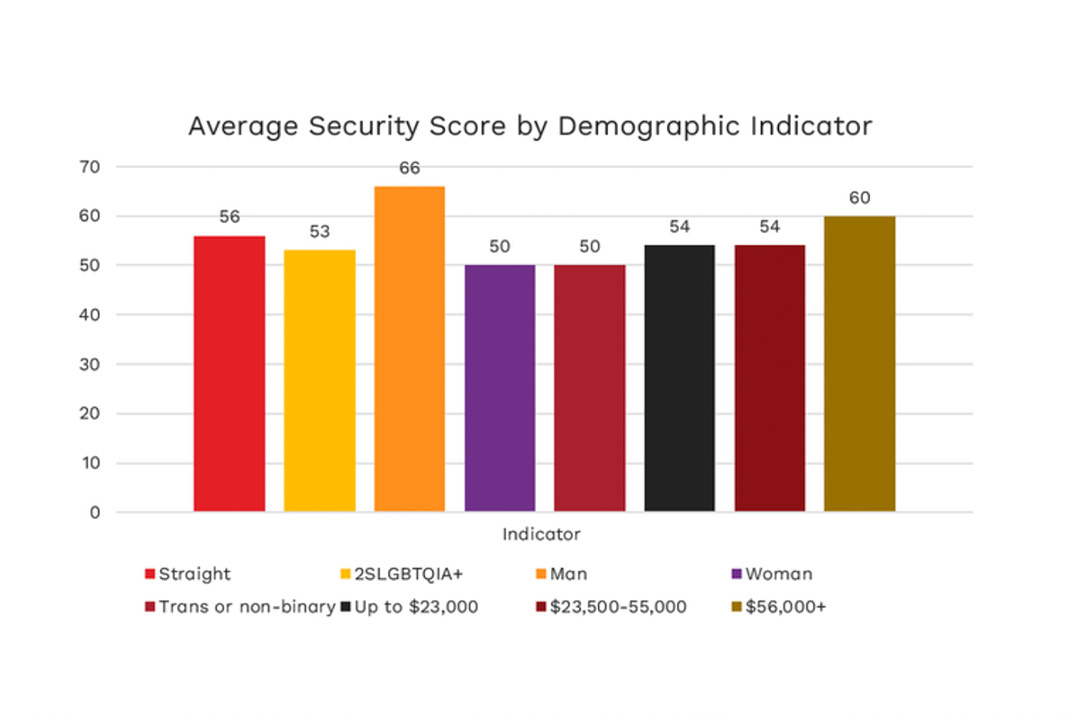
The study calculated housing security scores by asking participants a mixture of analytical and perception-based questions. Women and trans or non-binary respondents reported significantly less housing security than men, and 2SLGBTQIA+ respondents had lower scores than straight respondents.
One data point that stood out to researchers was that Black women living with their partners reported an average score of 39, not much higher than the score of 33 for women living in shelters.
"I was kind of shocked," Olokude told Taproot. "This is why I love research — now we've figured out something else that we need to untangle."
Lead researcher Brooke Leifso of the Colbourne Institute was surprised to find that Black youth had lower housing security scores the longer they had been in Canada.
"I thought that was an interesting determinant of health and approach," Leifso told Taproot. "(It's) something that needs to be looked at."
Headlines: April 15, 2026
- Two University of Alberta alumni, Noor Abdo and Mustapha Yassin, along with assistant professor Michael Litwack, launched a Charter challenge against the university's board of governors. In a statement of claim filed April 10, they allege that the university violated Charter rights by directing Edmonton Police Service to forcibly remove the "People's University for Palestine" encampment in May 2024. The encampment, set up on May 9, 2024, was dismantled on May 11, 2024, with police in riot gear. The university confirmed it received the lawsuit but declined to comment, saying it would provide a formal response through the courts.
- Mayor Andrew Knack suggested that private partnerships could help save Edmonton's aging outdoor ice rinks and swimming pools, many of which are more than 50 years old and face surging demand. During a March 6 council meeting, Knack warned that high repair costs and budget priorities for snow removal and public safety mean the city risks losing facilities, citing Scona Pool's 2022 closure due to deterioration.
- The Stanley Cup Playoffs are returning to ICE District in Edmonton for the seventh consecutive season, transforming downtown into a vibrant fan hub. Tens of thousands of people are expected for watch parties at Ice District Plaza, Fan Park, and Molson Hockey House, which hosted over 500,000 fans last season. Home-game tickets for Rogers Place went on sale starting April 14 for Round 1 packages and April 15 individual games.
- Edmonton pubs and restaurants are hoping for an extended playoff bump from the Edmonton Oilers, as a Moneris study indicates that Oilers fans significantly boost local business during games. Kelly Smart of Kelly's Pub near Rogers Place confirmed playoffs help increase business and plans to use patios and outdoor TVs to expand capacity. The study found that spending near ICE District surged up to 92% during the 2025 Stanley Cup Final games and saw a 214% spike during Game 7 of the 2024 finals.
- A new exhibit at Edmonton City Hall highlights student designs created to reduce textile waste through upcycling and reuse. The pieces come from 13 youth participants in the Reuse Centre's Sustainable Fashion Week workshop, which teaches sewing and design skills. Organizers say the initiative promotes practical ways to keep clothing out of landfills, as more than 39,000 tonnes of textiles were discarded between 2022 and 2024. The exhibit runs until April 27 and coincides with Earth Day, encouraging more sustainable habits.
- The Alberta Serious Incident Response Team (ASIRT) is investigating after a woman died in Edmonton police custody on March 26. Edmonton Police Service officers arrested her at a Mill Woods-area restaurant where she was reportedly "acting erratically." After her arrest, she was transported to the Edmonton police detainee management unit, where she arrived unresponsive. She died shortly after being taken to the hospital. Witnesses or anyone with footage are asked to contact ASIRT.
- The Dreamspeakers International Indigenous Film Festival returns to Edmonton from April 15 to 19, showcasing more than 30 films, workshops, and an artisan market. One of the world's longest-running Indigenous film festivals, it opens with a free screening of Nika & Madison at Metro Cinema. The festival also includes Light Strikes: Walk of Honour, a multimedia event at Amiskwaciw Waskayhkan Ihtawin (Beaver Hills House Park) on April 18. Online screenings begin April 20.
- The Alberta government will launch the Canadian Trucking Regulations Hub on April 22 to reduce bridge strikes and infrastructure damage. The tool offers permit information and route planning, allowing drivers to input load details for safe routes. Transportation Minister Devin Dreeshen noted that 39 bridges were struck in Alberta from 2023 to 2025, 23 of which happened because the truck's height exceeded bridge height, and cost more than $11 million in repairs.

iSMART opens $40M in specialized equipment to Alberta's innovators
A message from iSMART:
Through iSMART at the University of Alberta, businesses have access to more than $40 million worth of specialized equipment to bring their health and rehabilitation ideas to life.
The tools available for rent or use through the Institute for Smart, Augmentative and Restorative Technologies and Health Innovations, are far beyond what any startup or small to medium-sized company would be able to own themselves. But through iSMART, innovators can not only get their hands on advanced hardware but also benefit from the expertise to make the most of it.
"It enables a wide range of advancements for innovations anywhere from concept to validation," says Dr. Vivian Mushahwar, who oversees iSMART and ST Innovations, the industry-facing gateway to iSMART's resources. "We're able to cover all of that."
The process starts by contacting ST Innovations, which works with each innovator to understand their needs and advise on next steps. Innovators can be trained on the equipment and do the work themselves, or they can ask iSMART to carry out the project with regular check-in points. Either way, Dr. Mushahwar describes the relationship as a partnership built on continuous contact and collaboration.
ST Innovations also handles contracts and logistics, simplifying the experience of working with a university. "Often universities are seen as Fort Knox," Dr. Mushahwar says. "People don't know how to get there, where to go … And the outside innovators may not be able to understand how to penetrate through that." ST Innovations acts as a concierge service. "We remove the barriers that are in the innovation journey. We demystify the university."
Behind the equipment stands a vast network of professors, support staff, and trainees across dozens of labs, along with an industry advisory board that helps innovators achieve product-market fit and enhance their rate of success.
The track record backs that up. Fringe Fields Technologies came to iSMART with an idea for a non-invasive glucose-monitoring device and developed a watch-sized prototype that helped it access more than $13 million in investment. Davey Textiles won awards after developing a minimum viable product with iSMART's help. And Health Gauge used iSMART to validate its health-intelligence technology, leading to its acquisition by AI/ML Innovations Inc.
The equipment at iSMART — including robotic limbs, human-interface devices like pupil trackers, virtual reality sets, microfabrication tools, and much more — is a critical resource for supporting the health-tech ecosystem in Edmonton and beyond, Dr. Mushahwar says. "It's kind of a one-stop place for massive innovation."
Looking ahead, iSMART is purchasing an industrial knitting machine that will expand iSMART's activities in smart textiles and wearables. And Dr. Mushahwar sees more room to grow.
"Innovations in health technology … are not happening somewhere else," she says. "They're happening here, and they're happening now."
Happenings: April 15, 2026
Here are some events happening today in the Edmonton area.
- A Taste for Life at various locations
- Place Brand & Innovation: Examining the intersection of brand and business starting at 9am at Edmonton Unlimited
- Education Session: Donor Communications & Stewardship starting at 9am at Bison Lodge
- Food Fair starting at 9am at Heritage Park Hall
- The Conservation Value of Erosional Environments starting at 12pm online
- ᑕᐅᐧᐤ DIIFF 2026 Opening Ceremonies - tawâw starting at 1:30pm at CO*LAB
- ᓂᑲᐣíᐊᐧᐠ Community Dialogue: Walk of Honour - nîkâníwak starting at 3pm at CO*LAB
- Spring Refill with Infill starting at 4:30pm at Rocky Mountain Icehouse
- Indigenous Taste of the Market starting at 6:15pm at Old Strathcona Farmers' Market
- Edmonton Death Café starting at 6:30pm at Felice Cafe
- Nika & Madison starting at 6:45pm at Garneau Theatre
- Crow Said Poetry Showcase starting at 7pm at ArtsHub Creative Studios
And here are some upcoming events to keep in mind:
- April 23: YEG Trivia Night with ECAMP and Taproot at The Canadian Brewhouse (Downtown)
- April 23-24: Shumka: Back to Our Roots at Northern Alberta Jubilee Auditorium
- April 24-26: Free Jeans Weekend at Unbelts
Visit the Taproot Edmonton Calendar for many more events in the Edmonton region.

The Taproot Mini - No. 188
Test your crossword prowess and deploy a little of your Edmonton knowledge. Complete the puzzle.
If you ever want to catch up on a Mini you've missed, find in the puzzle archive.
The Taproot Mini is brought to you by ATB, your homegrown source of good advice to help conquer life's tougher puzzles. Learn how.
