
Historian seeks to tell the real story of Mill Woods
Mill Woods, the 24-square-kilometre development that makes up most of Edmonton's southeast quadrant, isn't quite what it seems from the outside, says historian Catherine C. Cole.
"The perceptions of people inside the community and outside the community are totally different," Cole told Taproot.
That's just one theme she aims to explore in her forthcoming book about the history of Mill Woods. She is hosting listening sessions with current and former residents at the Mill Woods branch of the Edmonton Public Library on May 13 and June 10 from 1pm to 4pm to better understand how Mill Woods has changed over time.
"It's an opportunity for people to talk about what it has been like for them to grow up in Mill Woods, or to live in Mill Woods — to watch Mill Woods grow up around them," she said, noting that she hopes to continue the sessions in the fall.
Mill Woods, with a population of around 78,000 (based on the 2019 municipal census), is commonly described as one neighbourhood, but it's actually a collection of more than 20 distinct neighbourhoods. It is bounded by 91 Street to the west and 34 Street to the east, and by Whitemud Drive and Anthony Henday Drive on the north and south.
Cole has hosted two listening sessions already, and so far, attendees have been a diverse mix, including a man and a woman who were among the first couples to build a home in the neighbourhood. "She actually brought a piece of paper with all these photographs of their house under development," Cole said. Another attendee was a recent immigrant to Canada who came "because he wanted to learn about the place he was moving to, and he wanted to listen to the conversation."
Cole said with a laugh that she has no connection to Mill Woods — she lives in Riverdale — but she's interested for a variety of reasons. The development started in the 1970s and would end up facing issues that are still relevant today: the need for affordable housing, the costs of suburban sprawl, the preservation of agricultural land, the need for transportation. "There's just so many urban challenges that played out through that development," she said, adding that she thinks it has lessons to teach city planners today, especially those working on Blatchford and similar projects.
Mill Woods began as a city-led housing development. In the late 1960s, land available for suburban development was declining, and the city was having trouble expanding the infrastructure necessary to access more, especially roads. The province owned a land bank southeast of what was then the city boundary. "The province acquired this chunk of land — the largest land bank in North America — and the federal government lent the money to the province to buy the land, and then the province sold it to the city at 1969 prices over the period of its development," Cole said.
Phil Ellwood, a senior city planner at the time, said the city should act as a land developer to help with housing affordability. In the original development concept, planners envisioned "a place for people — a community with a sense of place where the physical environment will be realized in the context of human scale," and a neighbourhood "large enough in its own right to create its own identity and sense of place."
That's one example of the city's perception of the neighbourhood not matching the reality of living there, Cole said. "One of the things I find really interesting is that people who are live in Mill Woods, or are from Mill Woods, really see how unique the community is and and they see it as being a very accessible, walkable, human-scale kind of place, whereas the rest of Edmonton either have never heard of Mill Woods, never been there, don't know what it is, or they think it's way out there."
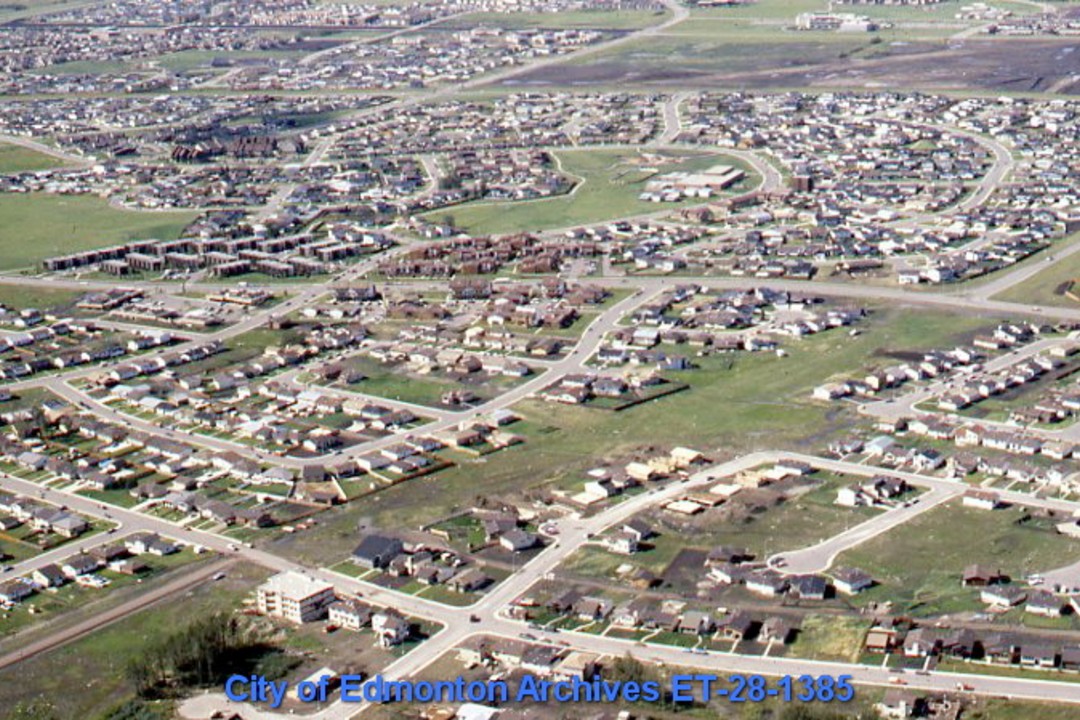
Mill Woods in its early days of development in 1980. (City of Edmonton)
Before Mill Woods became a massive city-planned housing development, the land was home again and again to displaced people, Cole said, starting with the Papaschase Band. The band was forced to relocate from Rossdale to a reserve in what is now Mill Woods in the 1880s, because settlers in and near Edmonton didn't want to live near a reserve. The band lost that entire reserve in 1888 under "highly questionable circumstances," as historian Jan Olson put it. Then the area was settled by German-speaking Russians who were not free to practise their Moravian faith back in Europe. The city quickly assembled the land the Moravians farmed on in 1969, annexing the parts that were in Strathcona County in 1970 and rezoning the area from agricultural to urban uses.
As Mill Woods was developing, it attracted displaced people from other parts of the world, such as Asians expelled from Uganda in 1972 and refugees from Chile after Augusto Pinochet's coup in 1973. Federal immigration policy also changed, making Canada more welcoming to people from countries outside of Western Europe, which led to a large increase in the South Asian population.
"For newcomers, (Mill Woods) was more affordable than other parts of the city," Cole said.
Mill Woods has been Cole's focus for several years now, and the book will build on previous work that focused on cultural diversity. "When we were doing the first work 10 years ago, we were really focused on the cultural diversity of the community and creating these arts outputs," Cole said. "Now I'm going back and filling in the gaps, and one of the gaps is really the whole city planning aspect of it."
She has also been hearing from residents about some dark days that shaped the community's collective memory, such as when 19,000 people were evacuated after a gas explosion and fire in March 1979. There was also the devastating Black Friday tornado in 1987 that, in Mill Woods alone, damaged 30 homes and injured around 15 people, before moving eastward and killing 27 people.
"It's really interesting hearing from these people in those sessions, and it's helping me with writing the book, because they tell me things I didn't know," Cole said. "They also give me a perspective on some things that I had already read about or understood to a degree, but they give you a different flavour of what really happened to actual people."
Even though Mill Woods has been fully developed for years now, it's still evolving, Cole said. "Already, the change from having the LRT there means people are coming into Mill Woods from other parts of the city who didn't before, so it has created a different kind of dynamic," she said of the extension of the Valley Line.
The neighbourhood is also starting to see infill, both small- and large-scale. Maclab Development Group purchased Mill Woods Town Centre in 2022 and says it plans to gradually build housing and other amenities on the parking areas, transforming it into a transit-oriented development.
Mill Woods is continuing to evolve with the rest of the city, Cole said, adding the final chapter of the book will look to the future. "We really need to be careful to not make assumptions about neighbourhoods and think that they're static," she said.
Correction: This file has been updated to include Catherine C. Cole's full name and more accurately reflect the population of Mill Woods.
Share