Edmonton Global's refresh aims to lift 'veil of unhappiness'
Armed with a new strategic plan and knowledge gleaned from many conversations, the head of the agency responsible for attracting foreign investment to the Edmonton metro region says she is focused on the individual needs of member municipalities.
"I kind of began from the (idea that) people are just people; I'm going to go talk to people," Edmonton Global CEO Daryn Edgar told Speaking Municipally. "Every person was constructive. They were forthcoming about the details and the attributes for their specific region and what ROI meant to them. It's not the same for every region; it's different because every region has different assets, they have different credentials, and they have different economic positions."
Edgar became CEO of the regional economic development agency in October 2025, replacing Malcolm Bruce, who had retired in March as five of 14 stakeholders were about to confirm their exit from the organization. Strathcona County, Fort Saskatchewan, Devon, Sturgeon County, and Parkland County all left in 2025. Leduc County voted to leave in December 2024; Gibbons did the same in November 2025, and Beaumont followed in December. A two-year notice period is required before they can formally exit. The other shareholders are the City of Leduc, Morinville, St. Albert, Spruce Grove, Stony Plain, and, of course, Edmonton.
One of Edgar's first duties was to meet with the mayors, chief administrative officers, and other key municipal staff from each shareholder, regardless of whether they were departing. She learned that dissatisfaction is not uniform.
"There are lots of different kinds of happy, and there are lots of different kinds of unhappy, specifically, for each specific shareholder — what is the happy and the unhappy?" Edgar pondered as she met with them. "I've got to say, I did come into a situation where there was this veil of unhappiness, and it was really opaque."
Spruce Grove Mayor Jeff Acker is optimistic about Edmonton Global now that Edgar is at the helm and the agency has new strategic and business plans. Treating municipalities as individuals while developing a cohesive region is beginning to pay off, he told Taproot's civic affairs podcast.
"I think we're relieved," he said. "We have identified some huge opportunities. We've streamlined the organization. We have way better accountability in reporting. I think, as a shareholder, we have good information now to share with our councils and our communities that we have a plan for the future."
Acker and Edgar both said the remaining and former stakeholders in Edmonton Global believe in regionalism as a way to attract foreign direct investment, but it hasn't always been easy to justify agency dues and their implications on tax assessments for residents and businesses. That's partly why the new plans from Edmonton Global emphasize accountability and return on investment.
"We're going to take our efforts and apply them to places where tax-base jobs and capital expenditures can be generated in the short term," Edgar said. "By the short term, I mean under 60 months, because we do have these very long close cycles. Market-making projects tend to get measured in years, whereas our close cycles are measured in months."
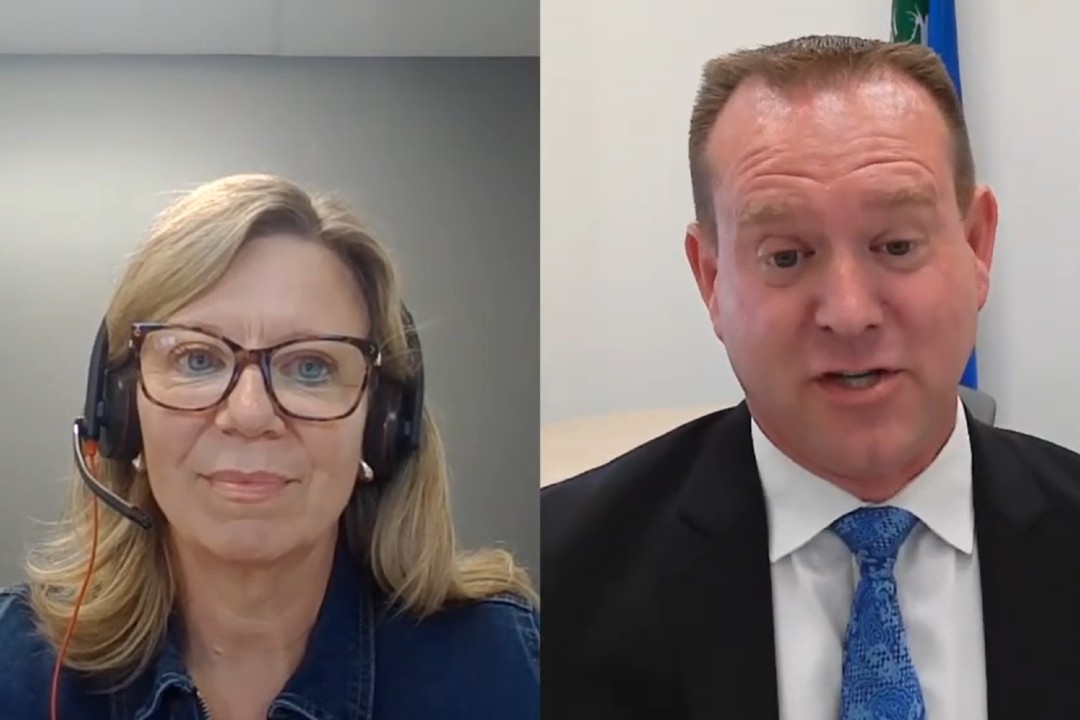
Edmonton Global CEO Daryn Edgar and Spruce Grove Mayor Jeff Acker spoke to Taproot on Episode 367 of Speaking Municipally.
Edmonton Global was not named for attracting Meta to build a massive data centre in the departed Sturgeon County, but promoting the Edmonton region globally has invisible influence on such projects coming together, Edgar said. The projects Edmonton Global has had an acknowledged hand in, such as the $20-million expansion of Teledyne Technologies or the similarly sized expansion of Polykar, will benefit not only Edmonton, where they are located, but the region as a whole through contracts, jobs, and demand for housing.
A big investment in any regional municipality benefits everyone because residents work, live, and play across municipalities, Acker added.
"Whether it's new housing builds, it's business-to-business development, or it's logistics … as we attract more investment, that brings new workforce, it brings new home buyers, and it brings new customers for our businesses."
As Leduc County — home to food processors, the Edmonton International Airport, and other key economic engines of the region — reaches its final decision deadline in December, Edgar said she is not trying to coerce the county to stay.
"The energy behind what we're doing with all shareholders is trying to understand their objectives and trying to meet their objectives with them as much as we can," she said. "We're doing that with Leduc County, but we're also doing that with Edmonton and Spruce Grove and St. Albert, because we're behooved to do that for all of our shareholders. The value of the whole has to be greater than the sum of the parts — that's the true spirit of the regionalism, to create the collaborative relationship so that we will get as close as we can to your individual objectives in the context of collaborating as a group going to market."
The truth is, Edmonton Global takes its name from Alberta's capital for a reason, she added. It is the anchor tenant, so to speak, and only its departure from the organization would spell doom.
"That would be the point at which we wouldn't be feasible anymore, because it does say Edmonton in Edmonton Global," said Edgar. "Where we need to get to, though, is a better level of matchmaking between what we have and what our target markets want. That's where I think we're going to meet everybody's shared objectives."
The agency will continue to promote the region as a whole even though former shareholders no longer pay dues, Edgar said. All who have departed are currently required to wait five years before rejoining, should they choose to.
Faith in Edmonton Global is growing, said Acker, who was vice-chair of the shareholders' group before Edmonton Mayor Andrew Knack succeeded him in May, with Morinville Mayor Simon Boersma remaining as chair.
"I think there's a growing confidence in my colleagues across the region that that message has been heard," Acker said. "We're not competing against Stony Plain or Edmonton or St. Albert. We're competing against Denver; we're competing against international locations."
Hear the full conversation on Episode 367 of Speaking Municipally, and stay tuned to Taproot in the coming weeks for reaction from shareholders past and present.
Correction: This story has been updated to more accurately reflect which municipalities are part of Edmonton Global and when those who have departed can return.
Share