
Your turn: Belgravia traffic, Leduc MDP, Beacon Heights
This week's calls for public engagement include an in-person meeting about short-cutting in Belgravia, a public hearing about changes to Leduc's municipal development plan, and an online survey about neighbourhood renewal in Beacon Heights.
The City of Edmonton will host an information session at the Belgravia Community League on Oct. 8 to discuss potential solutions to traffic in the neighbourhood. Residents can also share their thoughts at the urban planning committee meeting on Oct. 20.
The session is one of the final installments in an 18-month process aimed at addressing traffic and short-cutting in Belgravia. The roadways that surround and bisect Belgravia are considerably congested during rush hour periods because of heavy use from drivers going to and from the University of Alberta and the Groat Road Bridge, as well as those waiting for the LRT on the line running along 114 Street NW. The $100,000 budget for the project comes from the priority growth area project, which proactively upzoned properties near the university to prepare for denser development.
The city summarized feedback from April, which revealed a tension between a desire to relieve traffic congestion for Belgravia residents who want to leave the neighbourhood during rush hour and a fear that proposed solutions would make the problem worse. "There is a concern that any measures designed to enhance vehicle flow through and out of the neighbourhood might inadvertently encourage more short-cutting, which would further degrade the safety of local neighbourhood streets," reads the feedback summary.
The city presented traffic-calming and diversion measures for the intersection of 76 Avenue and 114 Street, as well as the area around University Avenue. It also contemplated measures within the neighbourhood, including converting some roads to one-way, closing road segments, and adding speed bumps. Feedback on all changes was mixed, as participants brought up competing factors such as parking and loading zones, school drop-off, LRT signals, and crosswalks.
Participants supported a cautious, staged implementation, using adaptable infrastructure that can be adjusted as needed. They also said that navigation apps encourage short-cutting on neighbourhood streets when arterial roads are congested.
Two adjacent community leagues, McKernan and Windsor Park, said they were concerned that the proposed solutions would simply move traffic into their neighbourhoods. The leagues requested that the city revisit their respective traffic management plans after the first phase of Belgravia's plan is implemented.
The project team will use the feedback to develop short-term recommendations. It will also review a mid-term development scenario to test how the traffic measures could support infill growth in the area. Staff will review the wider network to highlight any longer-term measures that can improve traffic operations. All measures will be brought to council's urban planning committee. Council would be required to approve a funding source to implement any future improvement measures.
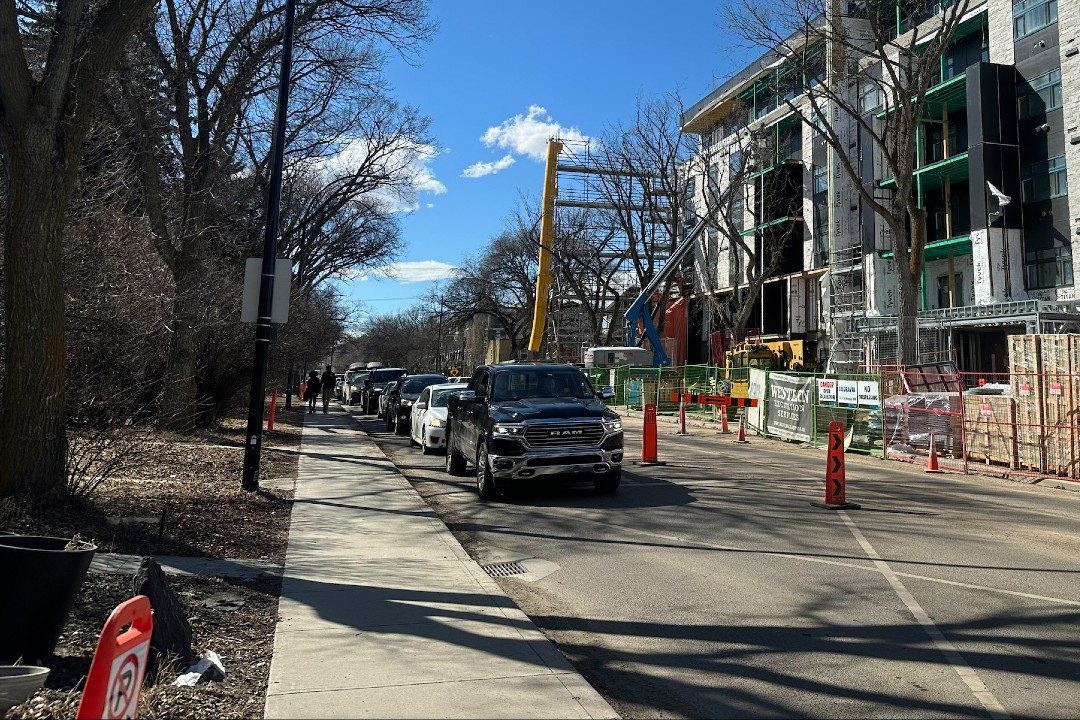
Vehicles queue on 76 Avenue west of 114 Street NW. The city is weighing different options to reduce short-cutting through Belgravia. (Stephanie Swensrude)
Here are some other opportunities to provide input in the Edmonton metro region:
- Until Oct. 5: Applications are open for boards and committees in Sturgeon County, with openings on nine bodies.
- Oct. 5: The City of Leduc is holding a public hearing on amendments to its Municipal Development Plan at the Leduc Civic Centre starting at 5:30pm.
- Oct. 6: St. Albert will hold a continuation of a public hearing about proposed changes to the land use bylaw that would make it easier to build small-scale infill in mature neighbourhoods, as well as transit-oriented development along St. Albert Trail.
- Oct. 6: The City of Leduc is hosting a drop-in session on the latest draft of its land use bylaw at the City of Leduc Civic Centre from 4pm to 7pm.
- Oct. 6: Parkland County is holding a County Chat at Wabamun Jubilee Hall from 5:30pm to 7:30pm.
- Oct. 14: Parkland County is holding a County Chat at Keephills Community Hall from 5:30pm to 7:30pm.
- Until Oct. 12: The City of Edmonton is seeking feedback on neighbourhood renewal in Parkview.
- Until Oct. 15: The City of Fort Saskatchewan is accepting applications to serve on four advisory committees.
- Until Oct. 15: The City of Edmonton is seeking feedback on neighbourhood renewal in Beacon Heights.
- Until Oct. 19: The City of Leduc is accepting applications for 35 positions on 10 boards and committees, including groups covering the environment, parks, recreation and culture, social initiatives, and community policing.
- Until Oct. 25: The City of Edmonton is inviting feedback on an application to change the area structure plan for the Edmonton Energy and Technology Park to allow for an AI data centre.
- Nov. 12: Parkland County is holding a County Chat at Holborn Community Hall from 5:30pm to 7:30pm.
- Until Nov. 20: Parkland County is surveying residents on its climate adaptation plan.
- Nov. 19: Parkland County is holding a County Chat at Holborn Community Hall from 5:30pm to 7:30pm.
- Nov. 23: Parkland County is holding a County Chat at Blueberry Community Hall from 5:30pm to 7:30pm.
- Ongoing: Thou Art Here Theatre in Edmonton has put out a call for stories about using public transit to inform its Untitled Bus Play.
- Ongoing: YEG Chinatown Re:VITA is conducting a survey on housing and development in south Chinatown.
- Ongoing: Ward pihêsiwin Coun. Mike Elliot has launched a survey about the 2027-2030 municipal budget.
"Your turn" is Taproot's weekly collection of public engagement opportunities in the Edmonton region. Watch this space every week for opportunities to make your views known. If you know of a request for public input, send it to hello@taprootedmonton.ca.
Share