
Municipalities grapple with communicating about data centres
An Edmonton-based communications company is helping Alberta municipalities talk about AI data centres as public opposition grows as rapidly as demand for the facilities.
"Data centres are basically so new as an issue that municipalities are getting completely caught off guard," said Quinn Nicholson, CEO of reVerb Communications.
The company has launched Data Centre Anonymous, a cheeky campaign based on the tropes of the alcoholism recovery program. The aim is to show municipalities that they are not alone in scrambling to deal with data centre applications and angry constituents. It's a bit of fun on a topic that reVerb takes seriously. "Our approach to this was, how can we initiate a clever campaign that kind of pokes fun at this and says, 'Look, we need to get together and sit in a room and have some stale coffee and talk this out and come to some new solutions,' because nobody's feeling heard at this point," Nicholson told Taproot.
Constituents are feeling blindsided, Nicholson says, because the rules for where data centres are allowed are often mired in area development plans, zoning bylaws, and designated industrial zones — terms that often make the average person's eyes glaze over. Plus, in many cases, the facilities have already been permitted for years through zoning bylaws without many concerns being raised. But when a tech giant breaks ground on a multibillion-dollar, hyper-scale data centre within a few kilometres of a person's house, suddenly the matter becomes a lot more urgent.
Take Meta's in-progress data centre in Sturgeon County. Many residents in the region were outraged that such a facility — which, depending on who you believe, will either raise power bills by up to $460 a year or actually lead to decreased power prices — could be built with seemingly no warning or public consultation. But the land use bylaw has long allowed for data centres in industrial zones, said Sturgeon County Mayor Alanna Hnatiw. "Over a year ago, when we made these land use changes and added (data centres) as a permitted use, we advertised that, we had a public hearing, and nobody came to speak to it," Hnatiw told the St. Albert Gazette in July, shortly after the data centre was announced.
This has been happening with municipalities all over the world, and especially in Alberta, as the provincial government wants to attract $100 billion in data centre investment by 2029. Nicholson said many municipalities feel that they've done their due diligence. "They've told the public through area planning that these things were happening, but nobody goes to area planning or zoning meetings, right?" he said.
That's where reVerb comes in. The first step in the Data Centre Anonymous 12-step program is to admit that a data centre application is not business as usual, said Rachel Rae, the company's director of business development, who led the campaign. That's because AI data centres represent more than just a potentially energy-intensive industrial building in a rural area. "We're in a little bit of an existential crisis as humanity, and the hub for where people can express this turns into a project of a data centre," Rae said. "Rarely is it about the merits of the project as a standalone project in and of itself."
Data centres are not new — in fact, there are three right in the core of downtown Edmonton, according to Alberta Data Centre Watch, including some that have been operating since the late 1990s. But data centres are receiving new attention as more facilities, and larger ones, are proposed to meet the demand linked to increased use of AI. Qu Data Centres has two facilities in Edmonton with a capacity of 2.5 megawatts and three megawatts each. For comparison, Meta's centre has an initial planned capacity of up to one gigawatt — more than 300 times what Qu's larger data centre uses. There are six data centres currently operating within Edmonton's city limits, with five more proposed in the region, plus Meta's approved project in Sturgeon County.
Many municipalities have welcomed these centres with open arms, citing increased tax revenue and job opportunities. At the same time, there's evidence that municipalities are thinking about pumping the brakes. BetaKit rounded up examples of Alberta municipalities dealing with public pushback on data centres, including examples in Red Deer County, Rocky View County, and the County of Grande Prairie. After an outcry in Olds, the Alberta Utilities Commission denied an application from Synapse Real Estate Corp. for a 1.4 gigawatt campus.
In Edmonton, Coun. Ashley Salvador intends to introduce a motion asking for a report with an analysis of land-use and environmental impacts of data centres; information about jurisdictional authority, regulatory framework, and governance; and options for removal from standard industrial zones. (The motion was to be debated at the Oct. 7 council meeting, but council adjourned before getting to it, and it will be discussed at a later date.) City administration recently opened public engagement on an application from Walton Global Investments to amend planning documents in a northeast Edmonton industrial park to allow for a large data centre campus in the Edmonton Energy and Technology Park.
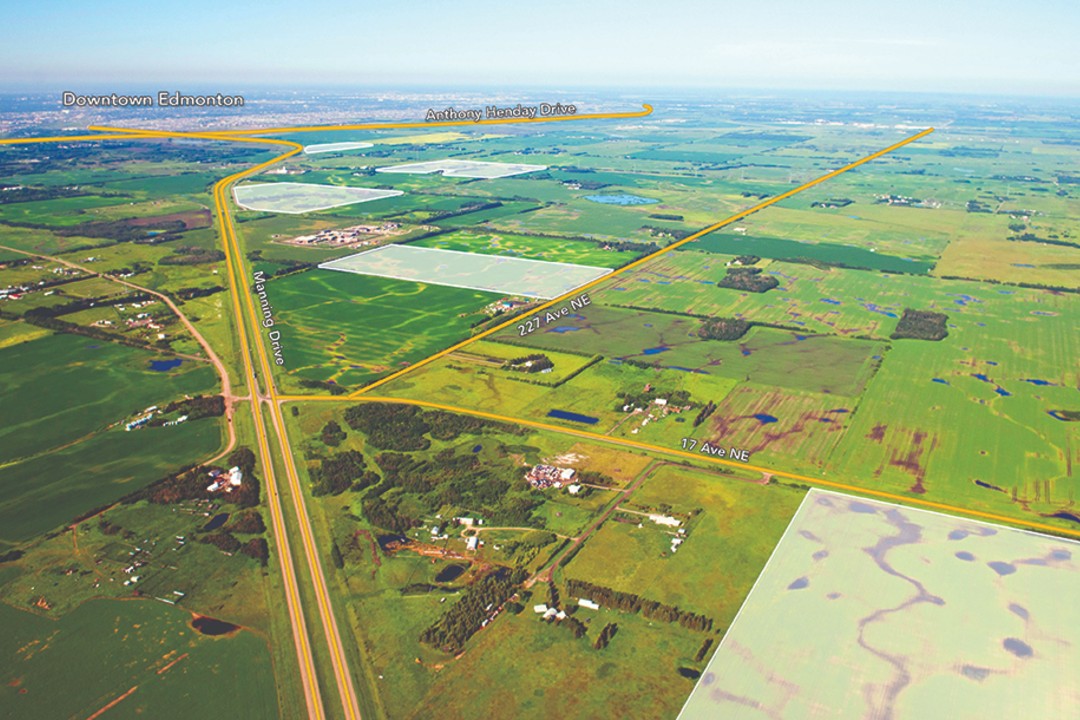
Walton Global Investments has advertised this parcel of land in the Edmonton Energy and Technology Park, part of which it has proposed turning into a large-scale AI data centre campus. (Walton Global Investments)
The Arizona-based company said it wants the city to alter the area structure plan for the EETP to facilitate "a master-planned, hyperscale-ready digital infrastructure project within the City of Edmonton, designed to become one of the largest data centre and compute-oriented industrial districts in North America."
The application points to the City of Edmonton's own policies to justify the change. It says the EETP has not developed as a petrochemical hub, as was originally envisioned when the area structure plan was approved in 2010. The application says a significant data centre campus "is a critical opportunity for the city to ensure it capitalizes on a multi-billion dollar investment to kick-start development in a historically underdeveloped area."
What does reVerb recommend?
A common theme in reVerb's advice to municipalities is that they need to have their own narrative in place that is separate from the proponent's. Nicholson said a private proponent will be focused on its investors and running a business at a profit. "A municipal government's interest is its people, and so they have to be telling and representing that side of the story."
The company also recommends being ready for when the application goes public, preparing for rumours about the project, and enhancing engagement efforts to reach the residents who never come to meetings.
Additionally, municipalities should be clear about what approvals are actually in their control, and what is decided by other levels of government, regulatory bodies, and the proponent itself. Residents will have questions about water, power, and gas supply, reVerb says, and those matters are decided by the Alberta Electric System Operator, the Alberta Utilities Commission, and the Alberta Energy Regulator. Meanwhile, a municipality decides on land use, development permits, roads, emergency services, and the standards for noise and light. Although municipalities retain discretion over rezoning, their decisions are supposed to be grounded in legitimate planning considerations, including whether the proposed use is suitable for the site and consistent with applicable planning documents.
Towns and counties in the United States are grappling with this. Monroe Township, a suburb of New York City in New Jersey, banned data centres across the township in April of this year after initially allowing them. Hexa Builders, which had received preliminary approval for such facilities before the ban, is now suing the municipality for $300 million, alleging that it reversed zoning decisions under political pressure rather than using a legitimate planning rationale.
Another element complicating the municipal discussion around data centres is that many of the projects are proposed for rural municipalities, which often have smaller administrations and council members for whom governing is a part-time job, Nicholson said. They may not be used to dealing with the magnitude of feelings around the rise of AI and data centres.
"They're just kind of flabbergasted by it — it's a total shift in some of their own community relations," he said. "They're just other people in the community that are doing this as part of their day-to-day, and suddenly they found themselves in the line of fire."
Share