
The Pulse
Aug. 29, 2025

The Pulse will be off on Monday, Sept. 1, for the Labour Day holiday. We'll be back in your inbox on Tuesday, Sept. 2.
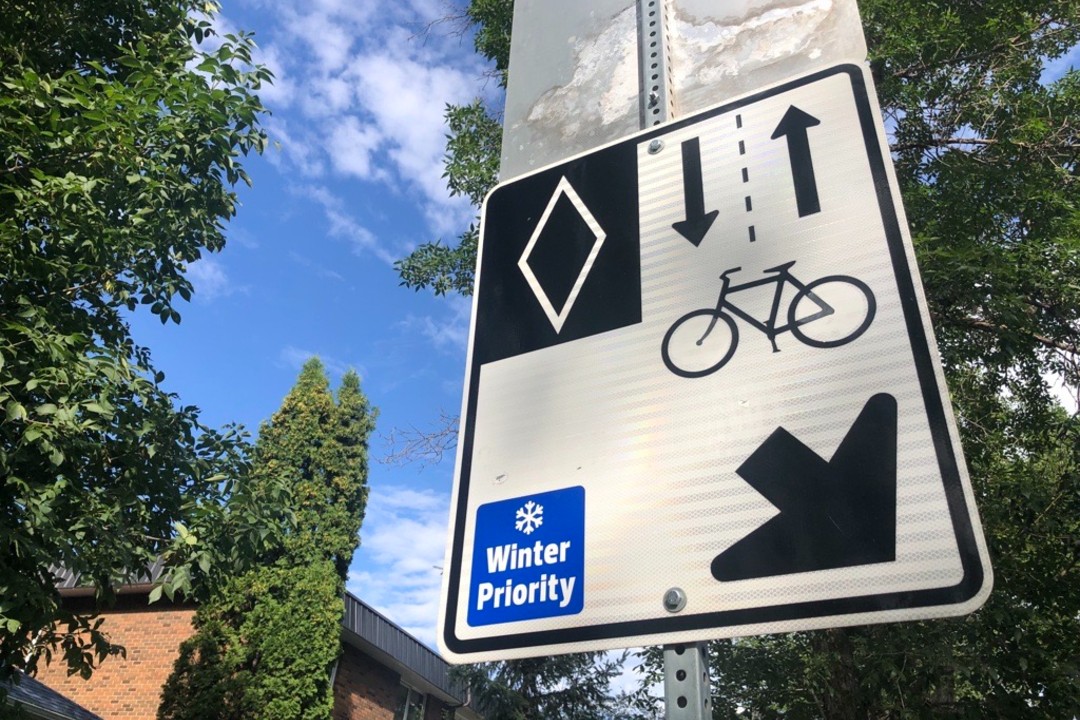
Why it costs so much more to clear snow from sidewalks, bike lanes than roads
The City of Edmonton spends close to the same amount clearing snow from 11,000 linear kilometres of roads as it does clearing it from about 1,500 kilometres of active pathways and other pedestrian spaces.
The annual snow and ice control budget is $67 million. The city spends about 55%, or $36.85 million, clearing roads across Edmonton and 45%, or $30.15 million, clearing anything else not classified as a road, like bike lanes, multi-use paths, public pedestrian squares, bus stops, LRT platforms, and staircases.
It's no question that active transportation infrastructure is much cheaper to maintain when snow is not flying. It costs about $178 per kilometre to replace, repair, and maintain active pathways, and $1,285 per kilometre to do the same for roads. But on snow days — the city had 25 snow events last winter — it costs more to clear active transportation infrastructure than it does roadways.
"(Clearing) active pathways ... of all types is more expensive," Valerie Dacyk, supervisor of infrastructure field operations at the City of Edmonton, told Taproot.
The costs to clear different types of pedestrian infrastructure vary greatly, Dacyk said. To clear a separated bike lane, one staff member pushes a machine down the lane, and it's done relatively quickly. Meanwhile, brick sidewalks or crosswalks, like those on Rice Howard Way, for example, require staff to remove ice using hard-bristle brooms. "Otherwise, the snow packs down, freezes, thaws, and causes ice layers," Dacyk said. "Whereas if you just have an asphalt crosswalk, it's all flat." Some pedestrian areas are even cleared the old-fashioned way — with a shovel — due to size and space constraints.
Active transportation options are also cleared to a different standard than roads, Dacyk said. "People on two legs are just a little bit less stable than cars on four wheels, so we just have to do that little bit extra for pedestrian (areas)."
The city's goal is to clear the priority bike lane network to bare pavement within 24 hours of a snowfall, and almost all other pedestrian areas to a "safe and passable surface" within three days of a snowfall. Meanwhile, for roads, the city aims to clear freeways, arterial roads, and business districts to bare pavement within one day; collector roads to bare pavement within five days; industrial roads to bare pavement in six days; and residential roads to a five-centimetre snowpack within 14 days.
The city is adding more bike infrastructure across the city. Council approved a $100-million investment over three years in the 2022-2026 budget to add 71 kilometres of bike infrastructure across the city. Plus, in June, council reviewed the new proposed Complete Streets policy that would require collector roads to have a shared-use pathway on one side, which the city would then be required to clear. The city will also consider adding new bike lanes in areas like Wîhkwêntôwin when these areas receive scheduled neighbourhood renewal.
City administration often works to cut operating costs and minimize tax increases. But the new cycling infrastructure could put pressure on the operating budget in the winter season.
Dacyk acknowledged that and said the city is always trying to find ways to reduce costs.
"We're testing new equipment as it becomes available, and we're consistently watching industry to see what the next best way of doing things is, because we are pushing towards being a winter city with pedestrian traffic," Dacyk said. "We understand it takes a little bit more, but we're doing our best to decrease those costs as well as increase the efficiency for it so people can rely upon it."

Celebrate Hope at the CHF Stars Awards Gala
Help deserving students living in affordable housing communities as they step toward brighter futures through education and opportunity. Join us for the Civida Housing Foundation's Stars Awards Gala at the AGA for an unforgettable evening featuring scholarship presentations, a gourmet dinner, exclusive gallery access, entertainment, and inspiring stories.
Headlines: Aug. 29, 2025
- Edmonton city council is set to consider a proposal to reallocate funds to ease west Edmonton traffic congestion in the Lewis Farms area. Ward Nakota Isga Coun. Andrew Knack will introduce a motion to widen key arterial roads, including sections of 215 Street (Winterburn Road), Whitemud Drive, and Webber Greens Drive. Residents and Vik Mahajan, CEO of River Cree Resort and Casino, emphasized the "unbearable" traffic due to rapid area growth. If approved, construction could start in summer 2026 and be completed within a year.
- Zellers is set to return to Londonderry Mall in Edmonton with a soft launch scheduled for Aug. 29. Landlord Henry Zavriyev said the 60,000-square-foot store, located in the former Hudson's Bay space, will be the first new Zellers in Canada, selling household goods and clothing. Federal trademark registries indicate the Hudson's Bay Company transferred the Zellers brand trademarks to Les Ailes de la Mode, a company associated with Isaac Benitah, owner of Fairweather and International Clothiers, who is believed to be operating this new incarnation.
- Edmonton Public Schools and the Edmonton Catholic School Division boards are advising parents to prepare for a potential teachers' strike or lockout after Labour Day weekend as negotiations continue between the Alberta Teachers' Association (ATA) and Teachers' Employer Bargaining Association. The ATA must give 72-hour notice for a strike, while the province can lock out teachers. The school boards are developing contingency plans, but parents are urged to prepare for school closures.
- The City of Edmonton is preparing for the 2025 to 2026 school year by reminding students and parents about traffic safety and transit. Drivers must observe 30 km/h playground zone speed limits and 40 km/h on residential streets, and park responsibly near schools. Edmonton Transit Service will resume school routes, increase peak hour frequency, and introduce three new school special routes in September. From Sept. 2 to 19, additional Transit Peace Officers, in collaboration with Edmonton Police Service, will be at high-traffic hubs to support riders during the "Here to Help" campaign.
- Edmonton Public Schools will remove several books from its libraries, including Margaret Atwood's The Handmaid's Tale because of sexual content, according to an internal document, CTV News reported. The move comes after an order from the province's education minister. The school board did not share the full list of books to be removed.
- Two Edmonton-area RCMP sergeants, Daniel Mayowski of the Westlock detachment, and Sheldon Robb of the Morinville detachment, were charged with breach of trust on Aug. 27. The Alberta Serious Incident Response Team launched an investigation into their actions on Feb. 16, 2024, alleging the officers engaged in "personal sexual relationships" with the same woman in connection with their duties. Mayowski's alleged conduct occurred Oct. 18 to Oct. 28, 2022, while Robb's spanned Jan. 1, 2020, to Jan. 31, 2024. Both sergeants were released on appearance notices, with court dates set for Oct. 1 and Oct. 2.
- Edmonton Strathcona MP Heather McPherson and activist Avi Lewis are preparing federal NDP leadership bids, The Star reported. Their potential candidacies signal the upcoming race to replace outgoing party leader Jagmeet Singh.
- Edmonton Fire Rescue Services responded to a fire that caused extensive damage to Chateau Lighting, located at 99 Street and 43 Avenue. Crews responded around 4:20am on Aug. 28, bringing the blaze under control within 90 minutes. Adjacent businesses, including Johnson Sewing, sustained smoke damage. No injuries were reported, and an investigation into the cause is underway.
- The Edmonton Police Service is searching for two missing 13-year-olds last seen in the city's north end. Isabella Calliou was reported missing after she was last seen Aug. 20 near Northgate Mall. She is 5'4" with hazel eyes, black braided hair, and has a scar above her left eye and a flower tattoo on her left hand and arm. Myles Mclean was last seen on Aug. 26 around 6:30pm at a gas station near 127 Street and 132 Avenue. He is 5'9" to 5'10" with a distinct haircut that includes a shaved head, short hair along his forehead, and longer hair in the back. He was wearing a blue Oilers T-shirt and grey shorts, and is known to frequent the Calder and Alberta Avenue neighbourhoods by transit.
- Business owners on Edmonton's 124 Street near 104 Avenue are raising concerns about safety after a Nissan accumulated parking tickets for more than a week without being towed. Local business owners told CityNews they contacted 311 and the Edmonton Police Service, noting the City of Edmonton's policy states vehicles are considered abandoned after 72 hours. Business owners expressed frustration over the delay, citing lost parking and fears that abandoned vehicles attract crime. The vehicle was eventually towed.
- Alberta's Finance Minister Nate Horner announced that the province projects a $6.5 billion deficit for the year, an increase of $1.3 billion from initial budget forecasts. The larger deficit is primarily driven by a $1.4 billion decline in resource revenues, largely due to lower crude oil prices and a stronger Canadian dollar. While corporate income tax revenue saw a slight increase, personal tax payments are expected to be down.
- The Alberta government is seeking feedback on its proposed Alberta Disability Assistance Program (ADAP), which is expected to launch in July 2026. Intended to replace or run alongside the Assured Income for the Severely Handicapped (AISH) program, ADAP faces criticism from groups like Inclusion Grande Prairie and Inclusion Alberta, which argue ADAP's proposed maximum benefit of $1,740, compared to AISH's $1,940, will drive people with disabilities into poverty and lead to federal benefit clawbacks. Public input is being collected via an online survey until Sept. 12, along with telephone town halls.

A moment in history: Aug. 29, 1987
On this day in 1987, Edmonton's recent Black Friday tornado was being declared the most expensive natural disaster in Canadian history.
Several weeks after the infamous tornado tore through the city's eastern end, a vice-president of Canada's Insurance Bureau estimated insured losses caused by the storm at $250 million. The final cost is now estimated at around $330 million in 1987 dollars, or $700 million adjusted for inflation.
.jpg)
Meteorologists watched Edmonton's skies with concern on July 31, 1987. The summer heat had already caused several strong thunderstorms in the week prior, and another storm was rolling in from southern Alberta. But no one was prepared for what happened next.
The tornado was first reported just before 3pm, when it briefly touched down near Leduc. A few minutes later, the twister touched down again outside Beaumont and began gaining strength. For the next hour, it travelled north, cutting through areas of Millwoods, Refinery Row, and up into Clareview and Fraser. It then finally set upon the Evergreen trailer home park, where 15 people died. It would later be classified as an F4 tornado, which includes winds of up to 418 kilometres an hour. Some have speculated that it could have been categorized as an F5, although that was not officially confirmed.
By the time it was over, 27 people were dead. Hundreds of homes were damaged, with some completely flattened.
Even after the tornado passed, emergency crews faced a dangerous situation. People were still trapped in collapsed and damaged buildings, and the tornado had caused fires, floods, and gas leaks in the areas it ripped through. There was also damage in the industrial areas east of the city, including one derailed train carrying hazardous materials. The city's ambulance system was utterly overwhelmed, and some of the injured had to be taken to hospitals in whatever vehicles were available.
The search for survivors continued for another 24 hours. In addition to the city's first responders, emergency workers from surrounding communities joined in the effort, as well as members from nearby Canadian Forces bases. The Red Cross set up a disaster relief centre for those who had been left homeless by the storm, with hundreds of volunteers lending support.
Black Friday changed the lives of many Edmontonians and altered how Alberta responds to natural disasters. It demonstrated the importance of providing immediate information to people during a disaster and led to the creation of Alberta's emergency alert system. It was also one of the catalysts for Canada's Doppler weather tracking system. While "City of Champions" was a nickname given to the city after its sports successes in the 1980s, it became cemented as part of Edmonton's identity when then-mayor Laurence Decore used it to describe the mass of volunteers who helped in the aftermath of the tornado.
Unfortunately, more costly disasters have followed Black Friday. The 2016 wildfire in Fort McMurray is now considered Canada's most costly, at nearly $10 billion. The province's emergency alert system has remained an essential legacy of Black Friday, especially in the face of ever-worsening summer wildfires. This week, high temperatures have led to more concern about wildfires in the province.
This clipping was found on Vintage Edmonton, a daily look at Edmonton's history from armchair archivist Rev Recluse of Vintage Edmonton.

Happenings: Aug. 29-Sept. 1, 2025
- Aug. 29: The AI Playground starting at 2pm at Edmonton Unlimited
- Aug. 29: Friday Nights at the Grand Night Market starting at 5pm at Happy Beer Street
- Aug. 29: Moonshine starting at 9:30pm at Fringe Theatre Arts Barns
- Aug. 30-31: Around the World On 83 starting at 9am on Saturday and 11am on Sunday at Old Strathcona Farmers' Market
- Aug. 31: Alberta Day in Edmonton starting at 11am at Alberta Legislature Grounds
- Aug. 31: Rat Academy 2 - Gnaw and Order starting at 2pm at Varscona Theatre
- Sept. 1: Damian "Jr. Gong" Marley & Stephen Marley starting at 8pm at Northern Alberta Jubilee Auditorium
And here are some upcoming events to keep in mind:
- Sept. 7: Savour Strathcona County at Strathcona County Community Centre
- Sept. 9: A Conversation with Peter Mansbridge at Horowitz Theatre
- Sept. 10: Meet and Greet: PACE team for City Council at Four Points by Sheraton Edmonton South
Visit the beta version of the Taproot Edmonton Calendar for many more events in the Edmonton region.

The Taproot Mini - No. 40
Test your crossword prowess and deploy a little of your Edmonton knowledge. Complete the puzzle.
If you know a crossword fan who would get a kick out of a daily puzzle, encourage them to sign up for The Pulse!
The Taproot Mini is brought to you by ATB, your homegrown source of good advice to help conquer life's tougher puzzles. Learn how.
