
The Pulse
Oct. 28, 2025

Here's what you need to know about Edmonton today.
Essentials
- 6°C: Sunny. Wind northwest 20 km/h becoming light near noon. High 6. UV index 1 or low. (forecast)
- Purple/Green: The High Level Bridge will be lit purple and green for Attention Deficit Hyperactivity Disorder Awareness Month. (details)
- 7:30pm: The Edmonton Oilers (4-4-2) host the Utah Mammoth (8-2-0) at Rogers Place. (details)
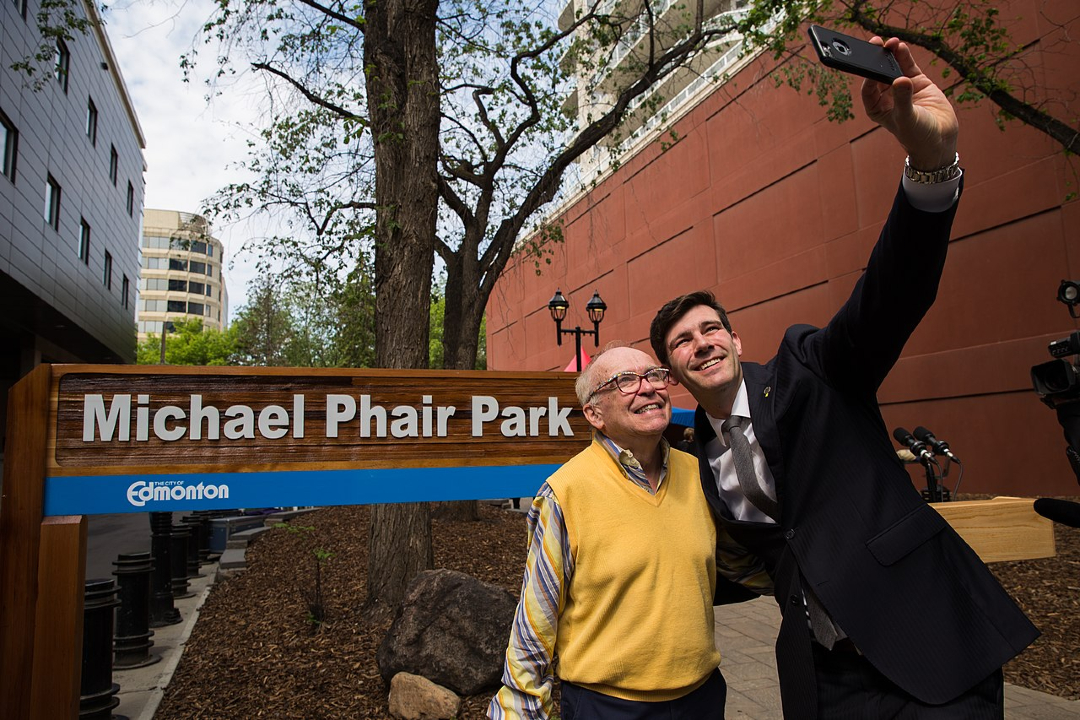
Book explores queer places and faces of Edmonton's downtown
A new book from the Edmonton Queer History Project details struggles, triumph, culture, and safe spaces in the city's downtown.
"It means something to have the permanence that comes with a book," Kristopher Wells, the founder of EQHP, told Taproot. "We've actively seen, for example, the Trump administration erase our community's history online and with national monuments, and kick out the words 'queer' and 'trans.' When you erase our history, you try to erase our existence. We hope that this book will act as a kind of a brick of activism."
Cruising the Downtown: Celebrating Edmonton's Queer History was produced by contributors to EQHP and edited by Wells, who was appointed a Canadian senator in 2024. It is based on stories and photos from the EQHP online map, which illustrates places, people, and moments downtown that continue to shape Edmonton's queer history. Many stories are from the 1980s and 1990s, but some date as far back as the 1940s, and a Pride timeline runs from 1980 to 2024. Darrin Hagen, Michelle Lavoie, Rob Browatzke, Remi Baker, Morgan Evans, Michael Phair, Kyler Chittick, and Japkaran Saroya all contributed, and story subjects are also part of the book.
"We invited the history makers, queer and trans Edmontonians, to reflect back on history, and we included their comments and their perspectives throughout the book as a way to animate and make the history come alive," Wells said. "(We were) able to have people reflect back, like (former) mayor Stephen Mandel on what it was like to be the first mayor to walk in the Edmonton Pride Parade … and some of the lawyers that worked on court cases supporting members of our community as we fought for our basic human rights and dignity."
Phair, the first openly gay politician elected in Alberta, and Liz Massiah, a longtime queer community organizer, co-authored the Cruising foreword and discuss the court cases. One is Delwin Vriend's historic victory at the Supreme Court of Canada to protect people from discrimination based on sexual orientation, on which EQHP helped produce a documentary. Another is the Pisces Health Spa raid, where Phair and 55 other men were arrested downtown for "being found in a common bawdy house."
Shelby L. Miller, who represented most of the men in court, shared her memories of the courtroom for Cruising. "The mood on the bench and in the courtroom made it clear that what was on trial was the issue of male homosexuality itself," she wrote.
Wells said bathhouses like Pisces are one place where queer people cruise, or search for casual sexual encounters, and the double entendre of "cruising" in the book's title is intentional.
"We decided we weren't going to sanitize our history for public consumption. Our history is about fugitive spaces, and you do find community at a lot of those spaces," he said. "You can't tell the history of the community without talking about sexuality and intimacy."
Bygone queer bars like Flashback (for which EQHP contributed to a 2024 documentary) are included in the book, as are activist organizations like the Gay Alliance Towards Equity (or GATE), arts hubs like the Citadel Theatre, and city-owned amenities like the Michael Phair Park. Wells said Cruising has no ambition to be the exhaustive list of queer history sites. Rather, he hopes readers come forward with their own contributions to EQHP's research.
"We want to create a venue for people to share their own personal stories and experiences," Wells said. "Many times, when people are sharing things, that gives us the impetus to dig deeper and see what else we can find by going through archives and doing interviews. We have so many more stories that we haven't even scratched the surface of yet that are waiting to be told."

Know anyone inspiring wellness?
Faces of Wellness returns for 2025. Recognizing Albertans who lead with care and impact.
Nominate someone you know today for a chance to award them with a getaway to the Alberta Rockies or a $550 well.ca gift card.
Headlines: Oct. 28, 2025
- The Alberta government invoked the Charter's notwithstanding clause in back-to-work legislation introduced on Oct. 27, compelling public school teachers to end their provincewide strike, which began Oct. 6. Premier Danielle Smith, speaking in Edmonton, said the move aims to prevent further "damage" to students, after teachers rejected a tentative agreement in late September. The legislation imposes the rejected deal, offering a 12% raise over four years and committing to hire 3,000 teachers and 1,500 educational assistants, despite the demands from the Alberta Teachers' Association for class-size limits. Classes could resume as soon as Oct. 29. Non-compliant teachers face $500 daily fines, and unions up to $500,000. The Alberta Federation of Labour warned of an "unprecedented response," and NDP Leader Naheed Nenshi called the legislation the "nuclear option." Nenshi clashed with Smith during Question Period in the legislature, and accused Smith of engineering the strike and lowering per capita public education funding.
- CBC News published an explainer after Alberta invoked the notwithstanding clause on Oct. 27 in legislation to force striking teachers back to work. The rarely used Section 33 of the Canadian Charter of Rights and Freedoms allows a legislature to override certain fundamental, legal, and equality rights for five years. The clause was a compromise in 1982 to secure provincial agreement for the Charter. Provinces like Quebec and Saskatchewan have used it recently, and Alberta previously used it in 2000 for anti-same-sex marriage legislation. The Supreme Court of Canada affirmed the right to strike in 2015.
- Edmonton Mayor-elect Andrew Knack outlined his top three priorities for his first 100 days in office: public safety, affordability, and addressing homelessness. He emphasized the urgent need to find day shelter spaces for unhoused residents ahead of winter and said the City of Edmonton must take leadership on homelessness. He said the City should consider redirecting existing funds and using vacant properties to establish shelters that offer financial assistance and medical care. He also noted that improving safety, particularly in the core, requires a holistic approach, including increasing downtown residency.
- In an opinion piece published in Postmedia, Kayode Southwood, a policy analyst with the Canadian Federation of Independent Business (CFIB), highlights new city councils in Edmonton and across Alberta must prioritize small business concerns. Southwood wrote that a CFIB survey found that 71% of small business owners feel municipal leaders neglect their needs, facing issues like rising costs, crime, and red tape, as seen with construction disruptions on Edmonton's Stony Plain Road. Businesses in Edmonton and Calgary also carry an unfair property tax burden, paying significantly more than their residential counterparts. The CFIB urges councils to limit spending, ensure predictable tax increases, and prioritize safety services to support economic competitiveness.
- A multiplex infill building under construction in Edmonton's Belgravia neighbourhood went up in flames late Oct. 26. Edmonton Fire Rescue Services responded to the second-alarm blaze, bringing it under control by 12:37am, with no reported injuries. The unoccupied fourplex, built by Everfor Studio, was in its lock-up stage. Fire investigators are determining the cause. This incident follows another infill home fire in the area in November 2024.
- The Law Society of Alberta has reduced the suspension for Edmonton lawyer Ajay Juneja on Oct. 27, after he appealed a 2022 conviction for six counts of professional misconduct. The charges stemmed from a 2018 "brawl" at an after-hours club, failure to be candid, and breaching a 2015 agreement to abstain from drugs and alcohol. The appeal panel overturned one conviction, finding the initial committee erred in deeming him "ungovernable" and by discounting his mental health treatment and positive references. The society had sought disbarment, but the panel noted Juneja's work as counsel in more than 15 homicide trials.
- The Edmonton Oilers hold a 4-4-2 record after 10 games, with coach Kris Knoblauch's frequent line changes potentially affecting team chemistry and five-on-five offence, sports journalist Daniel Nugent-Bowman wrote in The Athletic. While Connor McDavid has 12 points despite just one goal, his strong underlying stats suggest his performance will improve. The defensive pairing of Evan Bouchard and Mattias Ekholm has struggled, leading to their separation, Nugent-Bowman wrote. Goaltending remains a concern, though Stuart Skinner has a .903 save percentage, while Calvin Pickard's recent starts have been weak. Zach Hyman's return from injury is anticipated, and the team will seek a top-nine winger before the trade deadline.

Noted: Low turnout, slow count, mandate
The low voter turnout, the long and challenging vote count, and whether the next council has a clear mandate were all discussed on the latest Taproot Exchange by Taproot co-founders Karen Unland and Mack Male, plus managing editor Tim Querengesser and curator/reporter Stephanie Swensrude. For more than a quick snapshot, consider becoming a member for access to future livestreams.
Low turnout
Voter turnout was low in the 2025 municipal election, at 30.41%, compared to 37.6% in 2021. Could the long lines be the cause? That's not likely the reason, Male said. Given the loud voices who wanted new faces on council and the number of incumbents reelected, do angry people just not vote? Doubtful, despite rampant media coverage, Querengesser said. No incumbent mayor to rally against or behind? Possibly, the group ventured. A lack of exciting options for mayor given the overlap in platforms? More likely, the panel agreed.
"(With turnout,) it's not going to be one thing, it's going to be a whole bunch of different factors," Unland said.
Swensrude touched on a conversation she had with someone who felt voting in the municipal election was meaningless, because local politics don't fix international challenges. She then recounted how a friend who skateboards called their councillor to fix a light, which left a skatepark unusable after sunset, and the problem was fixed in days. "You have so much power in your own city to make things better," she said. "If every single person in the city did that little bit to engage with their municipal politicians, think of how much of a better place Edmonton would be."
Slow vote count
One Taproot member wondered why Edmonton's election had such a "bungled count process." The panel agreed that the provincially-mandated change from tabulators to hand counts was a key factor. Querengesser said one source he spoke to said Edmonton Elections was "inventing something from scratch," which caused stress and confusion for counting staff. The panel noted Edmonton's lag compared to Calgary could be because Edmonton stopped the Oct. 20 count at 1am while Calgary kept going.
As for the so-called "lost" ballots that caused confusion in Ward sipiwiyiniwak, Edmonton Elections said it was an administrative, technical error. Still, Male lamented that the hand count may have had the opposite outcome to the one the Alberta government promised. "The troubling part about this for me is that the ostensible reason why we had to count ballots by hand is because of concern about integrity in elections and fraud," he said. "And here we end up, doing this process, and people (such as mayoral candidate Tim Cartmell) are calling into question the integrity of the election."
Mandate might be simple
A Taproot member asked about the next council's mandate, adding they think it's clear given incumbents who supported bike lanes and infill were reelected. The panel was hesitant to co-sign that observation, however.
Swensrude said the low turnout might indicate that the most engaged Edmontonians have made their desires clear. Looking at council's role more holistically, Unland and Querengesser agreed that any council's mandate is simply to listen — even if that listening goes unnoticed.
"I think all of the listening that they did (during the last council term) is kind of invisible," Unland said. "I think the actual benefit of incumbency is that you have spent years actually talking to people and hearing their problems, and sometimes sending them away happy and sometimes sending them away unhappy."
Male and Swensrude discussed further observations about the election on Episode 329 of Speaking Municipally. Listening and subscription options are all right here.

Edmonton Opera's 2025/26 season pairs new voices with timeless legends
A message from Edmonton Opera:
Fresh off the success of Bravi! with the Edmonton Symphony Orchestra, the Edmonton Opera 2025/26 season continues to honour the past while championing what's next.
"Opera has the unique ability to touch hearts and connect us through stories and music that are universal," Joel Ivany, artistic director of Edmonton Opera, said.
At the heart of the lineup is the world premiere of Indians on Vacation, a new opera blending wit, tenderness, and contemporary resonance. Composed by Ian Cusson, with a libretto by Royce Vavrek, this new Canadian work follows Bird and Mimi, an Indigenous couple on a European journey inspired by a trove of old postcards from Mimi's late Uncle Leroy, who absconded with a family heirloom a century ago. As the couple unravels the mystery of Uncle Leroy, Bird confronts his own inner demons. Performances run at the Northern Alberta Jubilee Auditorium on Feb. 5 and 7, 2026.
Later in the season, Wagner's Siegfried continues the Ring Cycle in Jonathan Dove's intimate arrangement — an unforgettable coming-of-age quest forged by fate and fire. The production features the return of Jaclyn Grossman as the heroine Brünnhilde, the debut of 2024 Rumbold Vocal Prize winners Alex Halliday and Elizabeth Polese as Fafner and Waldvogel, and the highly anticipated return of Dion Mazerolle, reprising his acclaimed role as Alberich. Performances run at the Maclab Theatre at the Citadel Theatre on May 25, 27, 29, and 31, 2026.
Also on the calendar: the 2025 Rumbold Vocal Prize Grand Finale on Nov. 21, 2025, spotlighting emerging Canadian voices as they compete for one of the country's top vocal awards. This year's finalists include Hanna Crawford, Queen Hezumuryango, Korin Thomas-Smith, and Duncan Stenhouse.
Edmonton Opera has sharpened its value this season: ticket prices are 20% lower across the board, with full-season subscribers saving an additional 20%. For flexibility, you can build a mini-season with the Compose Your Own option — saving 10% on a mix that can include the Rumbold Vocal Prize, Indians on Vacation, and Siegfried (with an add-on option for Messiah at the Market) — or choose the Opera Duo Package to see Indians on Vacation and Siegfried for as low as $99, saving up to 20% versus single tickets.
This season is about legacy — voices that shaped us, stories we carry forward, and artists defining what's next. Explore special pricing and secure your seats today.

Happenings: Oct. 28, 2025
Here are some events happening today in the Edmonton area.
- The Shape of a Girl starting at 1pm at Maclab Centre for the Performing Arts
- A Talk with the International Committee on LGBTQ+ History Months starting at 4pm at Allard Hall
- Video Games. No Longer Child's Play starting at 5pm at Blue Chair Cafe
- Pathways of Poverty - Stories, Soup and Table talk on Poverty in our Community starting at 5:30pm at Heritage Park Pavilion
- How do we Keep Kids Safe Online? starting at 5:30pm online
- Fundraising Chat starting at 6pm at Edmonton Unlimited
- Build, Test, and Learn Session 4 with KD Singh: Building Fast with AI starting at 6pm at Edmonton Unlimited
- The History of Streetcars in Edmonton starting at 6:30pm at Bison Lodge
- Drag Me to the Archives starting at 7pm at City of Edmonton Archives
- Edmonton AI, Tech & Finance Networking Event starting at 7pm at GRETA Bar YEG
- Fall Feast of Words: Deborah Willis starting at 7pm at Strathcona County Library
- Tuesday Jam Hosted by Sean Croal starting at 8pm at Yardbird Suite
And here are some upcoming events to keep in mind:
- Nov. 5: Voices from the Street: Intersections of Identity and Food Insecurity at ArtsHub Ortona
- Nov. 8-9: Extra Life Edmonton Game Day at West Edmonton Mall
- Nov. 20: The Tyee & Taproot Edmonton Meet-Up at Rocky Mountain Ice House
Visit the beta version of the Taproot Edmonton Calendar for many more events in the Edmonton region.

The Taproot Mini - No. 80
Test your crossword prowess and deploy a little of your Edmonton knowledge. Complete the puzzle.
Reading Taproot's weekly Regional Roundup might help with clues like 1-Across and 1-Down. Subscribe to be in the know.
The Taproot Mini is brought to you by ATB, your homegrown source of good advice to help conquer life's tougher puzzles. Learn how.
