
The Pulse
Feb. 20, 2026

Help us better serve you by filling out the Taproot audience survey!
Essentials
- -14°C: Sunny. Wind up to 15 km/h. High minus 14. Wind chill minus 35 in the morning and minus 17 in the afternoon. Risk of frostbite. UV index 1 or low. (forecast)
- 6pm: The Edmonton Oil Kings (36-13-3) play the Regina Pats (20-26-6) at the Brandt Centre. (details)
- 5pm, Feb. 21: The Edmonton Oil Kings play the Brandon Wheat Kings (32-22-1) at Assiniboine Credit Union Place. (details)
Your turn: Snowberry, playgrounds, and Gibbons
This week's batch of calls for public engagement includes a neighbourhood structure plan for Snowberry, playgrounds in southeast Edmonton, and the future of the Town of Gibbons, along with other surveys and public hearings in Edmonton and the metro region.
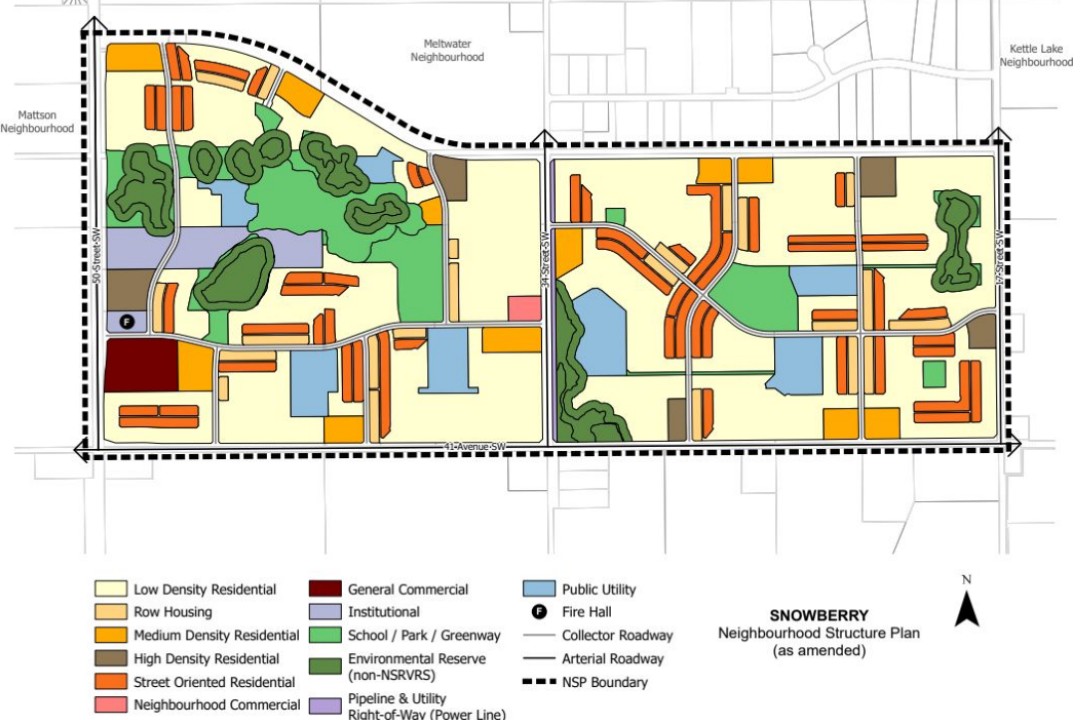
Edmontonians are invited to provide feedback until March 1 on the neighbourhood structure plan for the Snowberry neighbourhood in the Decoteau area. Stantec submitted the plan on behalf of Brookfield Residential, NAC Management Group, and Rohit Communities.
The planning process for new suburban neighbourhoods begins with an area structure plan that outlines at a high level how a group of neighbourhoods will develop. It also locates major facilities, arterial roads, and general land uses. The area structure plan for Decoteau was approved in 2015.
After the area structure plan is approved, developers must come forward to request permission to start work on a neighbourhood structure plan. Council recently voted 8-5 to authorize the creation of a neighbourhood structure plan for Kettle Lakes, the final subdivision that will be constructed in Decoteau. Some councillors voted against authorizing that plan because the area's integrated infrastructure management plan shows the neighbourhood will not generate enough tax revenue to cover operating costs. "Effectively, when we approve neighbourhoods that we know operate at a net loss, we are approving future tax increases," Ward O-day'min Coun. Anne Stevenson told Postmedia.
Council authorized the creation of the Snowberry neighbourhood structure plan in September. The plan outlines the vision of the neighbourhood, residential densities, major roads and utilities, and the location of schools and parks. Administration said feedback will be used to inform the city's planning analysis and ensure all factors are taken into consideration. Residents can also give feedback at the public hearing, where council will eventually vote on the plan. That public hearing is yet to be scheduled. If council approves the plan, it will pave the way for the neighbourhood's rezoning, subdivision, and development.
The proposed Snowberry plan has five residential land uses ranging from low to high density, with an overall density of 45 units per hectare. The applicant has proposed a commercial area in the southwest of the neighbourhood and two school sites.

Let's Find Out about the Whale Society of Edmonton
Did you know Edmonton once had a save-the-whales club, and it made a big splash? Learn more at a live recording of Let's Find Out, a podcast about history. Chris Chang-Yen Phillips will speak to Candas Jane Dorsey and Kathryn Ivany about this moment in Edmonton's past and other treasures in the city archives. Join us on March 3!
Headlines: Feb. 20, 2026
- Happy Beer Street has been officially designated as Edmonton's third entertainment district, allowing people to walk freely with alcoholic beverages during designated events on 78 Avenue between 99 Street and 100 Street. City council approved the bylaw establishing the district at its meeting this week, following a recommendation from executive committee earlier this month. Businesses in the area have planned more than a dozen events throughout 2026, with the first market scheduled for May.
- Edmonton fire crews battled a blaze in the abandoned Jasper Place Hotel on Stony Plain Road on Feb. 19, with firefighters facing challenges due to temperatures in the low -20s and the age of the building. The hotel previously caught fire in December 2019 while 41 people were living in it, resulting in it being declared unfit for human habitation by Alberta Health Services. Firefighters confirm the damage is so extensive the building will need to be torn down.
- Policing the Edmonton Oilers' Stanley Cup Playoffs run last year cost the Edmonton Police Service $979,096 in unrecovered costs over 28 games, the Edmonton Police Commission heard at its Feb. 19 meeting. There were 60 to 150 officers deployed to ICE District for each game, compared to 12 for a typical regular season game.
- The City of Edmonton said its digital waste collection calendars, available online and through the WasteWise app, have helped reduce the amount of printed calendars by more than 99% since the city completed its transition to paperless calendars in 2024.
- PrairiesCan is investing $6.5 million through its Regional Defence Investment Initiative in two Edmonton companies to expand Canadian defence manufacturing capacity. Zero Point Cryogenics is receiving $5 million to advance commercialization of dilution refrigerators and cryogenics for defence prototyping and mission-critical systems, while Logican Technologies is receiving $1.5 million to expand advanced manufacturing capabilities for defence-related technologies including sonar and naval communications.
- The Edmonton Elks will play a preseason game against the Calgary Stampeders on May 29 at Clarke Stadium, which the Edmonton team called home from 1949 to 1978. Dubbed "Night at the Knothole," the game will feature vintage activations and an expanded concourse to accommodate a larger capacity. Clarke Stadium was famous for the Knothole corner and the "Knothole Gang," a section for Edmonton youth with tickets going for just 25 cents back in the 1950s.
- About half of the surplus Turkish-made children's pain medication imported by the Alberta government in 2023 has been destroyed, Postmedia reported. Alberta Health Services stated that 700,000 bottles were donated to eight countries including Ukraine, while the other 700,000 bottles were disposed of due to looming expiration dates and logistical challenges. The medication cost $478,000 to store between 2023 and 2025, and disposing of it cost a further $718,000. The bottles were among those imported amid a Canada-wide shortage as part of a $70-million deal with Turkish manufacturer Atabay and Edmonton-based importer MHCare, though $49 million of that contract remains unfulfilled.
- During a televised address on Feb. 19, Premier Danielle Smith announced a plan to hold a referendum on Oct. 19 with nine questions on immigration and constitutional issues. The non-constitutional questions would ask Albertans whether the province should take more control over immigration, require a one-year residency before accessing provincial social support programs, charge non-permanent residents fees for health care and education, and require proof of citizenship to vote in provincial elections. Constitutional questions would ask about allowing provinces to choose justices for superior courts, abolishing the Senate, and permitting provinces to opt out of federal programs while still receiving funding. Smith blamed what she called "disastrous open-border immigration policies" for straining Alberta's services, though she did not mention her government's "Alberta is Calling" campaign to attract workers from other provinces.
A moment in history: Feb. 20, 1952
On this day in 1952, the Edmonton Mercurys were rowdily representing Canada at the 1952 Olympic Games in Oslo.
The team had an unlikely road to the Olympics. It was created and sponsored by an Edmonton car dealership, Waterloo Mercury, in 1949, and many of its players were employees. The team immediately started getting attention. Within months, the Mercurys had won the Western Canada Intermediate Championship. The next year, the team travelled to London to win gold at the 1950 Ice Hockey World Championships, where they outscored their opponents 42-3 in the tournament.
As a result, the Mercurys were chosen over six other amateur teams to represent Canada in the 1952 Olympics. It also helped that the talented players were unquestionably amateur athletes, which was a perennial dispute when it came to Olympic hockey. (One of the players had to ask permission from Mayor William Hawrelak to take time off from his job as a firefighter to play.)
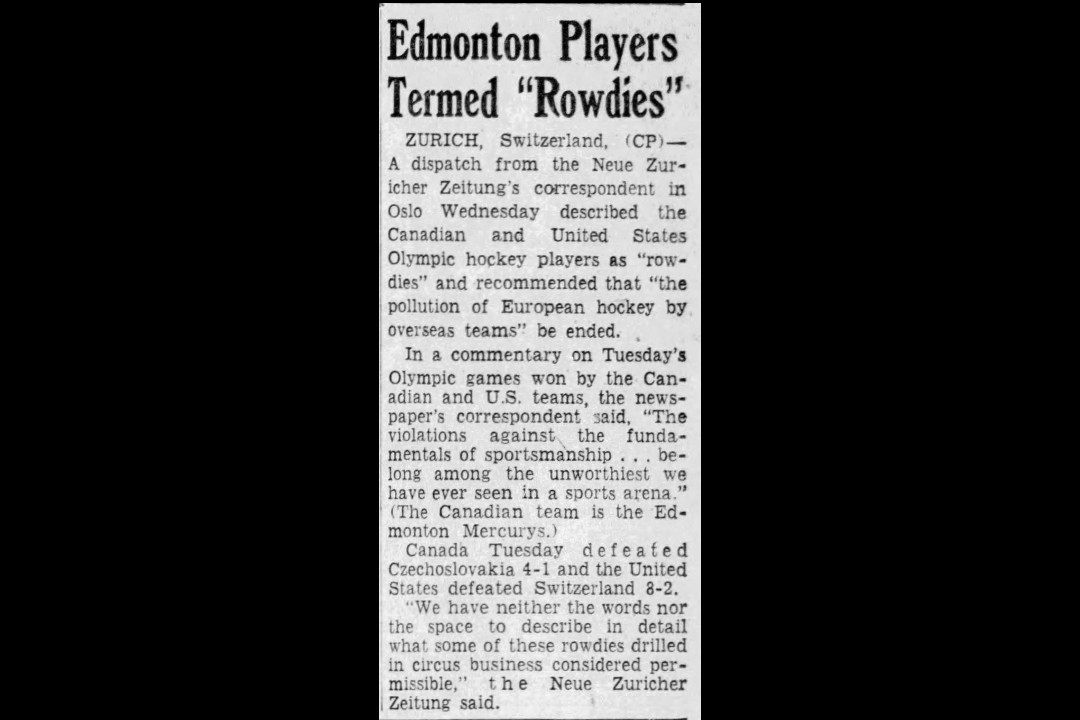
The aggressive North American style of play did not go over well in Europe. A Canadian Press story from the time quotes a Swiss newspaper correspondent who called the Canadian and U.S. players "rowdies drilled in circus business" on the ice, going as far as to call for an end to "the pollution of European hockey by overseas teams." One of the rowdies' unlikely defenders was Norwegian Prime Minister Oscar Torp. "Penalties make hockey a human game," he said.

Despite the penalties, the Mercurys dominated the tournament. They won seven of their eight matches and tied with the United States 3-3 in the final game. As the team with the better record, Canada was awarded the gold medal. At the time, no one knew that it would be the last Olympic gold in men's hockey that Canada would win for the next half-century.
After the Olympics, the Mercurys returned to Edmonton to enthusiastic fans. But the team would not last much longer. Jim Christianson, the owner of the car dealership that financed the team, died of pneumonia soon after the Olympic win. Six of the Mercury players teamed up and purchased the dealership after his death, while others moved on from Olympic hockey to work as firefighters, mechanics, and in other everyday jobs.
While they might not be as well-known as others in the city's hockey history, the Edmonton Mercurys' short, successful record has been recognized. The 1952 team was inducted into the Alberta Sports Hall of Fame, as well as Canada's Olympic Hall of Fame. And four surviving members of the Mercurys were invited to Salt Lake City to watch the men's hockey finals in the 2002 Olympic Games, where Canada ended its gold medal drought with a 5-2 win over the United States, 50 years to the day after the 1952 win.
This week has seen Canada's Olympic hockey teams continue to battle for that gold. The Canadian women fell just short, losing 2-1 in overtime to the U.S. and settling for silver on Feb. 19. The men's team faces Finland in a semi-final game on Feb. 20, following an overtime victory over Czechia.
This clipping was found on Vintage Edmonton, a daily look at Edmonton's history from armchair archivist Rev Recluse of Vintage Edmonton.

Happenings: Feb. 20, 2026
Here are some events happening this weekend in the Edmonton area.
- Feb. 20: Lunar New Year Celebration: Chef-Hosted Long Table Dinner starting at 6pm at Fairmont Hotel Macdonald
- Feb. 20: RavenWood Music Club: Megan Paige starting at 7pm at Salisbury Greenhouse (Sherwood Park)
- Feb. 20: Cocktail Class - Louisiana Cocktails starting at 7pm at Cocktail Culture
- Feb. 20-21: Pop-Up Mini Golf experience at The Creative Hive Event Centre
- Feb. 20-21: Winefest at Edmonton Convention Centre
- Feb. 21: Repair Cafe starting at 11am at Earth's Refillery Coop
- Feb. 21: Pints & Pages: Bridgerton Edition starting at 1pm at PYRO Wood-Fired Kitchen and Bar
- Feb. 21: February CEC Walk starting at 1pm at Sir Wilfrid Laurier Park
- Feb. 22: The Book Nook, A Book Fair starting at 10am at The Creative Hive Event Centre
- Feb. 22: Bikes & Brunch starting at 11am at Oliver Exchange Building
- Feb. 22: Jâca starting at 2pm at Horizon Stage Performing Arts Theatre
And here are some upcoming events to keep in mind:
- March 3: Let's Find Out: About The Whale Society of Edmonton at City of Edmonton Archives
- March 4: The Ripple Effect: Stories of Giving & Gaining at Nina Haggerty Centre for the Arts
- March 9: Green Drinks - March at The Buckingham Pub
Visit the Taproot Edmonton Calendar for many more events in the Edmonton region.

The Taproot Mini - No. 152
Test your crossword prowess and deploy a little of your Edmonton knowledge. Complete the puzzle.
For more on the answer to 1-Across and 8-Across, read on.
The Taproot Mini is brought to you by ATB, your homegrown source of good advice to help conquer life's tougher puzzles. Learn how.
