
The Pulse
March 30, 2026
Here's what you need to know about Edmonton today.
Essentials
- 0°C: Periods of light snow ending in the morning then a mix of sun and cloud with 30% chance of flurries. Wind up to 15 km/h. High zero. Wind chill minus 13 in the morning. UV index 3 or moderate. (forecast)
- 4-2: The Edmonton Oilers (37-28-9) defeated the Anaheim Ducks (41-28-4) on March 28. (details)
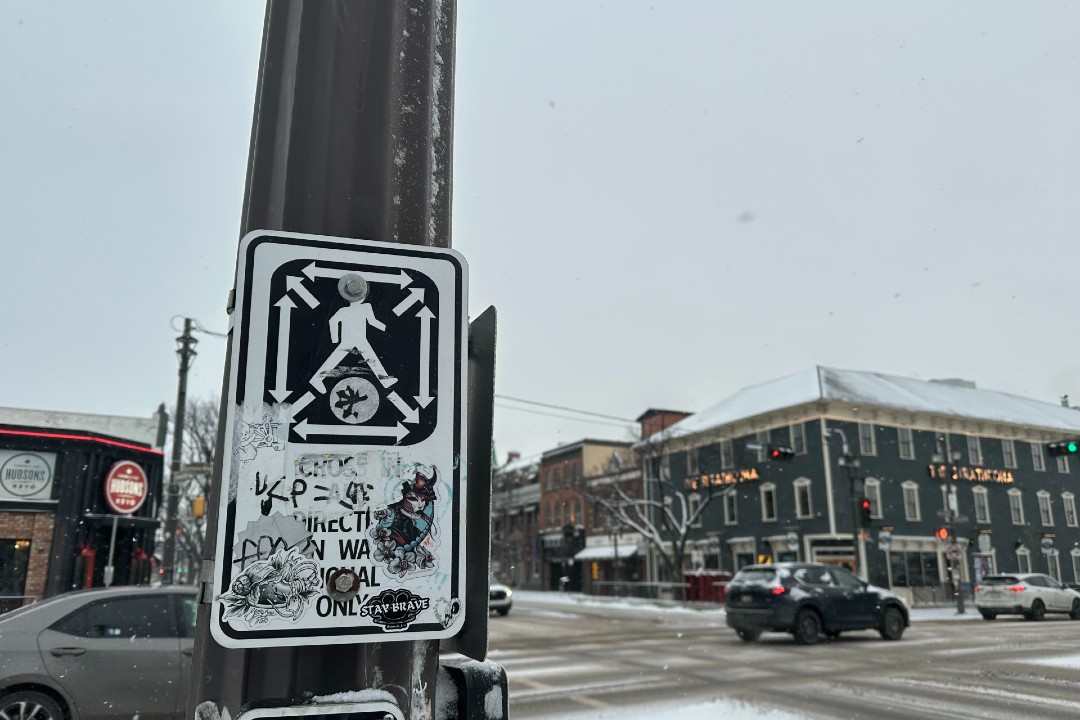
City to remove scramble crosswalks on Whyte Avenue
Three intersections that allow pedestrians to cross Whyte Avenue diagonally are slated to be reverted to traditional crosswalks this year as part of a bid to help buses move faster.
At a scramble crosswalk, all vehicles stop, allowing pedestrians to cross the intersection in any direction. The scramble at 105 Street was added in 2018, and the scrambles at Gateway Boulevard and Calgary Trail were added in 2021. They're seen as safer because they completely separate pedestrians from vehicle traffic; they even caught the eye of a news crew from Dallas that visited Edmonton in 2023 to learn about the city's Vision Zero initiative.
Changing the Whyte scrambles back to traditional crosswalks is a transit priority measure that is meant to help buses get down Whyte Avenue faster, said Shafayat Hossain, engineering project manager with transportation planning and design at the City of Edmonton. Routes 8 and 4, which run down Whyte Avenue, are on time only 67% and 79% of the time on weekdays, respectively, according to the Edmonton Transit Service route report card. Scrambles add delays for all road users, as they require a third traffic-signal phase. Hossain told Taproot the full suite of changes planned for Whyte Avenue could halve delays at those intersections.
Though the scrambles will be replaced with traditional crosswalks, Hossain said the city will not allow right turns on red and will only allow left turns during a dedicated arrow. This means the only time vehicles and pedestrians could end up in the same space is during a right turn on green.
"There is always the evaluation of the trade-offs and cost-benefit analysis," Hossain said, noting that his department has to balance what is technically possible, what is safe, what aligns with the City Plan, and other factors. "This is the solution that we are proposing."
Scrambles are safer because drivers don't turn through a crosswalk at the same time that a pedestrian is using it, said Brandon Kwong, board chair of Paths for People, an active transportation advocacy group.
"(There is) uncertainty and confusion around both right turns and left turns as they intersect with pedestrians — it's a super risky conflict point between road users," Kwong said, noting that right turns on green still put motorists and pedestrians in the same place.
Kwong questioned why the city would revert to traditional crosswalks in an area with high pedestrian volumes, especially when last year the city reached its highest number of traffic deaths in a decade.
The city will also widen the sidewalk where there is an existing bus stop on this stretch, meaning that buses won't have to exit and re-enter traffic, Hossain said. Buses will stop in the right-hand travel lane, and private vehicles will wait behind the bus as passengers board and disembark. The changes will also eliminate some right-turn lanes in the project area. Hossain said designs are still being finalized, and construction could start this year. The city doesn't have a timeline for completion yet.
Headlines: March 30, 2026
- Edmonton city council's executive committee started a four-year process to tackle derelict properties, aiming to address vacant commercial spaces that foster crime. The committee unanimously voted to prepare a new property tax subclass for derelict non-residential buildings. Challenges include defining "derelict," upgrading city tax software, and provincial Municipal Government Act limits, which restrict punitive tax increases to a maximum of 57% for non-residential properties.
- A Postmedia analysis of campaign finance disclosures and official vote totals from Edmonton's 2025 mayoral race breaks down campaign spending to show the cost per vote. Andrew Knack, who received 78,519 votes and won the race, spent $240,770, averaging $3 per vote, making his campaign the most cost-efficient. Tim Cartmell spent $812,472 for 61,668 votes, or $13 per vote, with total spending rising to about $1.48 million ($22 per vote) when including the Better Edmonton party. Michael Walters spent $346,166 ($14 per vote), while Omar Mohammad spent $199,000 ($10 per vote), according to the analysis.
- The bison has been named Edmonton's 2026 critter of the year, with residents invited to vote on a final design that will appear on merchandise. The campaign, led by Edmonton River, highlights overlooked aspects of the city's identity and the bison's historical importance to Indigenous peoples and the region. Once numbering in the millions locally, bison were central to life on the Prairies. Today, they remain a symbol of that legacy and can still be seen at Elk Island National Park.
- Edmonton-based Wyvern, an aerospace company, received $3 million in federal funding as part of a $6-million federal investment for defence-related firms in the region. CEO Christopher Robson said Wyvern will use advanced hyperspectral imagery from its satellites to uniquely identify "rogue vessels" at sea by their spectral "fingerprints," even if their automatic identification systems are disabled.
- The University of Alberta board of governors approved a controversial new hiring policy that removes equity, diversity, and inclusion (EDI) practices. This ends the previous policy of favouring candidates from historically underrepresented groups when equally qualified. Student groups and the Association of Academic Staff University of Alberta opposed the decision. Bill Flanagan, the university's president, said the change reflects a commitment to eliminate barriers for everyone. The university said it will comply with federal research funding EDI requirements.
- Municipal leaders around Edmonton expressed mixed feelings about proposed changes to provincial ridings in the final report from the Alberta Electoral Boundaries Commission. Edmonton Mayor Andrew Knack fears hybrid ridings, combining parts of Edmonton with communities like Beaumont and Enoch Cree Nation, could dilute representation. The commission recommended adding two new ridings for population growth, with the majority report proposing a net gain of one seat for Edmonton and two new hybrid divisions. The legislative assembly will debate the proposed changes.
- Alberta NDP Leader Naheed Nenshi criticized the federal NDP's direction after Avi Lewis won the party leadership on March 29. Nenshi said that Lewis, an outspoken opponent of fossil-fuel development who he said had previously "cheered for the defeat" of the Alberta NDP government, is not in the interests of Alberta. Edmonton-Strathcona MP Heather McPherson finished second in the race.
- The Edmonton Oilers have signed defenceman Tomas Cibulka to a two-year entry-level contract, beginning in the 2026-27 season. Cibulka, a 21-year-old from the Czech Republic, spent the last two seasons with HC Motor Ceske Budejovice in Czechia's top league. He previously played three seasons in the Quebec Major Junior Hockey League with the Val-d'Or Foreurs and Cape Breton Eagles.
Happenings: March 30, 2026
Here are some events happening today in the Edmonton area.
- Energy Affordability Workshop starting at 11am at NorQuest College
- Community Sound Healing & Meditation starting at 6pm at Delwood Community Hall
- Audreys Book Club: Lucia starting at 7pm at Audreys Books
- Streaming Movies with Kanopy & More starting at 7pm at St. Albert Public Library (Downtown)
- Come ye, and behold, as we assuredly DIE-NASTY starting at 7:30pm at Varscona Theatre
- Songwriter's Concert starting at 7:30pm at Allard Hall
- Rough Cut Comedy - Weekly Comedy Showcase! starting at 8:30pm at River City Revival House
And here are some upcoming events to keep in mind:
- April 9: Get Ready in the Neighbourhood at The Meadows Community Recreation Centre
- April 10: Sensory Gala at Bison Lodge
- April 15: Get to Know Rotary at Alberta Teachers' Association
Visit the Taproot Edmonton Calendar for many more events in the Edmonton region.

The Taproot Mini - No. 178
Test your crossword prowess and deploy a little of your Edmonton knowledge. Complete the puzzle.
Need a hint for 4-Across? You'll find it here.
The Taproot Mini is brought to you by ATB, your homegrown source of good advice to help conquer life's tougher puzzles. Learn how.
