Edmonton's approach to infill: Where the candidates stand
Most candidates seeking a seat on Edmonton's council in October said infill should proceed at a slower pace with stronger regulations in response to the question Which of the following comes closest to how you would guide infill development? on Taproot's candidate survey.
Infill has attracted plenty of media attention and controversy since Edmonton's new zoning bylaw came into effect in 2024, making it much easier to build larger infill developments in mature neighbourhoods.
Thirteen candidates said they would advocate for infill development to Proceed as allowed under existing rules. This group includes incumbent council candidates Anne Stevenson, Jo-Anne Wright, Erin Rutherford, and Keren Tang. But notably, no mayoral candidate chose this response.
Most candidates said they would advocate to Slow the pace with stronger regulations. Earlier this year, council voted to reduce the allowable length of a development and the number of entrances that are permitted to face a neighbouring lot, and to change the required design for the facade of infill buildings. A vote to keep the unit maximum at eight instead of reducing to six for mid-block developments squeaked by in a 6-5 vote. Among the 31 candidates who said they would like to slow the pace of infill development were mayoral candidates Rahim Jaffer, Andrew Knack, Michael Walters, Tim Cartmell, Omar Mohammad, and Utha Nadauk.
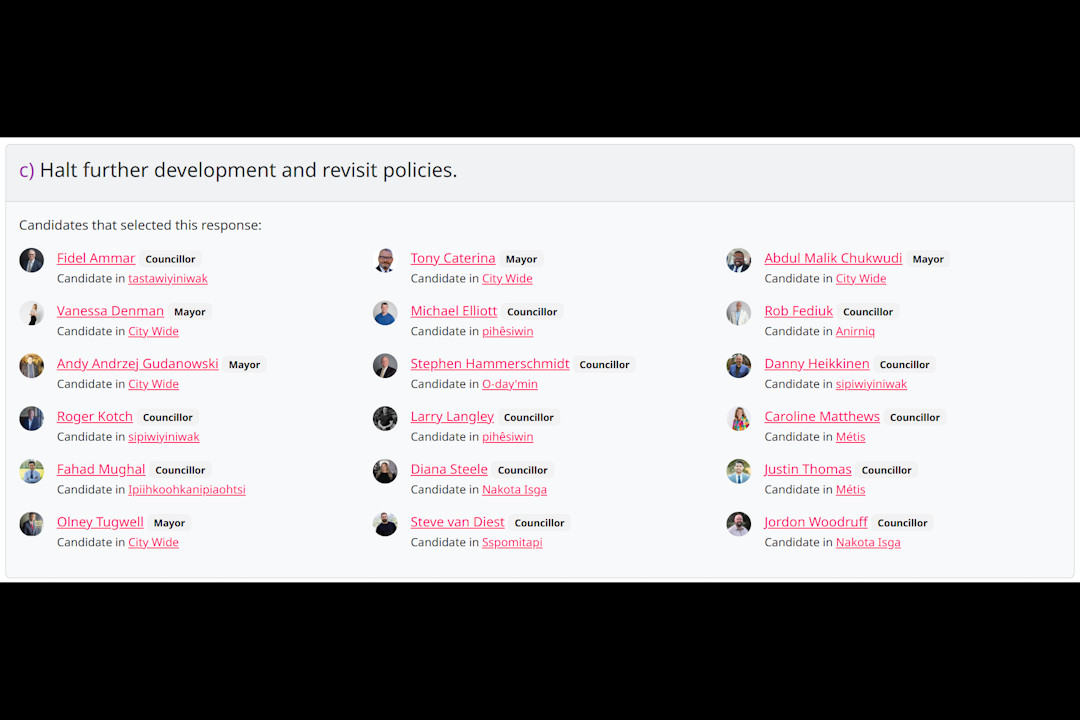
Eighteen candidates said they would advocate to Halt further development and revisit policies. This included Better Edmonton party members Michael Elliot, Stephen Hammerschmidt, and Caroline Matthews, and PACE members Fidel Ammar, Diana Steele, Justin Thomas, Steve van Diest, and Rob Fediuk.
Two mayoral hopefuls — Paul Bakhmut and Ronald Stewart Billingsley, Jr. — said they didn't have a position on the issue; tastawiyiniwak candidate Farhan Chak skipped the question.
As of this writing, 28 candidates for council and mayor have not yet completed the survey.
Housing starts in Edmonton in June 2025 were up 82% compared with 2024. Even though the city saw more infill and multi-family housing built since the new zoning bylaw was approved, the data shows that suburban sprawl with single-family homes is still the most common development pattern in Edmonton. Recent surveys among voters found that only 14% of respondents identified infill as a top concern.
Share