
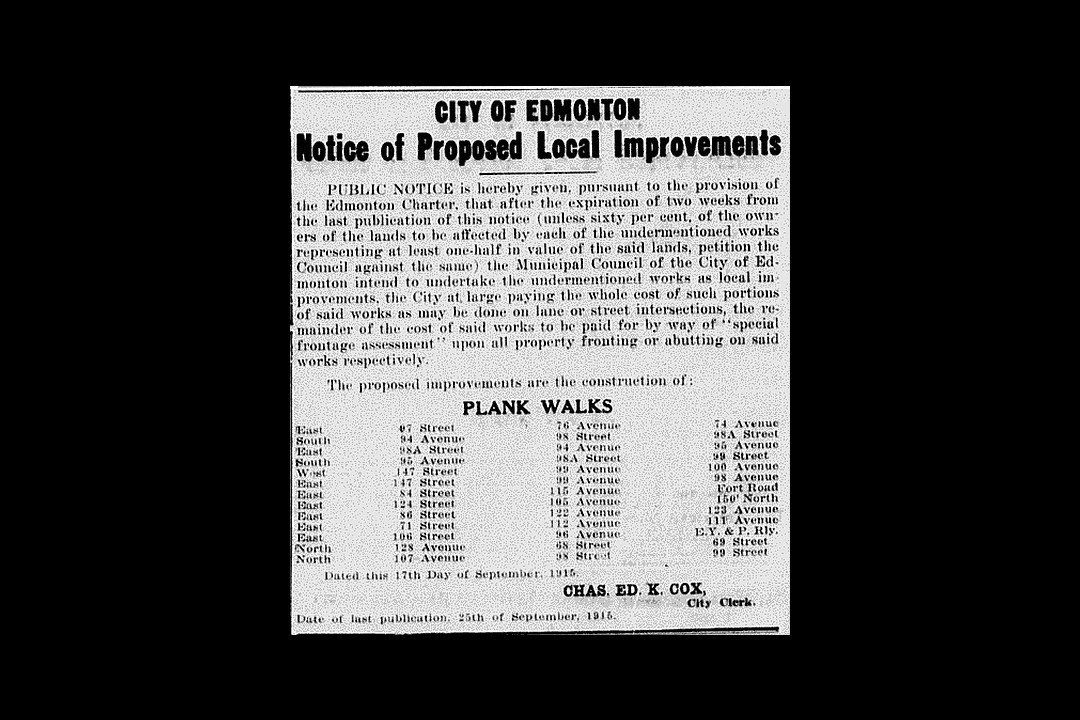
A moment in history: Sept. 18, 1915
By Scott Lilwall
On this day in 1915, the City of Edmonton gave notice that it would be laying some new wooden sidewalks.
In the city's early years. Edmontonians had a few options for getting around the growing city. There were horses and horse-drawn vehicles, automobiles first hit the streets in 1904, and the Edmonton Radial Railway was established in 1908. But most people had to rely on their own feet.
It could be a hard trek. Before the 1890s, people just had to put up with walking in the dirt, which sometimes meant trudging through thick mud as rainstorms and spring thaws left water pooled on the clay-loam streets. Around 1892, the city saw its first actual sidewalk built from wooden planks along Jasper Avenue. The planks sat on large ties to keep them elevated and out of the dirt.
Over the next decade, Edmonton's population exploded tenfold. New streets were added, with new plank sidewalks running along them.
In 1905, Edmonton was enjoying its new status as a city. And a city needed actual sidewalks. Following petitions from business owners who found the old wooden plank sidewalks too crowded and narrow, the city upgraded the wooden planks along Jasper to new granolithic sidewalks: a type of artificial stone made from cement and crushed rock. The gravel and sand from the process were local, mostly taken from the river when water levels dropped. The Jasper Avenue upgrade cost the equivalent of about $1 million.
Wooden plank sidewalks continued to be installed on less-travelled streets, such as those listed in the 1915 announcement, but granolithic sidewalks became more common over time. However, Edmonton's rapid expansion sometimes left newer areas of the city without solid sidewalks. Windsor Park became part of Edmonton in 1910, but the economic hardships following World War I and the Great Depression left it largely undeveloped, and residents had to do without sidewalks or streetlights. Eventually, that infrastructure would come to the area in the 1940s.

The post-war period in Edmonton saw a shift toward more suburban, car-centric design, and planners paid less attention to sidewalks. As the city itself noted in a 2008 sidewalk strategy report, neighbourhood planning in the 1970s and '80s didn't have much to say about sidewalks or walkability. This would leave the city with a rash of missing sidewalks along non-arterial roads. That would start to change in the late '80s and early '90s, leading to the completion of many of those missing sidewalks.
Walkability remains a major consideration in modern city planning. Still, there are calls for more attention to improving pedestrian options, and better maintenance and snow-clearing on those that already exist. This summer has also proven to be a particularly hard one on Edmonton's sidewalks. The pedestrian route along the High Level Bridge had to be closed for days because of wet weather. And in August, a section of sidewalk in north Edmonton was struck by lightning. The charred concrete became a neighbourhood landmark before the city removed it, with plans to send it to the University of Alberta for research.
This clipping was found on Vintage Edmonton, a daily look at Edmonton's history from armchair archivist Rev Recluse of Vintage Edmonton.
Share