
Voters told Taproot that tackling homelessness is an election issue
The growing responses to Taproot's listening work in the lead up to October's municipal election reveal that many voters want solutions to homelessness in Edmonton.
Earlier this year, Taproot launched our listening campaign at several in-person and virtual events, as well as posted a 2025 election question on our site. We have been gathering responses ever since, and at last count, more than 900 people have provided them. The listening was built around a simple question: "What issues do you care about as you consider who to vote for in the 2025 municipal election, and why?"
At least 167 of these respondents, or roughly more than 15%, told Taproot they are concerned that Edmontonians are unhoused and social challenges materialize when people lack stable housing. The most common concerns these respondents identified were the safety of housed and unhoused people alike, how the visibility of homelessness can deter people from visiting downtown and other central areas, the need for policing and social programs to be effective, and how essential it is for city council to have a positive relationship with the provincial government to make meaningful change.
The responses Taproot received are filled with emotions. "I live in McCauley, which is the dumping ground of the city for unwanted humans," one respondent said. "What will council and the mayor do to spread this misery throughout Edmonton? Why is McCauley ground zero for misery? Why can't I leave my house without tripping over stoned people? Why can't the city figure out how to help these people transition from the street into helpful, safe communities where they might have a shot at dignity?"
Respondents said the realities of homelessness are demoralizing. "It feels like society isn't working when large numbers are not having their basic needs met," one person said.
"It's heartbreaking and traumatizing," another added.
Taproot respondents were roughly split between expressing a desire for police to be more involved with homeless people and those expressing a desire for police to be less involved. Many in the latter group said addressing the underlying causes of homelessness could be a solution. "Prioritizing the safety of the city's most vulnerable populations (matters to me) — because people's lives are important, and because it costs way less to provide upstream solutions than it does to send out first responders to address the symptoms," a respondent said. "I want elected officials to divest from policing and move funds into community safety and supports, homelessness prevention, addiction support, and supportive and transitional housing."
Many who answered Taproot's election question said that, though homelessness is a provincial responsibility, it's still a municipal election issue in 2025. Numerous respondents said candidates who can build bridges with the province, while still championing the city, will win their vote. "We need provincial support now," one said. "It's clear to Edmontonians that our relationship with the premier and her cabinet is frayed and tense. We need a mayor whose vision appeals to provincial governance without bowing to it. Someone who can make issues like housing for people struggling with addiction and poverty and socioeconomic disadvantages worth investing in. That's who we need."
Taproot has worked to contextualize the current council's work on homelessness ahead of the Oct. 20 vote. This work included our Housing Complex series (where, among many things, we examined how Edmonton's work to tackle its challenges compare to other cities in North America and globally), analysis of city reports (which show that one in eight homes in Edmonton cannot afford their housing), and a synopsis of council actions, from declaring a homelessness emergency, nearly being sued for its city-directed dismantling of encampments, to the use of zoning reform and sales of public land to increase Edmonton's supply of attainable housing.
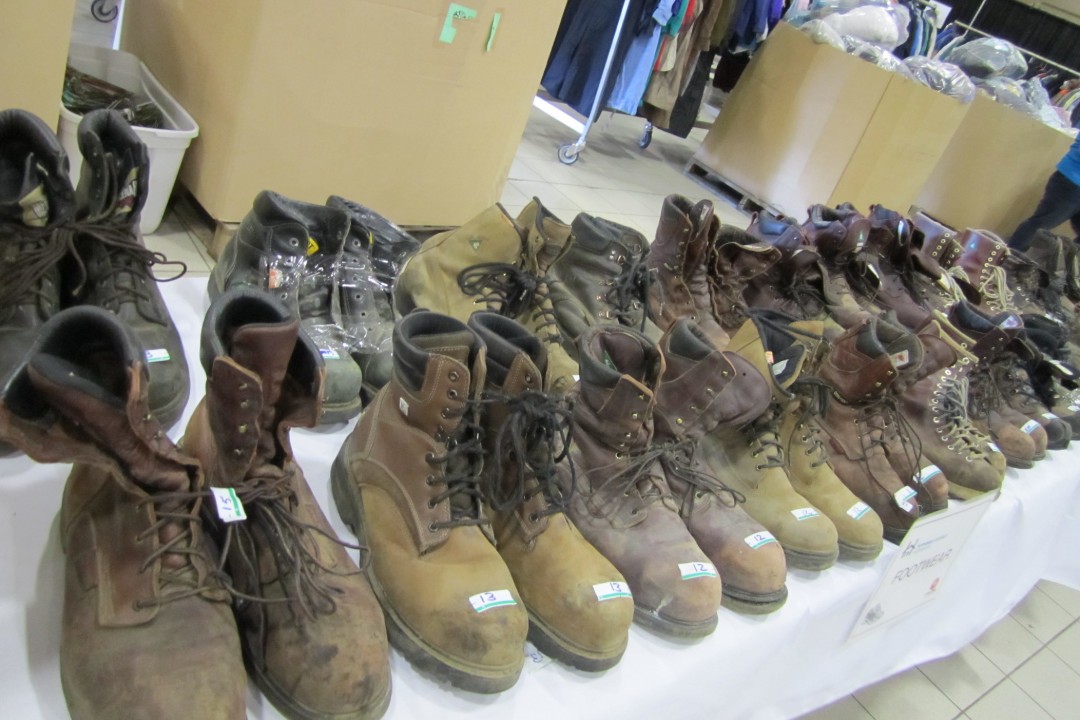
Edmonton's challenges with homelessness have grown considerably since 2019, though they have long been something city councillors and mayors must grapple with. In this file photo from 2011, donated shoes are on display at a city resource centre for those experiencing homelessness. (Mack Male/Flickr)
Provincial role in homelessness
An estimated 1,355 Edmontonians were unhoused or had temporary housing at the end of 2019, Homeward Trust data shows. The agency's most recent data shows the number of people unhoused or with temporary housing has grown to 4,763 as of July 2025. When measuring this increase, partially occurring during this council's term, it's important to note what the city can and can't do about housing. Healthcare, social services, and social assistance are the constitutional responsibility of the province. Edmonton's municipal government, meanwhile, is responsible for policing and can most readily encourage or discourage housing with land zoning. Some say its renewed zoning bylaw, for example, has helped Edmonton keep up with the rising demand for housing.
When it comes to housing and homelessness, the relationship between Edmonton's council and Alberta's government also matters financially. Housing projects are often co-funded by multiple levels of government. Veterans' House Canada, for example, just broke ground on building 40 units for unhoused veterans. Veterans' House Canada contributed $5.6 million, the federal government contributed $4.5 million, Alberta's government contributed $3.4 million (via the Canada – Alberta Bilateral Agreement on Housing), and the City of Edmonton contributed $2.6 million, as well as the land.
Homelessness emergency and encampments
In January 2024, Edmonton's council declared a housing and homelessness emergency. Municipal Affairs Minister Ric McIver dismissed this action as "performative." The action items in the declaration called for a community task force to be created and led by Mayor Amarjeet Sohi and the city manager. It also called for $3.5 million to find innovative solutions, and work to find more funding to combat homelessness.
Also in January 2024, a judge ruled against the Coalition for Justice and Human Rights attempts to sue the city for its evictions of homeless encampments. City and Edmonton Police Service staff dismantled almost 9,500 encampments in 2024. This cleanup work cost roughly $5.8 million. The provincial government contributed $4.5 million towards the removal and cleanup costs.
In 2024, Damian Collins, director of the Community Housing Canada Research Partnership at the University of Alberta, told Taproot the emergency declaration and the encampment response were not aligned in their aims. "(T)hose are, I would argue, contradictory actions on the part of the city," he said.
The 16-member Community Mobilization Task Force on Housing and Homelessness's final report, presented to council in April, highlights that the group's position is that it cannot solve homelessness. "Instead, our commitment was to address gaps in the current response and identify opportunities to grow untapped community resources and champions," the report authors wrote. The group nonetheless identified ways the city can act, including using city land to catalyze housing projects, making investments to create larger funding tools to build housing, providing operational funding for bridge housing organizations, and funding training for housing support workers.
How should the city respond to homelessness?
Some of Taproot's survey respondents called for greater enforcement of city bylaws, more social support to address the underlying causes of homelessness, and for the city to build more housing.
Within some of these enforcement options, however, lie data points that contextualize the situation. The Criminal Trial Lawyers' Association, for example, found that transit peace officers gave 90% of 5,721 trespassing tickets in 2024 to people without a fixed address. When it comes to enforcement by the police, the service does not release data that links housing status and arrests, but does track high-intensity crime locations. Among those are shelters and encampments. The service's crime statistics report for 2024 notes that calls to respond to "disorder," such as encampment complaints, have been rising since 2020. The same report found there were close to 100,000 calls about disorder in 2024.
The city has tools to curb disorder without using fines. One is the Community Outreach Transit Team, which pairs transit peace officers with staff from Bent Arrow Traditional Healing Society. Another is a data tool called Unison that the city has built, which helps social agencies, EPS, and others plan incident responses. The city used to fund the Core Patrol, but now the Edmonton Downtown Business Association provides operational money.
The city also sells land for $1 in many cases for below-market and supportive housing developments, such as a forthcoming one in Spruce Avenue by the Indigenous-led NiGiNan Housing Ventures. The city also sold land in Parkdale to Jasper Place Wellness Centre for $1 to expand the housing in the Bridge Healing Program. In The Quarters, the city sold a parcel to e4c for $1,000 to build transitional housing and more.
The current council has also approved grant funding for affordable housing. The current and future subsidized housing projects the city supports are on its website.
Further reading
In 2024, council instituted an affordable housing strategy and a homelessness and housing services plan that detail the city's plans to aid the growing unhoused population in Edmonton.
Share