
Housing advocates on both sides unhappy with proposed infill changes
As Edmonton city council prepares to decide what to do with some proposed changes to bylaws governing infill, neither opponents nor supporters of infill development are likely to be satisfied with the outcome.
Council's urban planning committee decided not to make a recommendation to council on two infill-related matters after hearing from dozens of residents on Feb. 9 and 10. Administration had recommended lowering the maximum number of units that can be built mid-block from eight to six in the RS zone, which applies to most mature neighbourhoods, as well as increasing the minimum lot size for each unit. Administration had recommended against making amendments to lower the maximum height allowance and to protect trees on private property.
All of this is now on city council's agenda for Feb. 17, with continuation scheduled for Feb. 18. If council supports making changes, administration will draft amendments to be debated at a public hearing, probably on April 7.
Before urban planning committee met on the matter, Taproot spoke to two advocates on either side of the infill debate: Dallas Moravec of Edmonton Neighbourhoods United and Jacob Dawang of Grow Together Edmonton. For Moravec, the proposed changes did not go far enough.
"It's the massing and the volume of the buildings that's actually creating the problem," said Moravec, a real estate agent whose group seeks to amplify the voices of residents who oppose multi-unit infills in mature neighbourhoods. "If we don't actually limit the length, the height, the width of the buildings … we don't feel like it's actually going to solve the problem."
On the other hand, Dawang worried that any further restrictions on infill could turn back important progress in Edmonton. His group sees infill as integral to housing sustainability and affordability.
Zoning that restricted development in mature neighbourhoods before "created a city where the only choice that many people had, if you could not afford a single-family home, was either to go out into the suburbs or maybe hope one day that you could afford a single-family home," Dawang said, adding that restricting infill "will give us less homes, it'll be pushing people out towards the suburbs once again, it'll be excluding people from neighbourhoods."
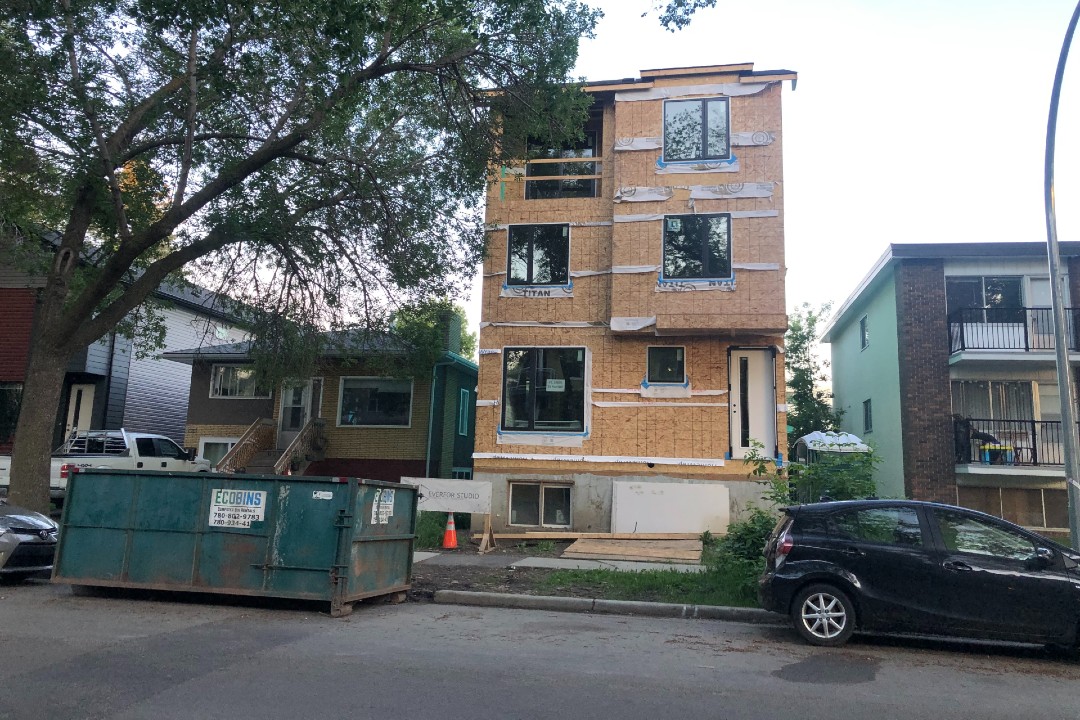
A mid-block infill in the Strathcona neighbourhood. (Stephanie Swensrude)
City council did make some changes to the bylaws in July, including reducing the number of side doors allowed and shortening the maximum length of a unit. More changes so soon after these were made could be premature, Dawang said.
"It takes longer than six months … to see these new builds fully built out, much less to have them occupied," he said. "We really haven't seen what these new ones look like."
But Moravec argued those tweaks weren't drastic enough.
"These developers can easily go back to the drawing board, make some small minor changes to their drawing, and then resubmit it to the development officers," he said. "It was really just a drop in the bucket and an incremental change."
Moravec also questioned whether there's demand for multi-unit infill.
"Really, the demand for housing is in single-family homes, and that's what I see as a real estate agent every day," he said. "Now they're tearing down … a perfectly good single-family home, which I'll never be able to figure out."
Dawang countered that there's plenty of choice if a single-family home is what you're looking for.
"In all of 2025, only 310 building permits were issued for five to eight units," he said. "There are 80,000 properties in mature neighborhoods."
What about the trees?
Another issue residents and councillors in mature neighbourhoods keep bringing up is protecting trees on private property.
"If there was a separate tree bylaw that worked to keep these trees in place, what it would do is make the developers have to work around the existing trees," Moravec said. "It would actually work to reduce that massing, which we feel is a huge core issue."
But making it possible for more people to live in desirable neighbourhoods close to services struck Dawang as more important.
"On one side, you've got a home for people. On the other side, you've got a tree," he said, adding that it would be best for the city to focus on protecting trees on public property. "Trees can be replanted. Trees grow."
City administration continues to advise against a private tree protection bylaw, citing a lack of compliance with current bylaws, high costs, and enforcement challenges.
On the need for better enforcement, both Dawang and Moravec agree.
"We need to fund more bylaw officers to enforce the rules," said Dawang. "We need to crack down on the builders who are causing problems."
Moravec concurred. "We see … lots of developments happening where construction is going awry, and developers are not following building codes, they're not following different protocols."
This story is based on a larger conversation with Dallas Moravec and Jacob Dawang on the Feb. 6 edition of Taproot Exchange, a members-only livestream conversation that goes deep on issues of interest to Edmontonians. Become a member for access to future livestreams, as well as recordings and transcripts.
Share