
Bike routes cancelled or put off despite council direction
Even though a council committee has told administration to proceed as planned with Edmonton's active transportation network expansion, regardless of parking and traffic concerns, administration has cancelled or deferred bike infrastructure in Grovenor, Terrace Heights, and along 95 Avenue in the west end.
Such moves have prompted a city councillor to seek funding options to complete routes that were approved in the current budget cycle, including those three, as well as to continue expanding the network from 2027 to 2030. And the Edmonton Bike Coalition is encouraging cyclists to take the road this week to demonstrate what the city would look like without bike lanes.
Ward Métis Coun. Ashley Salvador is set to introduce a motion at the Sept. 2 executive committee meeting to direct administration to bring forward two funding profiles during the 2027-2030 budget deliberations. The first would increase funding to finish off the routes planned in the 2023-2026 budget cycle. The second would allow the city to introduce another new round of active transportation infrastructure as informed by an update to the current implementation guide, to be presented to council ahead of budget deliberations.
At its Aug. 26 meeting, infrastructure committee heard an update on the routes planned in the 2023-2026 budget cycle. Administration had recommended that council proceed with only 13 remaining routes and reevaluate 14 others that would affect parking or vehicle lanes, to respond to community pushback and expected provincial legislation. Instead, councillors simply received the report for information, leaving the previously approved active transportation network expansion program in place.
However, the city's active transportation network expansion webpage indicates that infrastructure in Terrace Heights along 101 Avenue that was originally planned for 2026 is now under review until next year as administration analyzes how it will impact vehicle traffic. Infrastructure along 95 Avenue has been deferred as administration reviews impacts on parking and vehicle traffic, with no posted timeline for completion. Planned work in Grovenor has been outright cancelled after some residents raised concerns. The webpage said this is "due to community and council feedback about the loss of parking and changes to travel patterns" required for the unprotected bike pathways planned for the neighbourhood, adding that active transportation connections may be considered in future renewal opportunities.
Administration says it has delegated authority to make some design and routing changes in response to technical considerations and public feedback. To Salvador, that authority should not be used to prioritize parking and vehicle movement over active transportation goals.
"That's why this was an important conversation, to be very clear around what the expectations are from council around the criteria that we're using when we are continuing to build out bike infrastructure, and that heavily weighting parking and travel lanes at the expense of active transportation is not the intention," Salvador told Taproot.
Transportation minister Devin Dreeshen has signalled that he will introduce legislation that limits a municipality's ability to install bike lanes, especially if they take away vehicle parking or travel lanes. Given that context, deferred routes might never be built if the city doesn't act quickly, said Aaron Budnick, a volunteer with the Edmonton Bike Coalition. "With the legislation that's potentially coming up from the UCP, any delay on a project could mean that it's cancelled, effectively."
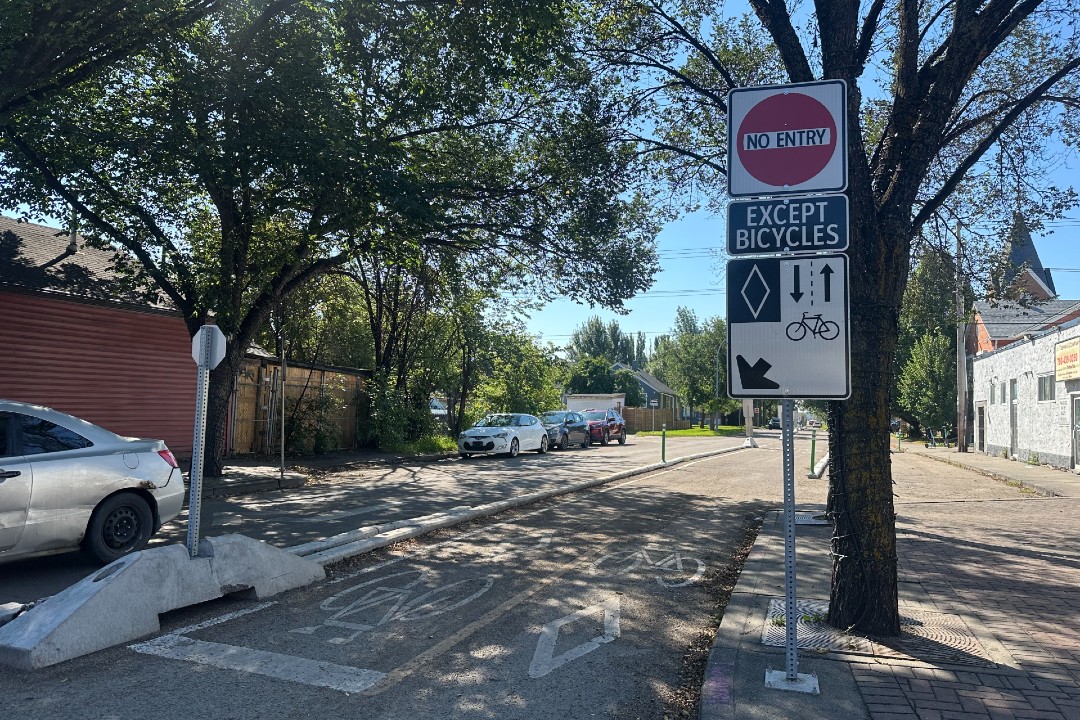
This bike lane on 100 Street south of Whyte Avenue was built as part of the active transportation network expansion. Councillors directed administration to continue the expansion as planned, despite some community pushback and expected provincial legislation. (Stephanie Swensrude)
Last year, Delton residents met with Dreeshen to discuss their concerns around parking and traffic, though bike infrastructure eventually proceeded as planned. Debate has emerged around a proposed bike lane on 79 Street through mature southeast neighbourhoods, where concerns over parking are again colliding with efforts to build a connected cycling network. And homeowners along 50 Street in Capilano, Gold Bar, and Fulton Place mounted a high-profile campaign this summer that ultimately prompted council to revisit the design, deciding to spend $4.9 million to preserve more curbside parking and travel lanes instead of the original $2.4 million.
Salvador led the motion to redesign 50 Street, but she considers it a unique corridor. "We're talking about a roadway that was actually a former highway connection — there was supposed to be a bridge that went over the river on 50th Street, so it's a four-lane road with a 10-metre-wide, centre-running median," Salvador said.
Budnick agreed that all modes could be preserved on 50 Street. "That is a spot where we can fit parking, driving, and a good quality bike lane all in the same spot."
But preserving parking and vehicle lanes on every constrained roadway would make protected infrastructure impossible, Salvador said. "If we are providing so much weighting towards parking and travel lanes, that potentially comes at the expense of the viability of being able to put in active transportation infrastructure — in many cases, when we're looking at constrained roadways in existing communities, it will make those projects just not viable at all."
In addition to Grovenor, Terrace Heights, and 95 Avenue, which were supposed to be built this year, administration had proposed re-evaluating 11 others slated for construction in 2027:
- 50 Street (101 Avenue to 109A Avenue)
- 64 Street (119 Avenue to Yellowhead Trail)
- 79 Street (76 Avenue to 101 Avenue)
- 84 Avenue (79 Street to 83 Street)
- 85 Street (93 Avenue to 98 Avenue)
- 88 Avenue/93 Street/87 Avenue (85 Street to 96 Street)
- 89 Street (76 Avenue to Connors Road)
- 92A Avenue/86 Street/alley (Connors Road to 85 Street)
- 93 Street (82 Avenue to 84 Avenue) and 84 Avenue (91 Street to 89 Street)
- 93 Avenue/82 Street/94 Avenue (85 Street to 75 Street) and 75 Street (94 Avenue to 94B Avenue)
- 106 Avenue (50 Street to west of 84 Street)
In implementing the active transportation plan, administration began with routes that were "low-hanging fruit," Salvador said, including projects that widened sidewalks into shared-use paths. Only now is the city approaching more complicated routes that are more likely to require changes to parking and traffic lanes. Salvador pointed to planned protected bike lanes in Bonnie Doon.
"There's high potential for ridership in those particular locations, and there's a desire from residents to see safe protected infrastructure," she said.
The report to infrastructure committee said 59 kilometres of active transportation infrastructure — including shared-use pathways, unprotected on-street bikeways, and protected bike lanes — have been built since council approved a $100-million project to expand the bike network in 2022. But Budnick said only about five kilometres of the build-out so far has included protected bike lanes. While shared-use paths and unprotected on-street bikeways can be good in contexts such as rural and suburban communities, he said, protected bike lanes should be used in the core of cities.
"The urban context, especially downtown, is just different. The risk factors are different, there's a lot more users of all types — cars, cyclists, everything," Budnick said. "We just need to be careful about using the facility type that is appropriate to the context."
The coalition's Week Without Bike Lanes, which started on Aug. 31 and is to run until Sept. 6, is intended to demonstrate what streets could look like without protected infrastructure. Those who feel safe and confident enough to cycle their usual routes on the road instead of in protected lanes are encouraged to do so, while following all relevant traffic laws.
"The purpose is to help everyone in the city understand what it would look like if the province did come in and remove bike lanes," Budnick said, adding that if bike lanes disappeared, cyclists would either drive or ride in mixed traffic, adding to congestion.
Hear more about active transportation and city policy from Salvador and Budnick on the Sept. 4 episode of Speaking Municipally.
Share