
On the agenda: Public spaces, accessibility, development fees
This week, councillors are set to review the first year of the public spaces bylaw, hear an update on the city's accessibility progress, and consider changes to the planning and business development model.
There is a community and public services committee meeting on Sept. 28, an urban planning committee meeting on Sept. 29, and an executive committee meeting on Oct. 1.
Here are some key items on the agenda this week:
- Transit and downtown peace officers issued 29% more warnings in the year after several bylaws were consolidated to create the public spaces bylaw. During the same period, there was a 9% increase in tickets issued, says a report that is set to be presented community and public services committee. The majority of warnings were related to proof of payment, controlled substances, inappropriate behaviours, and using transit spaces for non-transit purposes. At the same time, the Community Outreach Transit Team, known as COTT, recorded a 59% increase in engagements and interactions, which it attributes to enhanced operational alignment between transit peace officers and outreach teams, as well as increased community awareness following the opening of the Wa'awiyagabi Welcome Space at Central LRT Station. Administration said the data suggests "enforcement officers are using the public spaces bylaw for lawful placement purposes to intervene in problematic conduct, but are exercising discretion to use escalating enforcement and diversion tools as appropriate." Administration said it does not believe the changes can be attributed solely to the bylaw change, and that changing social programs and services have contributed. Council had requested the analysis after advocates said the new public spaces bylaw would have harsh consequences for vulnerable Edmontonians. Administration has proposed several amendments, including a new definition to distinguish privately owned public spaces, such as malls and lobbies, from municipal public spaces that are directly owned and controlled by the City of Edmonton. The regulation change also applies to the part of the bylaw that regulates temporary sheltering. "Limiting certain regulation to 'municipal public spaces' avoids the risk of unintentional overbreadth, provides clarity to the public on the extent of regulation, and ensures minimal impairment of activities that may have expressive or other protected aspects," the report said.
- Administration highlighted the progress it has made on the accessibility for people with disabilities policy. The city has updated its accessibility design guide, enhanced visibility of benches in four LRT stations, and offered additional employee training. It has also made progress on addressing a backlog on sidewalk maintenance and reviewed nearly 400 pedestrian crossing signals. Administration plans to develop a plan to support adaptive recreation, improve booking and scheduling for DATS, and review service levels for clearing sidewalks and bike lanes of snow and ice.
- Administration has presented options to bring the planning and development business model (PDBM) closer to its target level after years of increased construction activity resulted in a surplus in the reserve. The PDBM is funded by the fees charged for land development applications, development permits, building permits, and other associated services. The projected year-end balance of the reserve is $77.6 million, which is 105% of budgeted operating expenses. Council policy mandates that the balance should not exceed 75%. Administration recommends pausing inflationary fee increases in 2027, increasing staff levels, and investing in technology. It also recommends three actions that would require a policy exception: a one-time, $12-million transfer to the infill infrastructure program; a hold on funds for future growth planning studies; and a revision to the PDBM policy. Urban planning committee is set to review the changes, after which council will make the final decision.
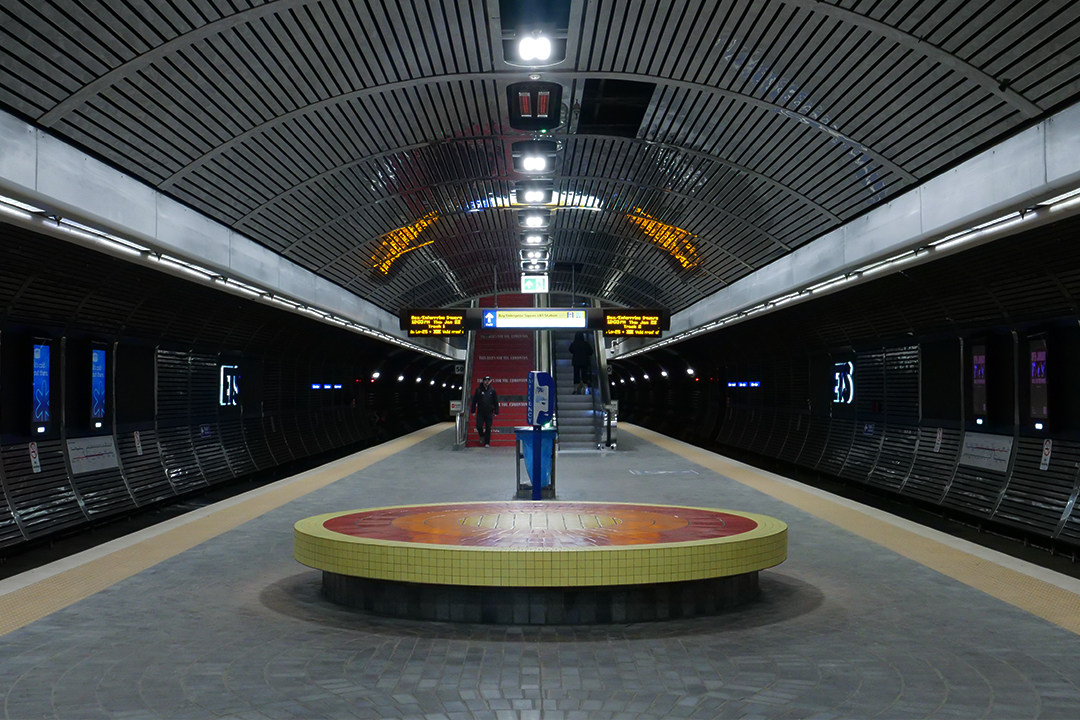
Administration has proposed amendments to the public spaces bylaw to add a new definition to distinguish privately owned public spaces, such as malls and lobbies, from municipal public spaces, such as LRT stations. (Sara Sheydwasser)
Here are some more key items:
- Representatives from the Highlands Historical Society suggested turning an existing unnamed landscaped area into a park to commemorate the neighbourhood's history after a notable transit stop was turned into a supportive housing site. Last summer, council's executive committee approved the sale of three sites to Jasper Place Wellness Centre for supportive housing, including a former transit loop that was once the end of the streetcar line that served Highlands, which was then a new suburb. When the sale was approved, councillors had asked for options to honour the neighbourhood's history.
- Offering an incentive for early payment of parking tickets would cost the city up to $1.15 million in capital costs as well as up to $300,000 annually, says a report that will be presented to community and public services committee. A jurisdictional scan of seven large Canadian cities found that five of them use tiered fines and early payment incentives. Implementing tiers and incentives would require the city to modernize its ticketing process, the report said. It could also reduce revenue by $300,000 to $700,000 annually.
- Building affordable housing on the same site as municipal assets, such as fire stations or libraries, could help get more built in the suburbs, administration said. A report set for community and public services committee says 6% of the total dwellings within the redeveloping area — generally, the area within Anthony Henday Drive — are affordable units, compared with 1% in newer neighbourhoods outside of the ring road. Council has previously considered affordable housing co-location at the Walker Fire Station, but ultimately decided against it due to high planning and design costs. Other options include using municipal reserve land and purchasing private land and offering it to affordable housing developers.
- Administration recommends using the heritage commemoration initiatives in the new heritage places strategy to recognize the heritage design characteristics along 129 Avenue in Calder. A report that will be presented at urban planning committee says council could also introduce a direct control zone to conserve the heritage character, or introduce a special character area zone, as exists in Westmount, Cromdale, Garneau, and Old Strathcona, though either option could limit future development.
- Edmonton Transit Service could add more stops to existing on-demand transit zones after three on-demand neighbourhoods are converted to conventional service next year. A report that is set to be presented to urban planning committee adds that administration is now able to add onboard fare collection to on-demand transit vehicles.
- A partnership between 911 dispatch and social services resulted in customer service training, new call diversion processes, and data sharing, but lacked capacity to make significant improvement to Edmontonians, according to a report to be presented to community and public services committee. The Integrated Call Evaluation and Dispatch (ICED) initiative aimed to "move from a traditional emergency response model toward getting the right response at the first call to Edmontonians," the report said. Since the program launched in 2022, mental health calls are now automatically routed to 211, a social services helpline, or 988, the suicide crisis helpline. Administration said the partnership is limited because, unlike police, most social services don't have the capacity to operate 24/7; privacy laws protect an individual's data but can make it difficult for service providers to share information quickly and develop plans for supporting callers with complex needs; and wage inflation has meant that fewer 911 dispatch workers can be employed within a static budget.
- Executive committee will review a proposal to offer the premium version of the Transit app to all Edmontonians. About 85,000 riders use the third-party app to plan trips in Edmonton, and about 4,300 more people download it each month, a report said. Administration is seeking approval for a four-year contract of up to $2.5 million that would provide free access to the "Royale" version of the app for all Edmonton region riders. The premium version of the app provides access to all route schedules and real-time trip data across the region, allows riders to plan trips in advance, provides more trip options, and gamifies app customization features that make the app more appealing and user-friendly, the report said. The agreement would also let administration access rider feedback submitted through the Transit app. The proposal requires executive committee approval only.
- Executive committee will review applications to designate the Campbell Residence and Reed Residence in Westmount, and the Judge Downes Residence in Strathcona, as municipal historic resources. If committee approves, city council will make the final decision.
- Administration has drafted amendments to the community standards bylaw that would require unsolicited mail containing images of a deceased fetus to be contained in a sealed, opaque envelope with a content warning. A report set to be presented to community and public services committee says the city has heard from residents who have been traumatized by receiving graphic mail with messaging related to abortion. The changes require council approval.
- Administration has proposed a minor change to the city's ward boundaries to place the entirety of the Glenridding Ravine neighbourhood within Ward pihêsiwin and the entirety of the Chappelle neighbourhood within Ward Ipiihkoohkanipiaohtsi. About 400 residents in Glenridding Ravine would move to Ward pihêsiwin from Ward Ipiihkoohkanipiaohtsi once the proposed adjustment came into effect, while the segment of the Chappelle neighbourhood currently has no residential population. City policy requires the returning officer to review municipal boundaries in the year following a municipal election. The population of each ward is supposed to be within 25% of the mean ward population of 103,700 people, and all wards are currently within the acceptable variance. If executive committee approves the proposal, it is ready for first reading; if approved, the final council vote will take place in the future.
And here are updates on some of the items we told you about last week:
- Council voted 9-3 for zoning bylaw amendments to regulate lodging houses more effectively. The revisions aim to address safety and compliance issues associated with lodging houses, providing clearer definitions and guidelines for operating such accommodations within the city. The changes come after ongoing concerns and complaints about the conditions and management of rooming houses in Edmonton. Councillors Ashley Salvador, Anne Stevenson, and Jo-Anne Wright voted against the changes; Coun. Aaron Paquette was absent.
- Council voted 12-0 (Coun. Aaron Paquette absent) for a rezoning application to allow for a smaller building in Parkdale. Coun. Ashley Salvador, who represents the neighbourhood, said the new zone could make a development more viable.
- Council voted 8-4 to approve a rezoning application in North Glenora across the street from Westmount Shopping Centre to allow housing up to four storeys at 11029 and 11033 135 Street NW. Coun. Reed Clarke, whose ward includes North Glenora, said he voted against the application because he believes the developer should stay with the existing zone. Councillors Mike Elliott, Thu Parmar, and Karen Principe were also opposed.
- Council voted 7-5 to approve a rezoning application in Bonnie Doon at 8515 and 8519 84 Avenue NW to allow housing up to about four storeys. Councillors Reed Clarke, Mike Elliott, Jon Morgan, Thu Parmar, and Karen Principe voted against the rezoning. Opponents said the mid-block location would not allow for a sensitive transition in scale from the surrounding bungalows, while those voting in support said the property's proximity to Bonnie Doon Shopping Centre and other amenities made the rezoning logical.
- Council voted without debate for a rezoning and district plan amendment in Montrose that would replace residential zoning at 12103 and 12107 66 Street NW with zoning for light industrial and small commercial businesses.
Meetings stream live on YouTube on the Chamber channel and River Valley Room channel.
For more on civic affairs, including a compare-and-contrast of Edmonton and European cities as well as takes on bike infrastructure, patios, bridges, transit, and former mayors' views of downtown, listen to Episode 373 of Speaking Municipally.
Share