
On the agenda: Municipal autonomy, funding outcomes, rezonings
This week, council will discuss its autonomy, look at outcome reports from municipal funding, and consider several rezoning applications.
There is a public hearing on Oct. 13, a non-regular council meeting on Oct. 14, and a special city council meeting on Oct. 16.
Here are some key items on the agenda this week:
- Council will hold a special meeting on Oct. 16 to discuss the Oct. 8 directive from the provincial government ordering Edmonton to revert its zoning bylaw to parameters that were in place before 2024 and restore minimum parking requirements to where they were before 2020. Smith said at a news conference on Oct. 8 that the current bylaw has led to "irresponsible" infill development, pointing to multifamily complexes in neighbourhoods dominated by single-family homes. "Let me be clear — the goal should not simply be more housing, but more housing that is planned and integrated in a way that works for both existing residents as well as future families," Smith said. The city has been given three months to amend its bylaw and 18 months to conduct a comprehensive review of its land-use bylaw. Mayor Andrew Knack urged the province to pause the directive, which he called "chaotic," noting that it will result in higher taxes and reduced affordability. Knack told Ryan Jespersen the special council meeting is to see if council is in agreement about municipal autonomy: "I think we'll need to have a clear discussion … do we want to make a public statement as a council on local autonomy?"
- Administration will report on the outcomes of $262.8 million provided to 1,351 recipients, including $137 million in operating subsidies to civic agencies, boards, and commissions, as well as $125.8 million supporting individuals and other external organizations. This is only the second year that the ABCs, individuals, and organizations have been required to report on outcomes, and many are still developing processes and performance measurements, the report said. Council-directed funding, which usually arises from a report to council, through advocacy by a non-profit, or as a solution to complex issues, nearly tripled from $7.4 million in 2024 to $20.1 million in 2025. This stream of funding does not go through the city's internal program funding process to ensure consistency, accountability, equity, and transparency, administration said. More than $10 million of council-directed funding went to Qualico for its publicly accessible private spaces in its Station Lands development.
- A landowner has proposed rezoning a lot in Ritchie at 9905 80 Avenue NW from a direct control zone that allows for a 20-storey building to a standard zone that allows for a four-storey building. Administration said the proposed rezoning would facilitate new development in a primary corridor close to bus routes and bike networks.
- Administration said it does not support a rezoning application for a property that is partially in the boundary of the Westmount Architectural Heritage Area. The site at 11038 126 Street NW was consolidated from three separate lots, two of which were zoned for four-storey residential development with no architectural controls, and the third zoned for 2.5-storey residential development in line with the architectural controls of the Westmount area. Residents who oppose the rezoning said the heritage area is a historically significant area that should be preserved.
- BM Homes has proposed rezoning a property in McKernan at 11302 75 Avenue NW to allow for a three-storey residential building that is taller than what is currently allowed. Administration said it supports the application because the property is a corner lot near the McKernan-Belgravia LRT station and the 76 Avenue secondary corridor. Some residents oppose the rezoning because they believe infill properties are being used for lodging houses or short-term rentals, and that the development would increase pressure for on-street parking.
- Council will receive a private update from the city manager.
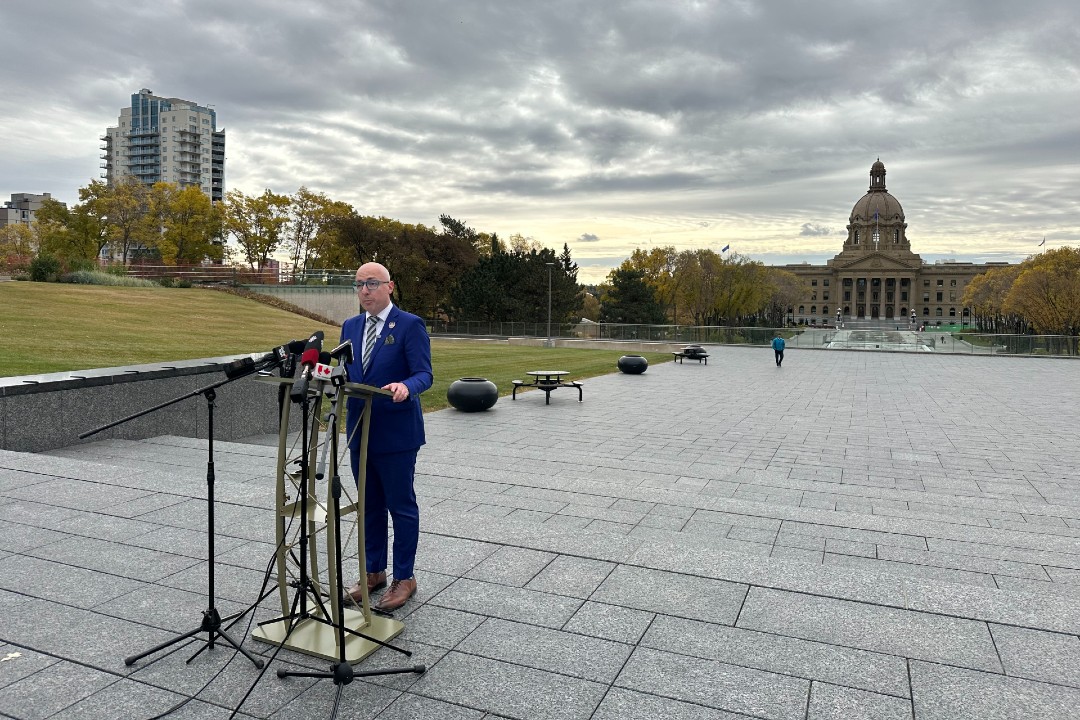
At a news conference on Oct. 8, Mayor Andrew Knack urged the province to pause its directive to revert Edmonton's land use bylaw to parameters that were in place before 2024. (Stephanie Swensrude)
Here are updates on some of the items we told you about last week:
- Council voted down a motion to remove the 25-cent fee for paper bags at drive-thrus. An administrative report found single-use waste has fallen 30% since Edmonton introduced its single-use item bylaw in 2023, although the data does not distinguish between different types of retailers. Supporters say the fee encourages people to reduce waste, while opponents argue it unfairly affects people on fixed incomes.
- Council voted to allocate the surplus in the planning and development business model. Part of it will pay for peace officers who enforce development compliance through bylaws governing traffic, community standards, public spaces, and public trees. Part of it will fund future growth plans for residential and non-residential development. Another portion will fund items identified in the Industrial Investment Action Plan. And council will vote during budget deliberations on allocating a final piece to the infill infrastructure program.
- The first reading on the bylaw that introduced a small change to ward boundaries in the southwest passed. The second and third readings will happen at a future council meeting.
- Council voted 8-5 to approve an increase to the electricity franchise fee charged to EPCOR, which will mean higher power bills for residents starting on Jan. 1. The fee will rise from 17.65% to 19.4% of electricity distribution charges, bringing Edmonton in line with Calgary. Administration had originally proposed raising the fee to the maximum 20%, which would have increased the typical monthly fee from $9.06 to $10.27. Councillors Reed Clarke, Mike Elliott, Thu Parmar, Karen Principe, and Erin Rutherford voted against the increase.
- Council voted 6-5 to direct administration to bring forward an unfunded capital profile to continue implementing the bike plan. Councillors Mike Elliott, Thu Parmar, Karen Principe, Erin Rutherford, and Keren Tang voted against the motion. Council will still need to debate the profile during the four-year budget deliberations.
- Council referred a discussion about changes to the city administration bylaw to the Oct. 21 executive committee meeting.
- Council designated the Reed Residence, Judge Downes Residence, and Campbell Residence as municipal historic resources.
- Council voted against a motion from Coun. Michael Janz to add a moment of silence to the beginning of each council meeting for people who have died due to traffic violence. While several councillors supported the intent, those who voted against the motion said it would open the expectation for council to recognize other tragedies such as suicide and drug overdose deaths.
Meetings stream live on YouTube on the Chamber channel and River Valley Room channel.
For more on the provincial directive on zoning and what it means for municipal autonomy, plus a look at waste, the bike plan, and Knack's decision to sell his car, listen to Episode 375 of Speaking Municipally.
Share