
Attainable housing needs to come in all shapes and sizes, proponents say
When Omar Yaqub struggled to help an IslamicFamily client escape domestic abuse, he knew something had to change. That incident and others inspired his work on the Diamond of Dunluce, a forthcoming development that will offer affordable housing for multigenerational living.
"She was caring for her elderly parents; she was also caring for her children, and one of her kids had special needs," Yaqub said during a groundbreaking event at 365 Dunluce Road NW on Oct. 26. "The choice she was given by our shelter system was abandon your parents, abandon your kids, or stay in abuse. That's not a choice — it's not a choice anyone should have to deal with."
It took about five years to solve her housing situation, and Yaqub continued to meet clients with similar needs, such as a family of 15 whose members escaped war only to struggle to live close together in Edmonton. Why? The supply of affordable housing with enough bedrooms and the right amenities for large families just wasn't there.
"The reason why the private sector doesn't build three-, four-, and five-bedroom units (in multi-family developments) is because the pro forma just doesn't work, generally speaking," Build Edmonton Homes CEO Gord Johnston told Taproot.
But Yaqub, Johnston, and Issam Saleh of Vivid Homes (who started Build Edmonton Homes with Johnston) found a way to add 96 townhouses with 290 bedrooms — meaning two to five per unit. Three-quarters of the homes are 20% to 50% below market. Johnston expects the development to be ready for move-in in the first quarter of 2028.
How? They received $9.3 million from the province, $3.6 million from the city, and $250,000 from the federally funded Green Municipal Fund administered by the Federation of Canadian Municipalities — more than one third of the estimated $37 million total. The rest is a mix of potential federal funds, private investment, philanthropic contributions, and what Yaqub calls "fairer financing," a model based on Islamic home financing practices, which forbid charging conventional interest fees.
"Almost all of the affordable housing in Canada is built using debt financing — it's below prime, but what that financing does is it actually prevents communities who (don't want to or can't) use conventional finance from participating in affordable housing," said Yaqub, whose title is "servant of servants" at IslamicFamily. "That also prevents that community from coming with other resources. Our community is also able to bring a community-based rent supplement that keeps affordable housing affordable, and it provides new maintenance dollars for affordable housing."
Multigenerational living comes in many forms. It can be everyone in one unit, a house with a basement suite or a backyard suite, or even just being neighbouring homes. And it can change as life happens, though housing players don't always acknowledge that, said Chelsey Jersak, one of the founders of Wello Living and the founder and strategic director of Situate, which helps infill developers with zoning and permitting.
"I grew up with a single parent, and I think there are times when a single parent and a child need to have a place to stay, like after or during a divorce," she told Taproot during a Wello event on Oct. 22. "We don't ever think about those household types when we're thinking about building housing. We're like, 'Nuclear families need housing.' Well, so does everybody else."
That's partly why she's building Wello One, an eightplex infill with two- and three-bedroom suites in Prince Rupert. It was designed for people who don't want a one-bedroom apartment and perhaps want to live with kin outside the single-family home. She expects it to open in December.
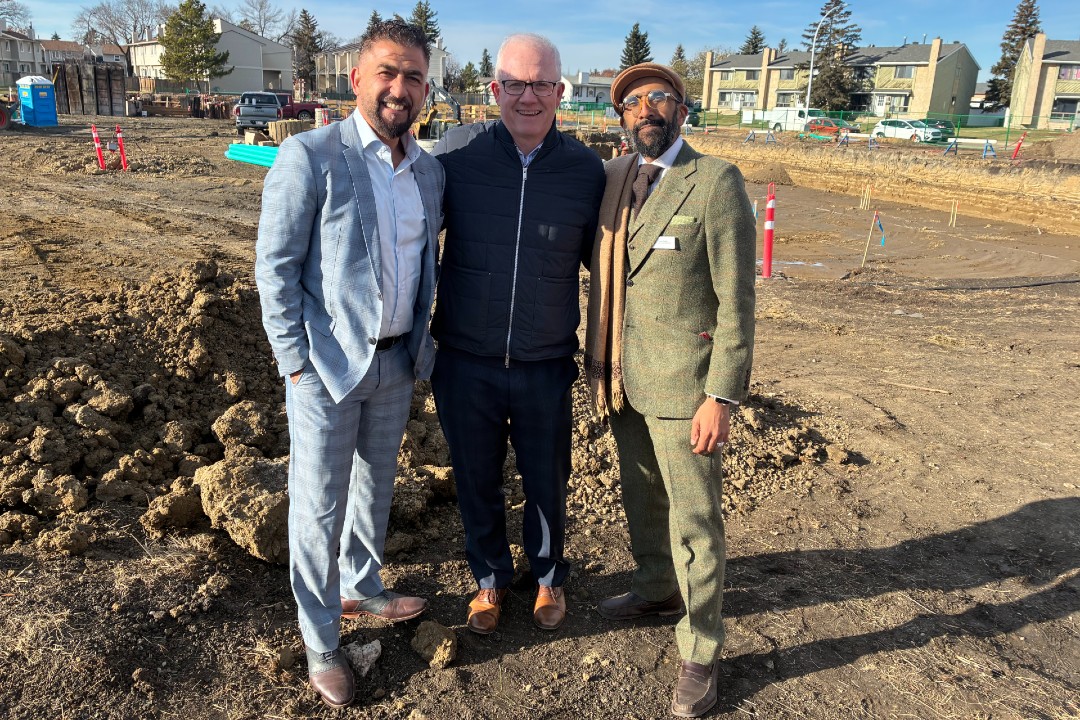
Issam Saleh of Vivid Homes, Gord Johnston of Build Edmonton Homes, and Omar Yaqub of IslamicFamily at the groundbreaking of the Diamond of Dunluce at 365 Dunluce Road NW on Oct. 26. (Colin Gallant)
Reasonably priced units help fill changing family needs, but they also address groups of friends who want to be roommates and people who just want to know their neighbours. Wello's website tagline puts it simply: "Housing made for people who want to live comfortably, in good company, and without going broke."
Rent prices aren't final yet, as she is still looking for the right property manager, which affects the final rate. But two of the two-bedroom units are limited to roughly $1,250 because the building was financed through Canada Mortgage and Housing Corporation's Mortgage Loan Insurance (MLI) Select program. The three-bedroom suites will obviously cost more, but come with the perk of en suite bathrooms for each bedroom.
Why bet on this? Jersak cited data from the City of Edmonton's Regional Housing Needs Assessment, which was released in June. It includes projections through 2034 that suggest the stock needed is split between nearly 60% for one-bedroom units, 26.7% for two-bedroom units, 12% for three-bedroom units, and 2.1% for units with four or more bedrooms. And the current stock is misaligned with population needs, the report found. About 60% of households consist of one or two people, while single-detached houses account for 56.2% of all dwellings.
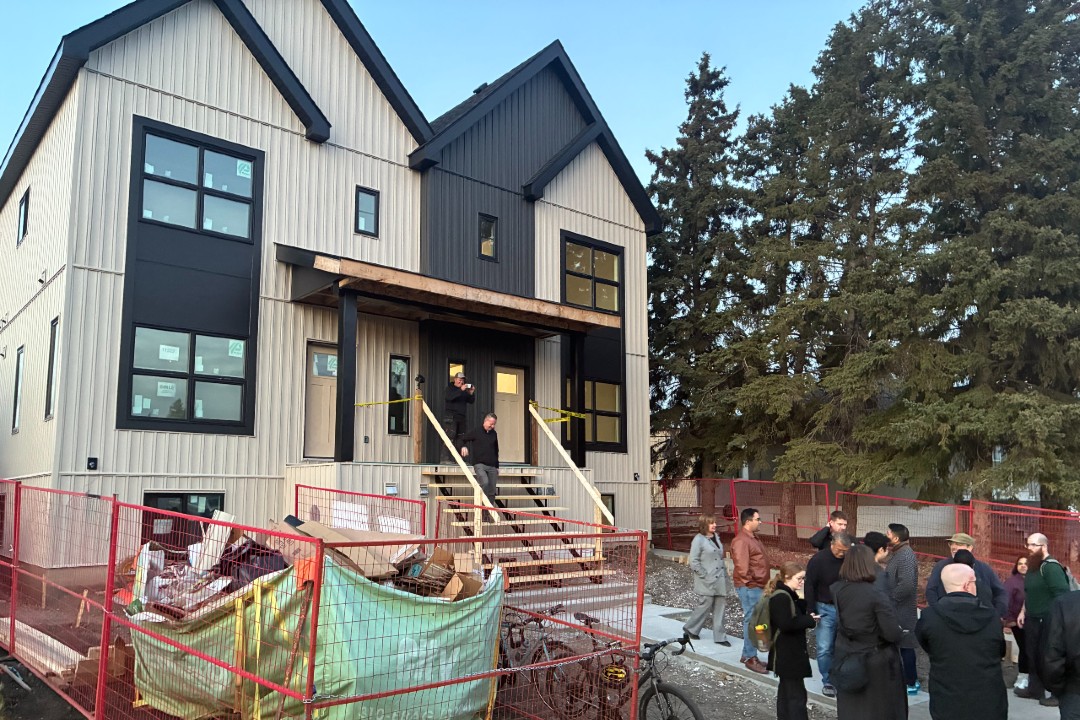
A tour group gathers at the Wello One eightplex development at 11320 113A Avenue NW on Oct. 22. (Colin Gallant)
New and different developments within the Henday face a mix of celebration and scrutiny. With the provincial directive to repeal measures from Edmonton's zoning bylaw renewal, the city is still figuring out what that means for development.
Jersak said Wello faced one concern from a neighbour about parking and driving impacts on children in the neighbourhood. Wello One is on a pie lot on the crook of 113A Avenue NW and will have 20 bedrooms, so the neighbour was concerned about the relationship between traffic, parking, and visibility. Jersak said added backyard parking mitigates that concern. Plus, Wello's website notes the development's potential for car-free living. It is very close to a shared-use pathway and transit, and amenities such as grocery stores are within walking distance.
Concerns are different with the Diamond of Dunluce, which the city awarded surplus school land to in late 2025. Later, Cynthia Kloeble of the Dunluce Park Estates Condominium Corporation voiced concerns about the development and plans for additional affordable housing on such land in March, saying Dunluce has much affordable housing and Dunluce Park Estates condos in the area were selling for around $200,000. Coun. Erin Rutherford, whose ward includes Dunluce, also questioned affordable housing development on surplus sites when the Dunluce sale came up in April of this year.
Coun. Karen Principe was set to introduce a motion on Oct. 28 that, if passed, would rescind the policy that allowed the Dunluce site and 13 others to be sold below market value for affordable housing.
Comfort and dignity
Yaqub's vision isn't just about land, affordability, or the number of units. It's also about design and amenities for multigenerational living that provide comfort and dignity. The Diamond of Dunluce includes considerations such as a shared playspace on site so kids can play without leaving the nest, plus suites as large as 2,700 square feet, big enough for comfortable wheelchair use and to allow large families to congregate.
"I believe this would be the largest affordable unit in town, if not in the country," Saleh said at the groundbreaking. "I guess this is what happens when we stop working in silos and start working together."
Staff from the City of Edmonton, which helped the development team through the process for the novel build, were on hand to celebrate that teamwork, as were Coun. Aaron Paquette (partly on behalf of FCM), Minister of Assisted Living and Social Services Nathan Neudorf, Edmonton-Castle Downs MLA Nicole Goehring, and former MLA David Eggen.
"The city and the province have been really instrumental in terms of that they're more focused on the overall project cost and the affordability, rather than the unit count as their primary motivator," Yaqub said in an interview. "That's enabled this project to be what it is."
IslamicFamily told Taproot on Oct. 28 that the team is awaiting word on additional federal funds. During his address at the groundbreaking, Yaqub said that federal funding wasn't exactly designed to make the costs of multigenerational housing work, as its funding formula generally rewards the number of housing units, rather than the number of bedrooms therein.
Share