
The Pulse
Sept. 12, 2025

Here's what you need to know about Edmonton today.

As strike looms, union says provincial policies have worn teachers down
Policy changes over the past six years have added to the workload that is pushing teachers to the brink of a strike, says the leader of the union representing them.
The Alberta Teachers' Association's 51,000 members have given notice of their intention to strike on Oct. 6. The union rejected a new labour contract that would have included a 12% wage increase over four years. But it's not just wages that are at play, Jason Schilling, the president of the ATA, told Taproot.
For example, a ministerial order that requires teachers to catalogue all books and remove ones with graphic sexual imagery is one more thing teachers don't have time for, he said.
"I'm a high school English teacher — I have about 500 books in my classroom," Schilling said. "I'm not sure when or where I would find the time in the fall to do that inventory, put it online, and then maintain that through the course of the year."
Education Minister Demetrios Nicolaides revised his original order on Sept. 8, after a list of titles that Edmonton Public Schools had created for removal attracted nationwide criticism. Beyond cataloguing and removal, the order requires schools to seek permission for which books to remove and figure out what to do with them when they come off the shelves.
Nicolaides told Taproot the order will remove images of masturbation, oral sex, child molestation, and sex toy use from school books, and that the revision protects classic literature. He added that the public-facing digital catalogue means Albertans can review titles and voice their concerns. "We are always open to having additional conversations with school boards if other books are of concern," Nicolaides wrote in an email. "Furthermore, any member of a school community can challenge a particular title and raise their concerns with the school and the related school board."
Recent policy changes over pronoun use and transgender participation in sport have also added to teachers' burden. But policy-related problems date back to 2019, when former premier Jason Kenney's United Conservative Party government was in power, Schilling said.
In 2018, before winning the provincial election, Kenney promised to put the curriculum created by the previous NDP government "through the shredder" because he deemed it to be ideologically driven. Once in power, Kenney's government scrapped the curriculum reviews underway and began anew.
Schilling said the schedule for the curriculum reviews has been accelerated, and this has caused headaches for teachers. "In the past, we used to (update) new curriculum on a three-year cycle, one subject at a time, and it would scaffold and build on something," he said. "Now we're introducing several subjects at once for teachers to rework all of their units, their lesson plans, and all of their resources for these different subjects. It's been heavy ones, like language arts and math."

Mayoral Candidate Virtual Forum — You're Invited!
Hear from Edmonton's mayoral candidates on Oct. 9 at 6pm. Join a free online event where candidates share their visions and answer your questions. This nonpartisan forum goes beyond debate to focus on real community issues. Don't miss this chance to make an informed vote.
Headlines: Sept. 12, 2025
- Edmonton city council's executive committee approved the sale of three sites in the Calder and Highlands neighbourhoods to the Jasper Place Wellness Centre (JPWC) at below-market value. This initiative aims to expand supportive transitional housing, with an additional $10 million in grant funding approved for six 12-unit buildings. JPWC's Bridge Healing program, which has significantly reduced emergency department reliance for homeless individuals, will expand into these sites and three others in Edmonton. Some Highlands residents expressed concerns about the community engagement process.
- Five Edmonton mayoral candidates — Tim Cartmell, Rahim Jaffer, Andrew Knack, Omar Mohammad, and Michael Walters — are set to participate in a debate on Sept. 12 at the JW Marriott hotel. Hosted by the Edmonton Chamber of Commerce and Global News, the event will allow voters to hear priorities ahead of the mayoral election on Oct. 20. The full 90-minute debate will be livestreamed on Global News platforms, with the first 30 minutes airing on Global Edmonton's television channel.
- The Canadian Civil Liberties Association issued a statement saying that it is "manifestly unconstitutional and deeply troubling" for the Edmonton Police Service to threaten a public campaign against the Crown if prosecutors exercise discretion in a way the police disagree with. The statement comes after Edmonton police objected to a proposed plea deal for a 29-year-old woman charged with first-degree murder in the 2023 death of an eight-year-old girl.
- RCMP responded to a weapons complaint at Archbishop Jordan Catholic High School in Sherwood Park on the afternoon of Sept. 11, initiating a lockdown. Authorities took a 14-year-old boy into custody, seizing what appeared to be a gun. No injuries were reported, and police confirmed there is no further threat. The lockdown was lifted after students were dismissed for the day.
- The Alberta government announced an $8 million investment to establish the Alberta Youth Employment Incentive to combat the province's rising 8.4% youth unemployment rate. Starting in October, the program aims to help 1,000 employers hire approximately 2,500 youth aged 15 to 24 by offering incentives. Nonprofit organization CAREERS will manage the grants.
- The Health Sciences Association of Alberta, representing more than 22,000 healthcare professionals, said its members have voted to reject a tentative labour deal with Alberta Health Services and other provincial agencies. A record 78% of eligible voters participated in the province-wide vote, with 59.4% rejecting the agreement. Union President Mike Parker stated that wages are the biggest issue, citing a dangerous shortage of healthcare professionals in Alberta, and urged the province to offer better compensation.
- Prime Minister Mark Carney announced five fast-track megaprojects, none of which are in Alberta, though carbon capture projects could prompt new pipelines in future rounds. Alberta Premier Danielle Smith met with Carney in Edmonton, and expressed encouragement despite the initial exclusion, hoping an Alberta project will be included when more projects are announced in November.
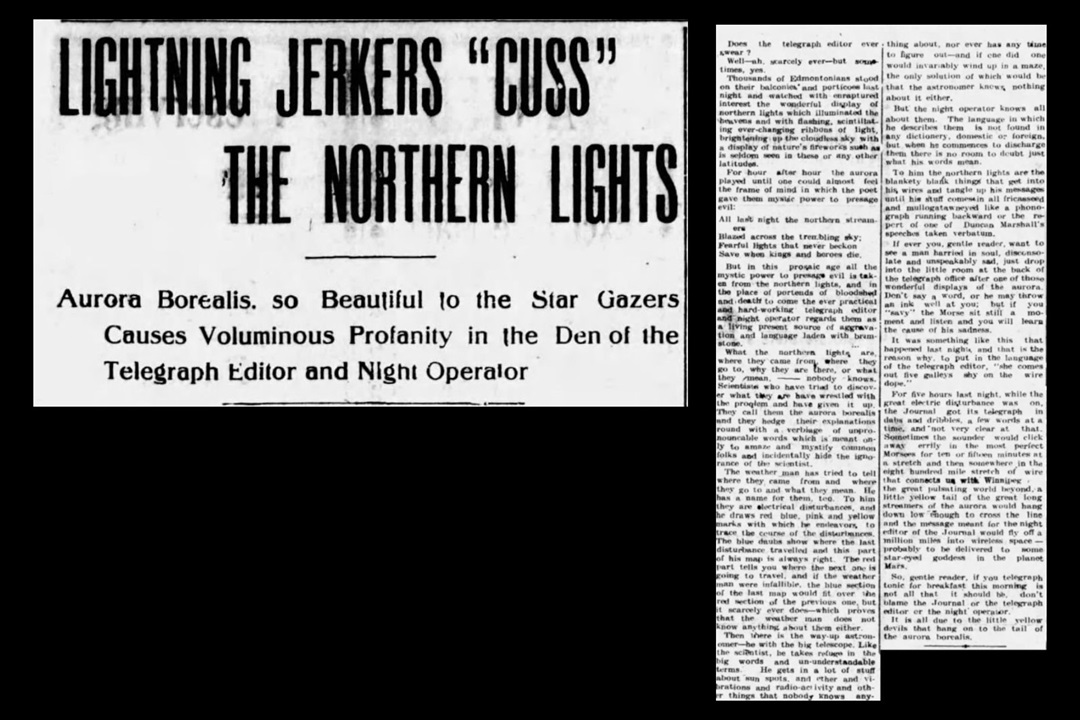
A moment in history: Sept. 12, 1908
On this day in 1908, an Edmonton telegraph operator was cursing his nemesis — the northern lights.
In a tongue-in-cheek article, the poor beleaguered operator (or "lightning jerker," which was apparently their nickname at the time), was fed up with the aurora borealis. He complained that while the heavenly light show might fascinate scientists and capture the attention of sky watchers, the magnetic phenomenon also leads to garbled telegraph messages.


In our ultra-connected world of 2025, it's funny to think about a poor lightning jerker shaking his fist at the sky and cursing the northern lights. But as antiquated as the telegraph is now, it's easy to forget just how important the technology was to early Edmontonians.
When telegraph service first came to the growing settlement in 1879, Edmonton was connected to the telegraph station in Hays Lake, Alberta. It would still be a few years until rail service arrived in Edmonton, meaning it could take months to receive information from the eastern part of the country via land or river travel. But then, in 1879, more than 2,000 kilometres of telegraph line connected Edmonton to Winnipeg, allowing for fast updates on the news in the rest of Canada and the world.
But telegraph communication didn't always work. For the first few years, the system was notoriously unreliable. In addition to disruptions from the northern lights, the telegraph service was frequently interrupted by poles falling over due to high winds or unstable ground. (In fact, apparently winter was the most reliable time due to the poles freezing in place.) Eventually, the line across the Prairies was rerouted to follow newly constructed rail lines, eliminating some of those problems.
The first operator for the government-owned Dominion Telegraph Service was Alex Taylor, a businessman who would play some part in most of Edmonton's public utilities. It took a while for Taylor to establish a permanent place for his telegraph office — it was temporarily set up in the log cabin of businessman John Walter, before being moved to Fort Edmonton. Eventually, Taylor would move to a small, meagerly equipped building and slowly build up the telegraph infrastructure.
The residents of Edmonton were hungry for news from the east, and Taylor made good use of his connection. He would compile updates from Winnipeg and send them along to the store owned by Frank Oliver for customers to read. These updates would eventually become the town's first newspaper, the Edmonton Bulletin.
The telegraph also kick-started the technology that would eventually replace it; Taylor encouraged the Canadian government to build Edmonton's first telephone line between the telegraph office and St. Albert. New lines would soon connect to Fort Edmonton and, eventually, private businesses. The lines would eventually be sold to the city in 1904, becoming its first public telephone company.
The telegraph remained an important part of keeping Edmonton connected into the start of the 20th century. However, as telephone technology improved and radio broadcasts became more commonplace, the usefulness of telegraph service started to decline. The federal government would eventually discontinue the service in 1923.
Communication is an often-overlooked part of a city's history, but technologies like the telegraph and later the telephone were a vital link for Edmonton to the rest of the world. The way these technologies keep us connected continues to be a subject of fascination for us — earlier this summer, a telephone-based public art installation based around these themes received international recognition.
This clipping was found on Vintage Edmonton, a daily look at Edmonton's history from armchair archivist Rev Recluse of Vintage Edmonton.

Happenings: Sept. 12, 2025
Here are some events happening this weekend in the Edmonton area.
- Sept. 12: Edmonton's Mayoral Debate starting at 5pm at JW Marriott (Edmonton ICE District)
- Sept. 12-14: AsiaFest YEG at Currents of Windermere
- Sept. 13: Perennial Exchange starting at 10am at Edmonton Horticultural Society
- Sept. 13: Sport Central BIKE DRIVE starting at 10am
- Sept. 13: Riverdale Apple Cider Celebration starting at 11am at Riverdale Community Hall
- Sept. 13: Annual Donation Drive: Fun Fair Carnival starting at 11am at On Side Restoration Services
- Sept. 13: Yoruba Gbo De Festival starting at 10am at Churchill Square
- Sept. 13: A City for Life - Community Conversation on Inclusive Transportation starting at 1pm at Centennial Centre for Interdisciplinary Science
- Sept. 13: SoulFire starting at 8pm at Yardbird Suite
- Sept. 13-14: Down by the River Festival at Louise McKinney Riverfront Park
- Sept. 14: Lady Flower Gardens Music Festival starting at 1pm at Lady Flower Gardens
- Sept. 14: Script Salon: Tough Guy starting at 7:30pm at Holy Trinity Anglican Church
And here are some upcoming events to keep in mind:
- Sept. 20: Civida Housing Foundation Stars Awards Gala at Art Gallery of Alberta
- Sept. 25: ECAMP Trivia Night: Elections Edition at The Canadian Brewhouse (Edmonton North)
- Oct. 2: Get to Know Day at InnoTech Alberta
Visit the beta version of the Taproot Edmonton Calendar for many more events in the Edmonton region.

The Taproot Mini - No. 49
Test your crossword prowess and deploy a little of your Edmonton knowledge. Complete the puzzle.
If you know a crossword fan who would get a kick out of a daily puzzle, encourage them to sign up for The Pulse!
The Taproot Mini is brought to you by ATB, your homegrown source of good advice to help conquer life's tougher puzzles. Learn how.
