The Pulse
Sept. 30, 2025

Here's what you need to know about Edmonton today.
Some voters told Taproot that reconciliation with Indigenous nations matters for their vote
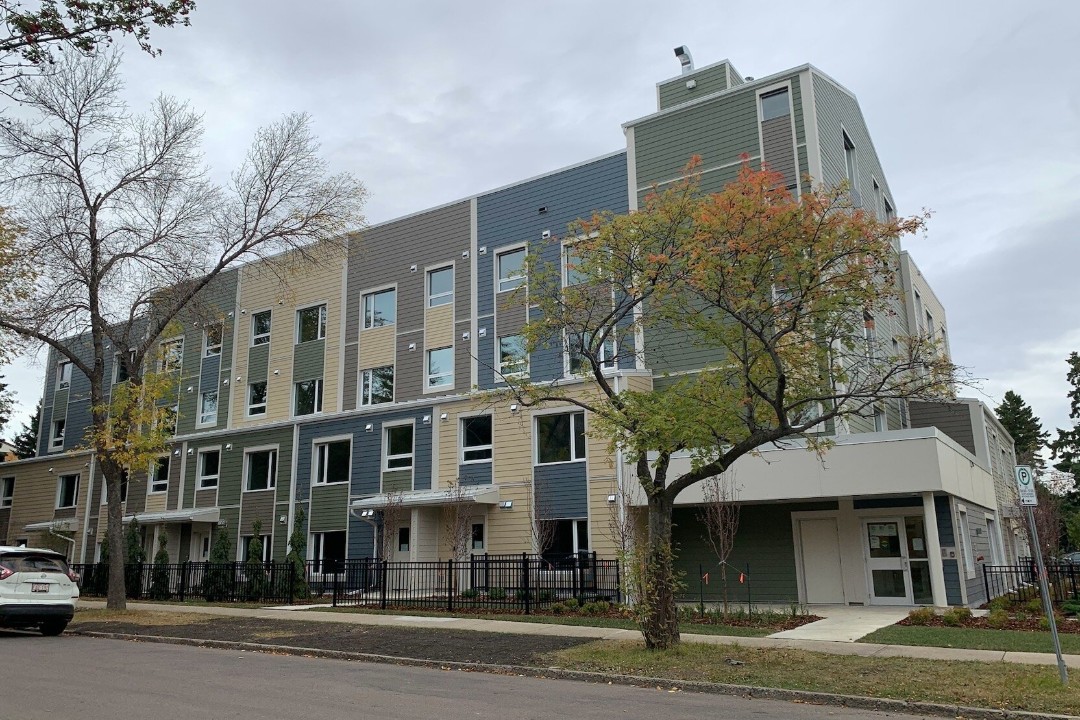
The growing responses to Taproot's listening work in the lead up to the municipal election on Oct. 20 reveal that some voters expect results rather than rhetoric when it comes to how the city reconciles with Indigenous nations and peoples.
Edmonton and its residents are all treaty people because the city resides on Treaty 6 land. The city, province, and Canada itself were built atop Indigenous territory in ways that led to significant harm. In Edmonton, the damaging legacies include the Camsell Hospital, which housed Indigenous people from across Canada for tuberculosis treatment, often against their will, the large number of residential schools in Alberta, and the forced removal of the Papaschase people from what's now partially Mill Woods.
Earlier this year, Taproot launched our listening campaign at several in-person and virtual events, and we posted a 2025 election question on our site. We have been gathering responses ever since, and at last count, more than 925 people have provided them. The listening was built around a simple question: "What issues do you care about as you consider who to vote for in the 2025 municipal election, and why?"
Roughly 20 people told Taproot that reconciliation with Indigenous nations and peoples will inform who they will vote for on Oct. 20. Many of these respondents tied reconciliation and Indigenous peoples with other points, including being more critical of police funding, supporting cultural heritage, building appropriate housing, protecting Indigenous women and children, and supporting Indigenous leadership and indigeneity.
One respondent said they will vote for candidates who support "meaningful movement towards defunding the police, addressing anti-Blackness, Islamophobia, and Indigenous discrimination." They added that they want to see Edmonton "prioritizing Indigenous reconciliation in all policies."
Another said they will vote for candidates who support the city building diversified affordable housing. "We need to build affordable housing for larger and extended families that reflects their needs. This requires new approaches to housing that take into consideration the worldviews, architecture, and family structures of Indigenous and new settler communities."
When it comes to candidates, Indigenous reconciliation has not been a dominant talking point. Recently, Shani Gwin, founder and CEO of pipikwan pêhtâkwan, said in a post that mayoral candidates have mentioned Indigenous peoples, but have done so "usually in regards to overrepresentation in houselessness or when they discuss 'safer cities.'"
Gwin continued: "What has been disappointing to see is the lack of any Indigenous representation of community members in campaign photos or videos WITH the candidate. If there was, that may signal to me there's relationship building or investment … or that we are even an important community worth your campaign time … This is not enough."
Taproot has worked to explain where Edmonton is at when it comes to Indigenous reconciliation and its relationship with Indigenous peoples and nations.

Step In. Step Up. Step Forward.
Edmonton Startup Week returns Oct. 6 to 10. Five days of workshops, socials, and events celebrating the vibrancy of the startup community in Edmonton. It's a time to build connections, discover what is possible, celebrate new companies, and inspire entrepreneurship in all of us.
Headlines: Sept. 30, 2025
- Members of the Alberta Teachers' Association (ATA) overwhelmingly rejected a tentative agreement with the province, with 89.5% of 43,362 votes cast opposing the deal. The union, representing 51,000 public, Catholic, and francophone teachers, said a strike could happen on Oct. 6 if no new agreement is reached by that date. Talks between the two sides have been contentious. The strike would disrupt classes for more than 700,000 students across Alberta.
- The Edmonton Police Service confirmed that a suspicious fire on Sept. 29 at a home in the Canora neighbourhood was the same duplex it searched earlier this month in connection with the missing person case of 15-year-old Samuel Bird. While the fire's connection to Bird's disappearance, which police have deemed suspicious, is unknown, investigators are treating the fire as suspicious and are seeking information about a white cargo-style minivan. Edmonton Fire Rescue Services reported no injuries.
- Kalen Anderson, one of Edmonton's City Plan creators, says the document needs a "revamp" as the city's population grew 16% in five years, reaching its 1.25 million target in 2025, seven years ahead of schedule. Anderson, who is now CEO of BILD Edmonton Metro, suggests the new mayor and council, set to be elected in the Oct. 20 municipal election, should re-evaluate the City Plan, focusing on its economic growth chapters for job creation and partnerships. She emphasizes the plan should be treated as a guide, not a "dogmatic document," and council should heed public feedback, like concerns over the zoning bylaw.
- The University of Alberta reinstated law professor Florence Ashley a week ago, one week after placing the professor on non-disciplinary leave. The university initially cited community safety concerns regarding Ashley's social media posts about the Sept. 10 killing of conservative activist Charlie Kirk. A subsequent review determined no safety risk, leading to Ashley's reinstatement. Ashley, who was not asked to participate in the review, expressed concerns that the university's actions aimed to suppress free speech.
- Misericordia Hospital in Edmonton unveiled an Indigenous healing garden for patients and their families. The new garden features plants known for their Indigenous healing properties, as well as a fire pit and water feature.
- John de Ruiter, a self-styled spiritual leader, and his wife Leigh Ann de Ruiter are scheduled for an "exceptionally long" four-month jury trial on six counts of sexual assault. Defence lawyer Dino Bottos stated the length of the trial, set for Jan. 19 to May 29, is due to six complainants and extensive evidence. De Ruiter was initially charged in January 2023, with police alleging he told female followers of his Oasis Group/College of Integrated Philosophy that sexual activity with him would lead to "spiritual enlightenment." His wife was charged in March 2023 with the same six counts.
- Two senior Alberta Health Services (AHS) procurement officials, Jitendra Prasad and Blayne Iskiw, were briefly directors of a numbered company with ties to MHCare Medical, an Edmonton-based supplier that has received more than $600 million in AHS business since the pandemic, the Globe and Mail reported. Corporate filings in October 2022 showed Prasad, Iskiw, and Khalil Mraiche as directors. The company listed MHCare's Edmonton office as a registered address. This revelation adds to multiple ongoing investigations by the RCMP, the province's auditor general, and a retired judge into AHS's procurement decisions. Iskiw subsequently joined MHCare as a consultant in November 2022.
Edmonton's responsibilities on Indigenous relations: Where the candidates stand
Candidates are narrowly split when it comes to their responses to Taproot's candidate survey on Edmonton's responsibilities regarding Indigenous relations.
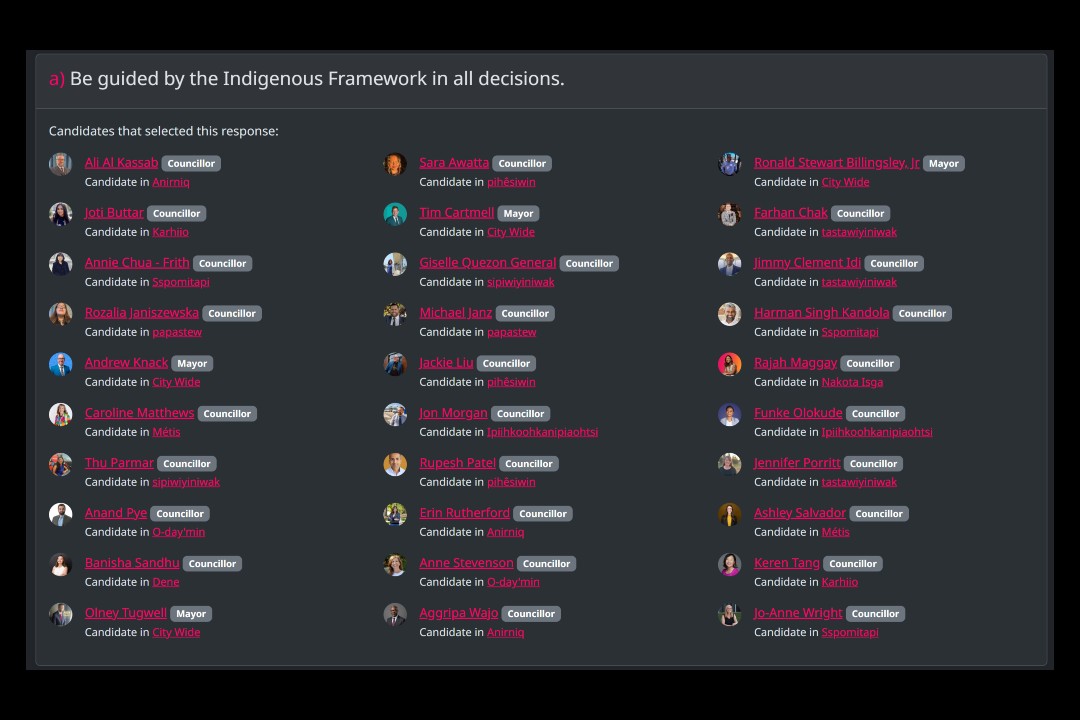
Thirty, or a slim majority of candidates for mayor and council who completed the survey, answered this question by choosing that they will Be guided by the Indigenous Framework in all decisions if they are elected. That framework holds the city to seven commitments, including supporting reconciliation, eliminating systemic racism, and making city spaces welcoming for Indigenous people and practices. Four mayoral candidates — Andrew Knack, Olney Tugwell, Tim Cartmell, and Ronald Stewart Billingsley, Jr — chose this option.
Twenty-four candidates, meanwhile, answered the question by choosing Engage with Indigenous communities on specific issues. Though this response option drew less support overall than the Indigenous Framework option, among candidates for mayor it was the most popular option, with seven — Abdul Malik Chukwudi, Andy Andrzej Gudanowski, Omar Mohammad, Rahim Jaffer, Tony Caterina, Utha Nadauk, and Michael Walters — choosing it.
Nine candidates selected a third option, which represented a break with established policies. If elected, they said they will Focus on core municipal services, leaving reconciliation to the federal and provincial governments. Council candidates Rob Fediuk, James Gosse, Justin Thomas, Jordon Woodruff, Stephen Hammerschmidt, James Miller, Larry Langley, and Fidel Ammar chose this option; Vanessa Denman, who's running for mayor, also did.
Two candidates said they did not have a position on this question: Paul Bakhmut, who's running for mayor, and Jesse Watson, who's running in Anirniq.
Ashok Sui, a candidate in Sspomitapi, did not answer the question.
As of this writing, 28 candidates for council and mayor have not completed the survey.
The context around the question is deep, historic, and ever changing. As Taproot offered for context in the survey, before Edmonton existed, Indigenous peoples used what became the city as a meeting place and home, and signed Treaty 6 with the Canadian government. This has made the city's relationship with Indigenous nations complex. At the end of the last council's term, Edmonton adopted the Indigenous Framework. It sought to balance city processes with Indigenous approaches, and has led to basics like allowing smudging in recreation facilities, and increasing awareness across the city's workforce. The city launched its Municipal Response Plan in 2022 to respond to the 94 calls to action in the Truth and Reconciliation of Canada report.
In 2024, Taproot reported that the city's work on Indigenous-led housing remains complex. As we reported recently, some voters who answered our election question said reconciliation with Indigenous nations matters for their vote.
For more on Edmonton's 2025 municipal election — from where candidates stand to voting info — visit edmonton.taproot.vote. There you can complete the Taproot Edmonton Survey and immediately see which candidates for mayor and council in your ward align with your views.
Métis: Where the candidates stand on the Taproot Survey
Taproot asked candidates to complete a 30-question survey covering a wide range of topics relevant to Edmonton's next city council. It was informed by the 900+ responses to our election question, insights gathered at listening sessions, input from our election partners, and our own observations of what Edmonton's next city council will face.
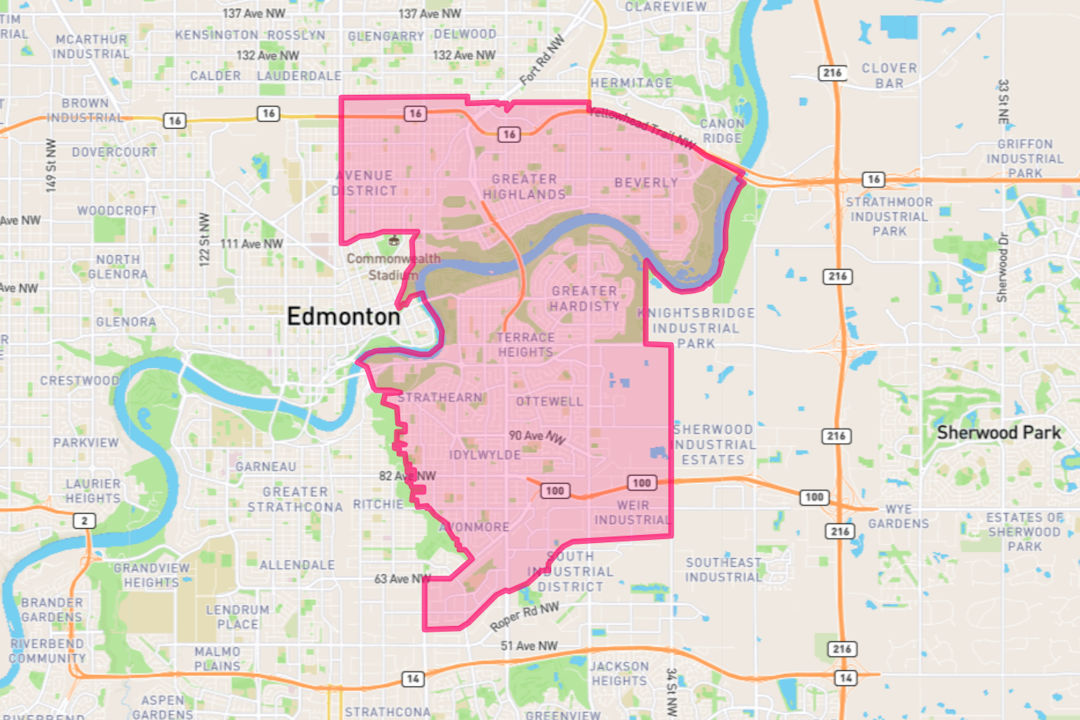
Here are the answers we've received from the candidates in Ward Métis:
Want to see which candidates best align with you on the issues that matter most? Take the survey and find out.
For more coverage of the 2025 municipal election in Edmonton, visit edmonton.taproot.vote.
Happenings: Sept. 30, 2025
Here are some events happening today in the Edmonton area.
- National Truth and Reconciliation Day at various locations
- Marketing for Hippies 101 Daylong Workshop - Live starting at 9am at Creative Hive
- Time In Lines - Poets Explore Our Region's History starting at 6:30pm at Bison Lodge
- Edmonton AI, Tech & Finance Networking Event starting at 7pm at GRETA Bar YEG
And here are some upcoming events to keep in mind:
- Oct. 2: Inclusion in the Heartland - The Value of Difference Conference at Dow Centennial Centre
- Oct. 8: interVivos Presents: A Municipal Affair at 9910
- Oct. 11: Public Art Walking Tour at Tawatinâ Bridge
Visit the beta version of the Taproot Edmonton Calendar for many more events in the Edmonton region.

The Taproot Mini - No. 61
Test your crossword prowess and deploy a little of your Edmonton knowledge. Complete the puzzle.
This week's puzzles are themed for Canadian Finals Rodeo Week in Edmonton. Enjoy!
The Taproot Mini is brought to you by ATB, your homegrown source of good advice to help conquer life's tougher puzzles. Learn how.
