
The Pulse
Nov. 7, 2025

Here's what you need to know about Edmonton today.
Essentials
- -1°C: Cloudy. 30% chance of flurries early in the morning. Periods of snow beginning in the morning. Risk of freezing drizzle early in the morning. Amount 2 cm. Wind southeast 20 km/h becoming light in the morning. Temperature steady near minus 1. Wind chill near minus 8. (forecast)
- Red: The High Level Bridge will be lit red for Project Red Ribbon Campaign. (details)
- 8pm, Nov. 8: The Edmonton Oilers (6-5-4) host the Colorado Avalanche (8-1-5) at Rogers Place. (details)
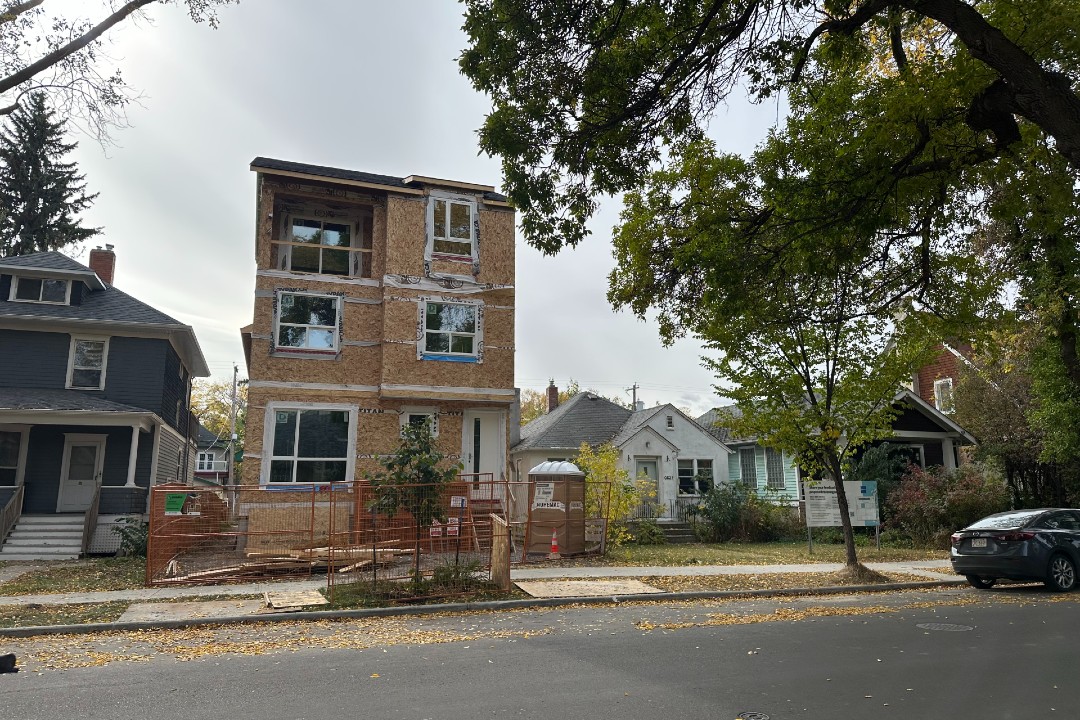
Groups target turning character homes into co-ops to protect neighbourhood heritage
Some residents of mature Edmonton neighbourhoods are working to create ways to preserve the character of their neighbourhoods by converting older homes into co-op housing.
Yasushi Ohki told Taproot that his company, Green Violin Community Development Company, is developing a model that would allow residents who want to preserve the character of their neighbourhood to pool money and purchase older homes, in part to prevent them from being demolished to make way for infill developments.
"(We could) get investors who have that lens — they love living here, they want to preserve their own property value by maintaining this cute neighbourhood," he said. "Not to be trite, but you know — quaint, cute, historic, nostalgic, romantic — any one of those words on what describes what we love about neighbourhoods."
There are about 40 emerging and established community land trusts in Canada, including the Calgary Urban Indigenous Land Trust and Canmoreland CLT.
While Ohki has been primarily working with people living in the Allendale neighbourhood, some Garneau residents are interested in seeing the model in their neighbourhood. Jillian Ames is a housing researcher at the University of Alberta and has lived in Garneau for about a year.
Ames said while she isn't opposed to dense housing types in a central, transit-rich community like Garneau, she believes some family-friendly homes should be preserved. "I think that we do need to be conscious of the community that we're trying to move towards and have a vision, and make sure that we're covering all (housing types) and not just letting big developers with all the dollars come in and dictate what the fabric of the community ends up being," Ames said.
On a related note, the Garneau Community League has launched a private house registry to connect prospective buyers to owners looking to sell in the neighbourhood. "This registry is not for investors or speculative buyers," the league said on its website. "It's for people who want to make Garneau their home, and for sellers who want to pass their house on to someone who will truly be part of the community."

Don't miss this family-friendly festival Downtown
Kick off the holiday season with Downtown Winterval, a festival that brings 104 Street to life with sleigh rides, ice-carving lessons, photos with Santa, and live music. New this year, we've got street hockey for the kids, all on a street-wide patio! Join us Nov. 22 from 3pm to 8pm.
Headlines: Nov. 7, 2025
- Edmonton city council faced mixed reviews regarding its decision to allocate $1 million for a new day shelter. The funding decision, aimed at addressing homelessness in the city, drew varying opinions from stakeholders. Some advocates, like Niginan Housing Ventures CEO Keri Cardinal, argue that housing-first solutions with social supports are more effective, while others see the funding as a positive step toward addressing systemic issues. The city is now consulting social agencies to determine how quickly the new shelter measures can be implemented.
- Edmonton Police Service Const. Renzo Geronimo faces several charges, including sexual assault, unlawful confinement, being unlawfully in a dwelling house, and breach of trust following a two-year investigation by the Alberta Serious Incident Response Team. The police watchdog began its probe on Sept. 8, 2023, into an allegation of on-duty sexual assault. Geronimo, a five-year veteran of the police service, is currently in a non-front-line role, with his duty status under review. His next court date is set for Dec. 10.
- The Alberta Teachers' Association (ATA) launched two legal challenges on Nov. 6 against the province's back-to-work legislation, Bill 2. The first seeks an injunction to temporarily halt Bill 2, which forced teachers back to work on Oct. 29, ending a three-week strike. The second is a constitutional challenge against the Alberta government's use of the notwithstanding clause to pass the legislation. ATA president Jason Schilling said the clause undermines collective bargaining rights guaranteed under the Charter of Rights and Freedoms. Bill 2 imposed a previously rejected wage deal and includes fines for non-compliance. Justice Minister Mickey Amery said the government will defend the legislation, emphasizing its aim to ensure "finality" and return children to school.
- Conservative MP Matt Jeneroux, who represents the federal riding of Edmonton Riverbend, announced his resignation from the House of Commons on Nov. 6. This decision follows rumors that he was considering crossing the floor to the Liberals and makes him the second Conservative MP to depart the caucus this week, after Nova Scotia MP Chris d'Entremont joined the Liberals. Jeneroux, first elected in 2015, cited a need to focus on his family and expressed disappointment with the outcome of the recent election. His resignation will trigger a byelection for his Edmonton seat.
- The Edmonton Oilers will host a public autograph session at West Edmonton Mall on Nov. 27, from 6pm to 8pm. The full team roster will be available to sign personal items or team-issued cards. The first 300 fans at Connor McDavid's and Leon Draisaitl's stations are guaranteed an autograph, with McDavid exclusively signing custom Upper Deck cards. OEG and West Edmonton Mall partnered for the free event, which limits fans to one signature per player.
- The Alberta Serious Incident Response Team (ASIRT) has cleared RCMP officers who fatally shot 15-year-old Hoss Lightning in Wetaskiwin on Aug. 30, 2024. In a report released Nov. 6, the police watchdog concluded the officers were justified, believing Lightning was pointing a gun from inside a backpack. Lightning, from Samson Cree Nation, was reported missing from an Edmonton group home and had called police, was shot at up to 17 times after appearing to point a backpack at an officer, though no gun was found. ASIRT acting executive director Matthew Block stated officers acted reasonably. Lightning's family called the report "biased and contradictory."
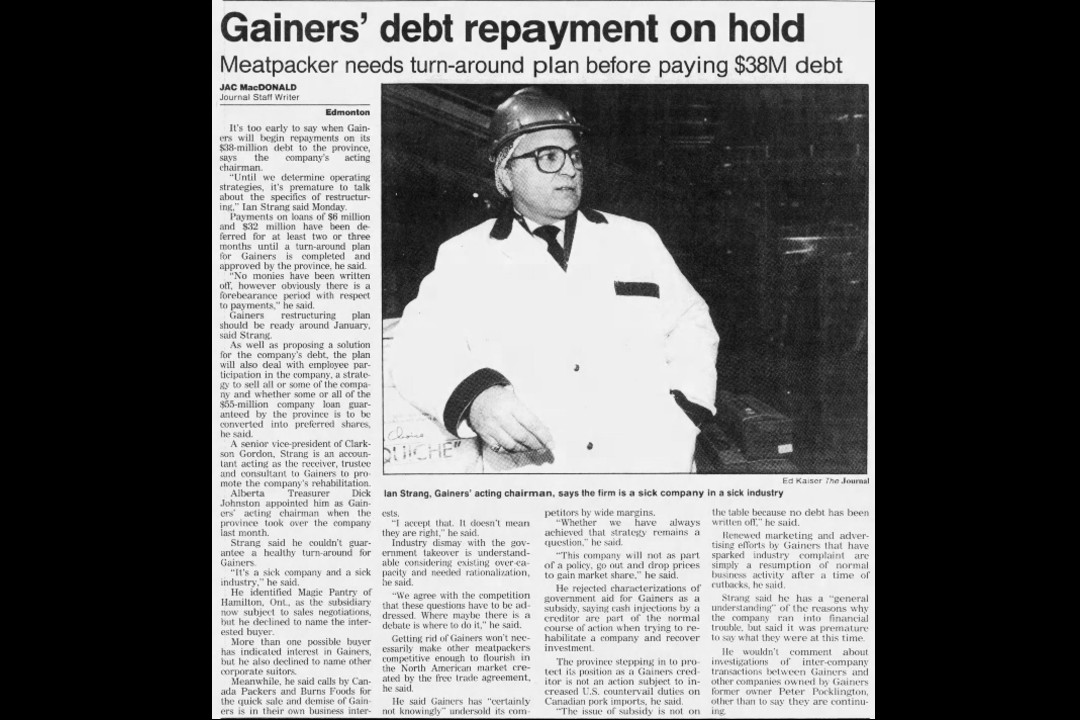
A moment in history: Nov. 7, 1989
On this day in 1989, the Gainers meatpacking plant was restructuring — just years after it played host to one of the longest and most heated strikes in Alberta's history.
The meatpacking plant's financial and labour battles were big news in the 1980s, but the meatpacking industry has been a central part of Edmonton's development since its early days.
In the late 1880s and early 1900s, two areas just beyond Edmonton's borders became major hubs for the meat industry: One north of the river, and one south of it. To the north was an area that became known as Packingtown. In 1908, the Swift plant opened in the village of North Edmonton on the outskirts of the city along Fort Road. A few years later, the Burns company opened another plant. The tiny village grew rapidly as workers settled near the plants, leading to retail shops, cafés, and other businesses setting up along Fort Road. When the railway was extended to North Edmonton, cattle could be brought to the plants faster and more efficiently, leading to the stockyard there becoming the second-largest in North America. In 1912, the city absorbed North Edmonton, and the meatpacking industry in Packingtown and other parts of Edmonton continued to grow. In 1936, Canada Packers built another massive facility in the area, employing 1,000 workers at its peak.
While Packingtown is best known, there was also a substantial meat industry to the south in Strathcona. In 1891, John and Amy Gainer arrived in Alberta and opened a small dairy at their home near present-day Whyte Avenue. Seeing the growing demand for meat in the expanding city, the pair soon added a slaughterhouse to their operations.
The small abattoir grew into a successful business, and Gainer replaced his modest wooden shop with the two-storey brick Gainer Block in 1902. The building not only had more space, but also held the offices needed to manage his growing meatpacking business, which by then had expanded along the Mill Creek ravine. Soon, other slaughterhouses opened in the area, taking advantage of the ravine to move and store hundreds of pigs, sheep, and other livestock. The sounds and smells of the meatpacking operations became part of life in neighbourhoods like Ritchie.
Meatpacking remained a significant industry in Edmonton into the latter half of the 1900s, especially after the Second World War, when rising wages led to more demand for meat. The Gainer company grew into a massive operation, but as other plants opened in other parts of the province, it began to decline.
In 1972, the Gainer family sold the Gainers plant, which was resold a few years later to Peter Pocklington, then the owner of the Edmonton Oilers. Pocklington made sweeping changes. He moved the plant north and bought out Swift, a competitor, merging the two companies. This made the Gainers plant one of the largest meatpacking operations in Canada, with annual sales reported at around $800 million. But it also led to discontent among workers, who complained of mistreatment and low pay. This ultimately led to the strike.
In June 1986, more than 1,000 Gainers workers went on strike, following Pocklington's plans to cut wages and eliminate pensions. The strike lasted nearly seven months and gained national attention. Pocklington took an aggressive stance, hiring replacement workers, and expressed his desire to break up the union. Clashes between protestors and police turned violent, and more than 400 union members were arrested. Protestors criticized the provincial government, particularly for its restrictions on picketing and weak response to what they said was Pocklington's bad-faith approach to negotiations. The strike also led to a nationwide boycott of Gainers products.
Eventually, due to government pressure, Pocklington and the union reached a deal that saw workers rehired and some demands met, though many workers were unhappy with the deal. Two years later, the provincial government provided a $65-million loan to the company, in part to fund the construction of a new plant. Some have described the loan as a bribe for returning to the negotiating table. The company later defaulted on the loan, and the promised new plant never materialized.
Edmonton's meatpacking industry, once a significant part of the city's economy, has largely disappeared. Gainers was sold off and permanently closed in 1997, one of a wave of closures that hit the big plants in the 1990s and 2000s. The Gainers strike remains one of the most important and memorable events in the history of labour activism in Alberta. Almost 40 years later, the province finds itself in another era of labour action, following the United Conservative Party government's use of the notwithstanding clause to force striking teachers back to work in October, and the growing signs of a looming strike by some provincial nursing staff.
This clipping was found on Vintage Edmonton, a daily look at Edmonton's history from armchair archivist Rev Recluse of Vintage Edmonton.

Happenings: Nov. 7, 2025
Here are some events happening this weekend in the Edmonton area.
- Nov. 7: Oh, Henny! A Queer Cabaret at Grindstone Theatre
- Nov. 7: The Carrot Friday Nite Live presents Drifting Tunes starting at 7pm at The Carrot Community Arts Coffeehouse
- Nov. 7: Canada's Drag Race Takeover: Goodbye to 103 starting at 8pm at Evolution Wonderlounge
- Nov. 7-10: natHacks at University of Alberta (Donadeo Innovation Centre For Engineering)
- Until Nov. 8: YIKES! Film Festival
- Until Nov. 8: Rocky Mountain Wine & Food Festival at Edmonton Convention Centre
- Until Nov. 8: Farmfair International at Edmonton EXPO Centre
- Nov. 8-9: NOSH Food Fest at Strathcona Community Centre and County Hall
- Until Nov. 9: Under $100 Art Show at Boardwalk Building
- Nov. 9: Book Launch: Erin McDougall starting at 2pm at Audreys Books
- Nov. 9: Script Salon: EDEN by Fran Kimmel starting at 7:30pm at Holy Trinity Anglican Church
- Until Nov. 11: Remembrance Week Guided Tours at Prince of Wales Armouries Heritage Centre
And here are some upcoming events to keep in mind:
- Nov. 11: Remembrance Day ceremonies
- Nov. 18: Sustainable and Scalable Affordable Housing online
- Nov. 20: Watching the World burn... and how to cope with grace at Arcadia Brewing Co.
Visit the beta version of the Taproot Edmonton Calendar for many more events in the Edmonton region.

The Taproot Mini - No. 88
Test your crossword prowess and deploy a little of your Edmonton knowledge. Complete the puzzle.
The Taproot Edmonton Calendar is full to the brim of events listings like the one in 1-Across!
The Taproot Mini is brought to you by ATB, your homegrown source of good advice to help conquer life's tougher puzzles. Learn how.
