
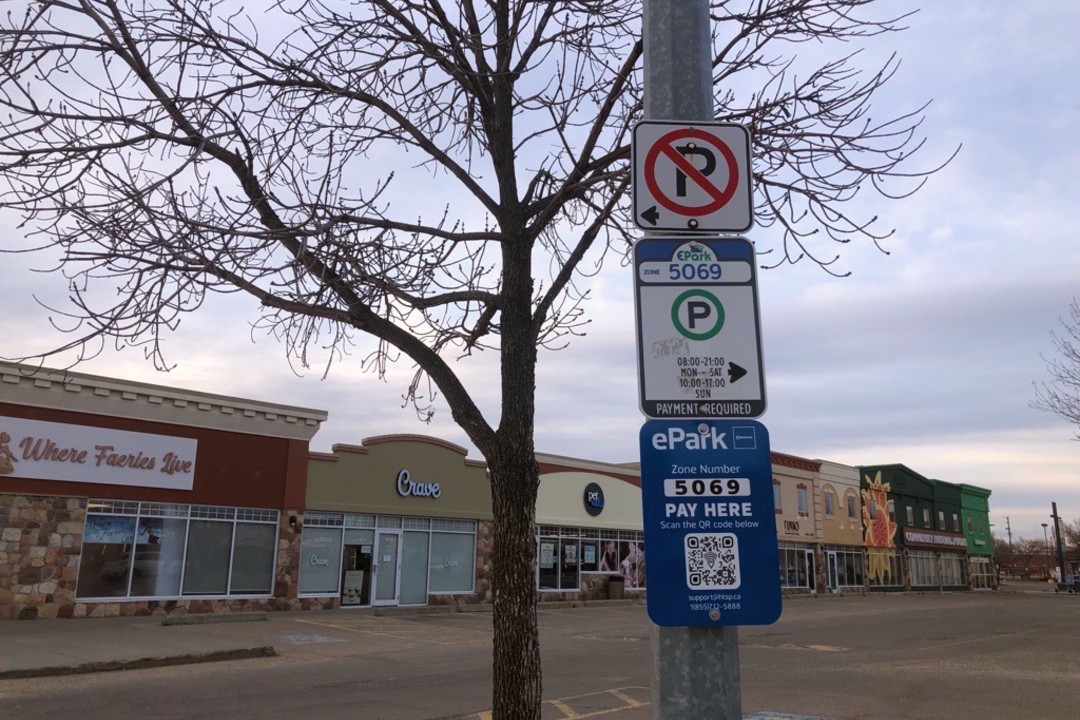
An audit found that Edmonton lacks formal guidance for setting parking rates, providing free or discounted parking, and managing residential parking restrictions. Administration has accepted all three recommendations. (Stephanie Swensrude)
On the agenda: Parking audit, lodging houses, McKernan rezoning
This week, councillors will review an audit of city parking operations, consider tighter rules for lodging houses, and evaluate a rezoning in McKernan across from the Cross Cancer Institute.
There is an audit committee meeting on Sept. 14 and a public hearing on Sept. 15, both starting at 9:30am. On Sept. 16, council services committee meets at 9:30am, followed by a continuation of the Sept. 8 city council meeting at 1:30pm.
The Sept. 15 public hearing includes four items postponed from Aug. 25: rezonings in Glenwood and Inglewood, a road closure in Alces, and a package of zoning bylaw amendments. Council heard from seven speakers on the Glenwood application before voting 10-0 to postpone it. The other three items were postponed 12-0 when council adopted the agenda, before debate.
Here are some key items on the agenda this week:
- An audit of parking operations found the city lacks a clear council-approved vision and formal guidance for rates, discounts, and residential restrictions. Auditors also found unexplained rate differences between areas with similar demand and inconsistent guest-permit rules. The city manages about 6,000 parking spaces and collected about $13 million in parking revenue in 2025. Administration accepts all three recommendations and plans to address them through its parking program modernization. The parking app contract was generally well managed, but auditors identified gaps in cybersecurity communication, occupancy data, and access to vendor performance data. Enforcement and fines were outside the audit's scope.
- Council will consider zoning bylaw amendments that would lower the threshold for a lodging house from four individually rented bedrooms to three. Lodging houses would be prohibited in row and multi-unit housing in the small-scale residential and small-scale flex residential zones, as well as in secondary suites. In the small-medium scale transition residential zone, they would remain allowed in multi-unit housing, with a cap of 12 bedrooms per lot, but not in row housing. Administration says the changes would improve enforcement, though lodging houses can be difficult to identify before occupancy. Since the beginning of 2024, the city has approved 12 permits for new lodging houses with four to eight individually rented bedrooms. Consulted groups said lodging houses can provide affordable, flexible, and culturally relevant housing, while stressing tenant protections and property maintenance. Whole homes rented to multiple tenants under one shared tenancy would remain allowed.
- Council will consider a rezoning at 11537 University Avenue NW in McKernan, across from the Cross Cancer Institute, to allow a building up to 16 metres tall, or about four storeys. The site is within 400 metres of the Health Sciences/Jubilee LRT station. Administration supports the application because it would allow more housing near transit, employment, and services. All 10 responses to the mailed notice opposed the application, raising concerns that included building scale, loss of sunlight and privacy, traffic, and parking.
An audit found that Edmonton lacks formal guidance for setting parking rates, providing free or discounted parking, and managing residential parking restrictions. Administration has accepted all three recommendations. (Stephanie Swensrude)
Here are some more key items:
- Council will resume its discussion of public engagement on the 2027-2030 budget and the city services and quality of life survey, after postponing both reports to Sept. 16. The budget engagement report found participants wanted a focus on core services but disagreed on what counts as core.
- Council services committee will consider three options for the 2027 meeting calendar. One would retain the current structure; another would move executive committee to Mondays and public hearings to mid-week where possible; a third would replace 19 one-day public hearings with 11 two-day hearings. That model would require more Thursday and Friday meetings but create three additional recess days. The final calendar report will go to council's Oct. 27 organizational meeting.
- A city audit found that the municipal fleet maintenance program effectively manages maintenance to meet the needs of departments using more than 5,000 vehicles and pieces of equipment. Auditors found one area for improvement: There is no formal process to track feedback on parts suppliers, making recurring problems harder to identify across garages. Administration accepts the recommendation. The program supports vehicles such as snowplows, fire trucks, waste trucks, and DATS buses, but excludes conventional transit buses and LRT vehicles.
- Audit committee will consider the Office of the City Auditor's 2027-2030 operating budget, starting at about $3.14 million in 2027, down $111,000 from the adjusted 2026 budget. It would retain 17 full-time-equivalent positions throughout the four years. A separate follow-up report says administration has closed 10 audit recommendations since the last update, leaving 27 outstanding as of Aug. 27, including four that are overdue.
- Administration will ask council to postpone the report on proposed active transportation network amendments to Dec. 8 to minimize service impacts for applicants at subsequent public hearings. Coun. Ashley Salvador's motion seeking active transportation funding options and Coun. Thu Parmar's proposal to examine shifting up to $220 million from neighbourhood renewal to arterial-road renewal remain listed as motions pending on the Sept. 8 selection sheet.
- Council's continuation also includes two postponed private discussions: one on public safety involving the Edmonton Police Service and peace officers, and another on an intergovernmental update concerning a provincial pre-budget submission and partnership opportunity.
And here are updates on some of the items we told you about last week:
- Council gave first reading to the bylaw establishing a tax subclass for derelict non-residential properties. It still requires further readings. Council also passed all three readings of the bylaw expanding the derelict residential subclass citywide, with eligible properties to be included starting with January 2027 assessment notices.
- Council approved funding for the Valley Line transition management office, supporting the transfer of Valley Line Southeast operations and maintenance from TransEd to the Edmonton Transit Service in 2027. The approved request includes about $7.7 million for the temporary office and $20.5 million for vehicles, tools, equipment, and operating systems for the expanding LRT network, funded from the LRT reserve. It excludes the payment to terminate the TransEd contract.
- Council approved the updated climate resilience policy and committee recommendations on climate implementation priorities. The policy update adds adaptation targets and a sustainable return-on-investment threshold for new city buildings. New funding for climate actions will be considered through the 2027-2030 budget process.
- Council approved the updated public art policy and committee recommendations on the heritage places strategy. The art update clarifies the basis for funding, including the collection's maintenance needs. The heritage update broadens the city's approach beyond built heritage to include natural, Indigenous, community, and cultural heritage.
- Council approved committee recommendations on the snow and ice control policy, including requests for 2027-2030 budget options to improve school-zone clearing and continue assisted snow removal.
- Following its review of the operating and capital financial updates, council voted 12-1 to request options for drawing down the Planning and Development Business Model reserve, along with any recommended changes to the related fiscal policy. Coun. Jon Morgan opposed the motion.
- Council gave first reading to the municipal tax relief delegation amendment, which would let the city assessor delegate decisions to directors and managers. It also passed the bylaw repealing municipal historic designation for the Arlington Apartments, whose remaining walls were demolished in 2008 after a 2005 fire.
Meetings stream live on YouTube on the Chamber channel and River Valley Room channel.
For more on how Edmonton's climate priorities connect to the upcoming four-year budget, listen to Episode 371 of Speaking Municipally, featuring an interview with Alberta Ecotrust's Mike Mellross.
Share