
Bikeology launches with push to design cycling with women in mind
A new non-profit is seeking to encourage more women and girls to ride bicycles by combining community events with advocacy aimed at making cycling infrastructure safer and more practical for all.
Heather Young-Leslie, president of the Bikeology Guild of Canada, told Taproot there are barriers, both physical and social, to women who want to get around by bike.
"For a lot of women, what they experience is that the bike world tends to be kind of testosterone-dominated with men of very good intentions," she said. "Whatever those reasons are, when it comes to designing urban infrastructure, when it comes to talking about who's going to use the infrastructure, the default assumption is that you are a fit male who is probably white, whereas we know that the bicycle, historically, has been this great democratizer."
Bikeology will hold an official launch on May 31 at the Garneau Theatre. Mayor Andrew Knack will proclaim "Women's Freedom to Cycle in Edmonton Day," and Jill Thomson will showcase her urban artscapes in the lobby before a screening of the documentary Women Don't Cycle and several bike-themed short films. A researcher will also present data about the use of bike lanes in Edmonton. Let's Bike There, a group of Edmonton moms who hold meetups for families using or interested in cargo bikes, will host a play date at Garneau Park before the screenings.
Young-Leslie was the organizer who brought the Ride of the Fancy Women to Edmonton in 2021, encouraging women to hop on a bike in their most fancy and feminine attire. Bikeology will host the next one on June 14.
Through Bikeology, Young-Leslie hopes to make the work year-round, and she would love to see it spread across Canada.
Men cycle to work at about double the rate of women, according to Statistics Canada, although the gap is narrowing. Census data shows the gap is even wider for those who are visible minorities. Research suggests high-quality cycling infrastructure can boost ridership, but infrastructure alone does not guarantee a more diverse cycling community.
Young-Leslie said the barriers can be especially high for women who have moved here from other countries. "There's a big, wide range of immigrant populations here — a lot of those women never had the opportunity to learn to ride a bike, and there's no support for an adult woman who wants to learn to ride a bicycle," she said.
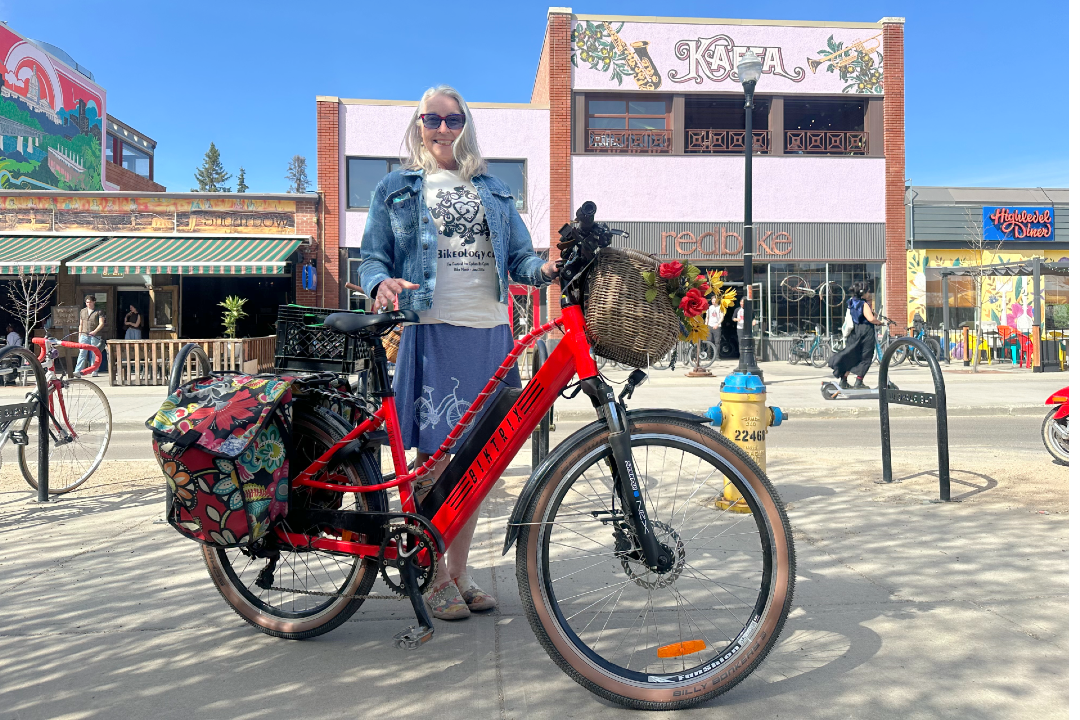
Heather Young-Leslie has launched the Bikeology Guild of Canada, a non-profit that advocates for women and girls in the cycling community. (Stephanie Swensrude)
Bikeology has been in contact with organizations such as the Africa Centre and the Newcomer Centre to build programs for women who want to learn.
Although Bikeology is officially launching on May 31, its members have already been active since last summer. They have participated in and hosted group bike rides, offering a chance for newer riders to get comfortable navigating city streets.
"For women in particular, social riding is a really great gateway to feeling more confident (about) using the street and the infrastructure," she said. "Those kinds of rides are really useful for helping to socialize people into what are good, safe bike-riding practices."
On top of hosting events, the organization will advocate to the city to consider women when designing cycling infrastructure, especially moms doing domestic labour such as running errands and shuttling children. Young-Leslie said a lot of the city's infrastructure is designed for fit young men who can easily manoeuver a curb cut or hop over small obstacles. But for a parent running errands in a cargo bike, subpar infrastructure can turn into a roadblock.
While daycares usually have parking spots for people driving to drop off and pick up kids, they often lack good cargo bike parking, Young-Leslie said. She would also like to see more bike-detection lights at intersections so riders don't need to press the pedestrian button to get across. And she wants council to reconsider the $250 fine for riding a bike on the sidewalk, especially in areas where there aren't safe alternatives.
These changes would improve cycling conditions for people of all genders and ages, not just women, she said.
"That's exactly the reason why you need safe bike infrastructure, because you're not seeing kids, you're not seeing mothers with their kids on the back of their bike, not seeing dads with their kids on their bike," she said. "You're not seeing the range of people who would be using a bicycle, and that's the voice that we want to be prioritizing."
Share