
Volunteers start looking at repairs for unpaved trails in river valley
Edmonton's unpaved trails have seen extensive damage due to the record rainfall so far this summer, says the head of the volunteer group that maintains them.
"We've had reports of some trails that are on slopes just collapsing … it's been pretty disruptive on the natural surface trails in the river valley," said Joe Yurkovich, president of the Edmonton Mountain Bike Alliance.
Edmonton's river valley and ravine system has unpaved single-track trails, which are generally maintained by the EMBA, and paved double-track trails, which are maintained by city crews. Users of Trailforks, a website for reporting conditions on both unpaved and paved trails, have recorded several sections of both types of trail that are flooded, eroded, blocked by trees or landslides, or closed completely. The city has directed trail users to check its cautions and closures app for up-to-date information, but as of publication time, the map is not entirely current.
Edmonton broke its record for the wettest summer ever as of July 27. The city was soaked with 580 millimetres of rain in June and July alone — much more than the average annual rainfall of 423 millimetres. Much of the rain has come during severe thunderstorms, which means the trails are not only soaked and muddy, but could be blocked by downed trees or branches.
The EMBA has an agreement with the city that allows it to maintain more than 150 kilometres of unpaved single-track trails in the river valley and ravine system. This involves trimming branches, removing fallen trees, smoothing out ruts, and repairing wooden trail features. These aren't just the steep trails cut into a slope that you might see mountain bikers careening down — it also includes mellow trails often used by walkers to get to more secluded parts of the river valley.
But it's been hard to get out and maintain the trails due to all the rain, Yurkovich said. "People are expecting this is going to continue, just with all of the water saturated on the ground and getting hot weather, it's going to produce more storms, so we're not all that optimistic that there's an end in sight," he said. "But when we get the opportunity, we go out there, and we do work on the trail." He added that the weather has also delayed the construction and opening of the alliance's new mountain biking skills park in Queen Elizabeth Park.
Coreen Shewfelt of Bike Edmonton said the destroyed trails have had a big impact on cyclists who rely on them for transportation, not just recreation. "There's definitely been a lot of challenges navigating the river valley lately on all the trails because of all the water we've had," she said.
Shewfelt said there's been a lack of information available on closed routes, including in Mill Creek Ravine, which flooded several times near the end of July. "Nobody had put out any information about that. There was no signage or closures or anything on that trail, and so people were just going down there and then just hitting the brakes," she said. The city said some areas might not immediately have signage due to the ongoing emergence and extent of closures.
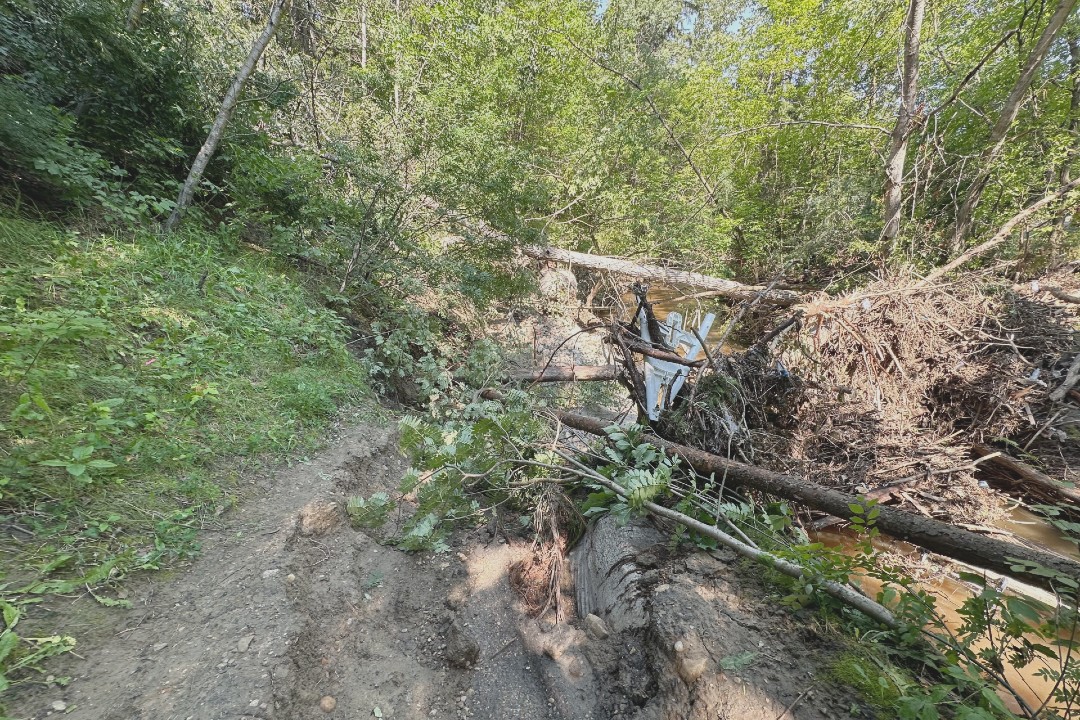
A trail in Mill Creek Ravine now comes to an abrupt end, as it has been partially washed away and blocked by deadfall. (Stephanie Swensrude)
Shewfelt said she was worried about the city's priorities in restoring active transportation infrastructure after weather damage. For example, she said, there was a tree down on 83 Avenue, "one of the busiest bike routes in Edmonton," and it blocked the bike lane for more than 48 hours. "I realize this is a lot, we've had record rainfall, it's really hard to keep up," she said, but she wondered why the bike lane stayed blocked for so long, especially since the car lane was cleared earlier.
The flooding issues have led some trail users to cut new paths to get around puddles. However, Bike Edmonton and EMBA advise against this because it can damage the environment. Trail braiding happens when people step or ride off a main path to avoid mud or puddles, creating multiple smaller paths that can accelerate soil erosion, destroy native plants, and widen the footprint of the trail.
Erosion can be particularly bad in Edmonton's natural spaces compared to other regions because of the composition of the soil, Yurkovich said. "We've got a lot of clay and organic soil, so when it rains, it takes quite a while for those trails to dry out, and if people go on them and ride or run or walk, they leave bike tracks or footprints, and that just takes up more volunteer time to rehabilitate that."
The EMBA is asking river valley users to stay off trails when they're muddy or wet.
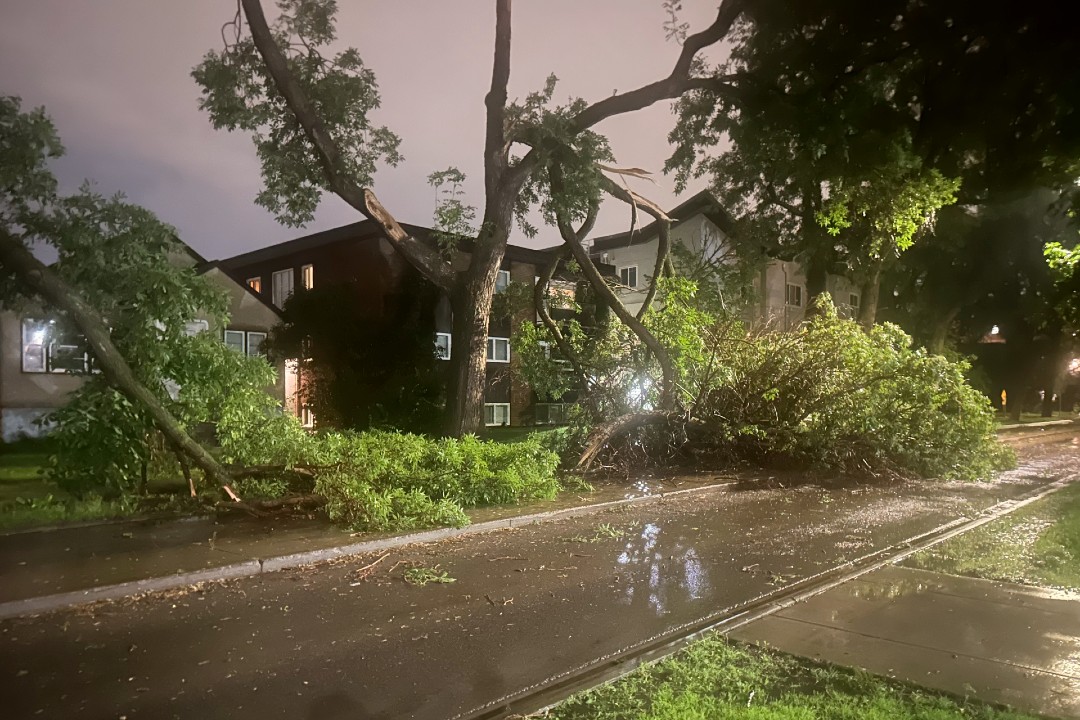
A tree blocks the road and bike lane on 83 Avenue shortly after a severe thunderstorm on July 25. The tree was still blocking the bike lane for several days. (Stephanie Swensrude)
After the opening of the mountain bike park, which is now scheduled for the beginning of September, Yurkovich said the organization plans to broaden its volunteer base and board members to include more general trail users, including those from other athletic groups.
"We're all trying to promote the river valley, we all enjoy being out in the river valley, we want it preserved as a natural space, and we're all interested in preserving the trails," he said.
Yurkovich added that he hopes the change will contribute to a positive public perception of those using the river valley, whether it's on two wheels or on foot.
"Too often you see something like, 'the mountain bikers versus, say, conservationists.' That's not really the case," Yurkovich said. "People want to be out in the river valley — it's a fantastic amenity, and it contributes greatly to the quality of life."
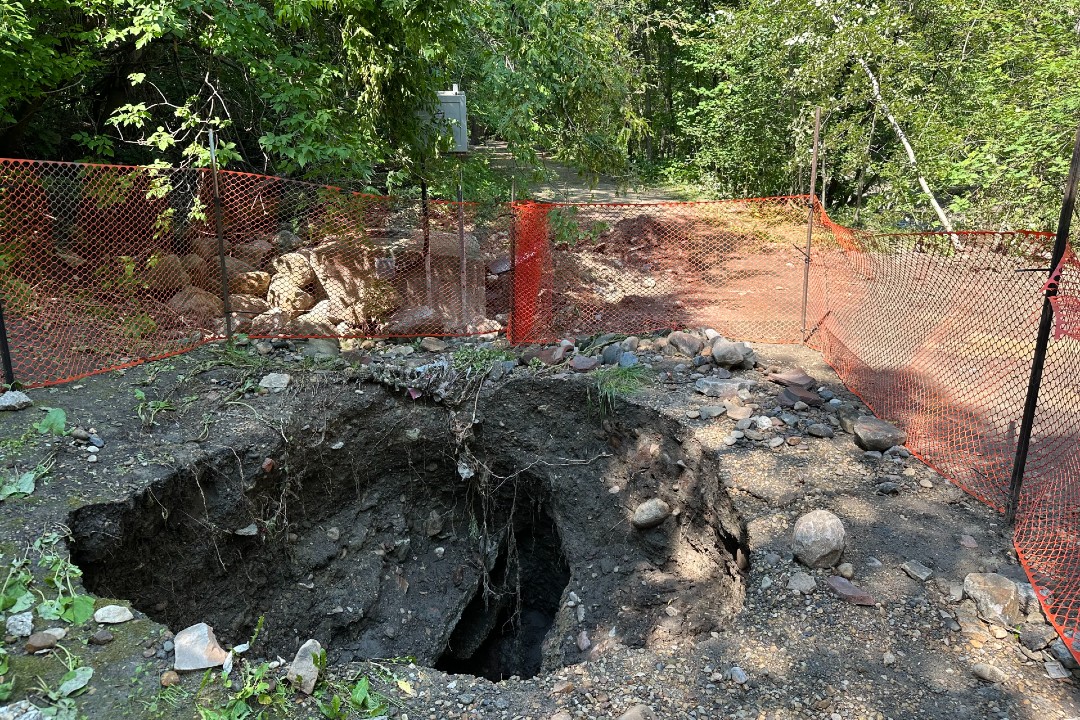
A sinkhole on a trail in Mill Creek Ravine on July 29. (Stephanie Swensrude)
Share