
On the agenda: Snow, climate, heritage
This week, councillors will review new climate action priorities, a proposed update to the snow-and-ice-control policy, and a new heritage places strategy.
There is a community and public services committee meeting on Aug. 31, an urban planning committee meeting on Sept. 1, and an executive committee meeting on Sept. 2.
Here are some key items on the agenda this week:
- Administration will present an updated policy and program for snow and ice control after a scheduled review. Resources and service levels this winter are expected to remain consistent with previous years; however, council can choose to fund an enhanced service level starting in winter 2027-2028. Administration said the "well maintained city" service package would stabilize operations and create year-round positions to provide festival and event support, "ensuring consistent, high-quality services that keep Edmonton's economy moving throughout the year." Council will vote on the policy at a future meeting. During record snowfall in the winter of 2025-2026, Mayor Andrew Knack said he wanted to significantly increase funding for snow clearing.
- A third-party review of the city's climate strategies and action plans highlighted the need for more focused actions, closer alignment with the municipal budget cycle, and better monitoring and evaluation, says a report set to be presented to executive committee. Administration has identified 27 action items in its update to the climate implementation priorities. The report says the first priority is to establish an ongoing and accountable relationship with Indigenous peoples regarding climate. The remaining priorities are divided into the following categories: buildings and land use, transportation, infrastructure, nature and water, and low-carbon energy and waste. About $257 million would be required to meet all 27 priorities, about half of which is planned to be presented for consideration in the 2027-2030 budget process. About $5 million can be met with existing budget, and the remaining $129 million has no planned or existing funding source. Administration said it will also transition the carbon budget to a more comprehensive climate budget, which will use the priorities as its basis and also evaluate all other city projects in the 2027-2030 budget for their contribution to both climate risk and emissions.
- Urban planning committee will review the updated heritage places strategy following nearly two years of work. The proposed new heritage places strategy includes four pillars: natural heritage, Indigenous heritage, community and cultural heritage, and built heritage. Its guiding principles are to be inclusive, integrated, community-led, living and evolving, visible and accessible, and collaborative. The strategy is presented alongside a new council policy that outlines how the strategy will be implemented. A main goal of updating the strategy is to widen the definition of "heritage places" to include not just historic buildings, but also natural spaces, cultural landscapes, and community landmarks.
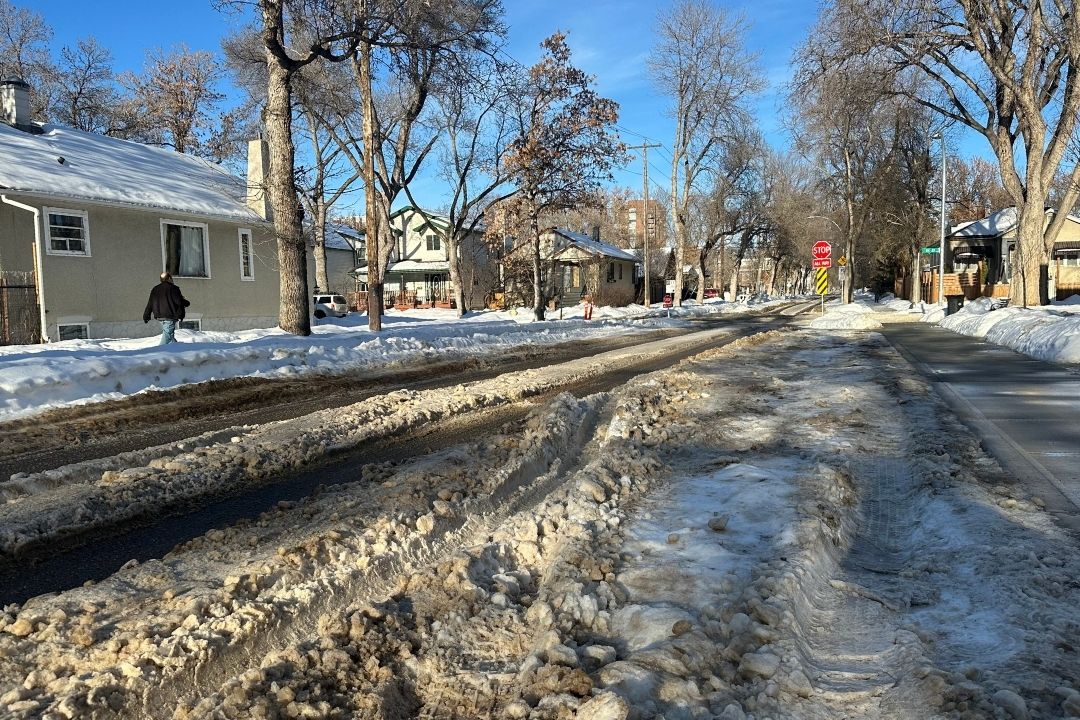
Snow covered the streets during record snowfall in January 2026. The proposed update to the snow-and-ice-control policy would keep service levels consistent with recent years. (Stephanie Swensrude)
Here are some more key items:
- Administration has prepared three options for enhancing cleanliness in Chinatown. The first option involves maintaining the cleanliness funding the neighbourhood receives, which is already more than other neighbourhoods. The second option is to increase funding of city-provided services, at a cost of $600,000 to $900,000. The third option would involve a city-funded and community-led cleaning service. The Chinatown Transformation Collaborative and YEG Chinatown Re:VITA have proposed separate community-led programs. CTC's program focuses on professionally delivered operational cleaning services, while Re:VITA's emphasizes community stewardship, neighbourhood activation, and placemaking. Administration didn't include the cost of the third option as it may involve a request for proposals.
- Administration is increasing the fees that construction companies must pay when they obstruct road lanes. The daily on-street construction and maintenance (OSCAM) permit fee will rise to $32 from $25 in an effort to further incentivize faster completion of construction projects that necessitate road closures. Administration is also introducing a $10 daily fee for waste bins that are placed on public roadways. A report that will be presented to urban planning committee says that construction-related road closures were in place for an average of 43 days before a daily fee was introduced in 2019. That number fell to an average of 25 days in 2025.
- Administration plans to use more technology in parking enforcement, says a report that will be presented at a community and public services committee meeting. Parking complaints have increased by about 45% since 2023, creating a persistent backlog of unresolved complaints, the report said. The city plans to launch automated parking enforcement in 2028. Staff will also explore digital tickets, which the report said could save about 7,500 operational hours annually.
- A report says 81% of 311 complaints in 2025 were resolved within established timelines. The report, which is to be presented to executive committee, said administration has continued to improve the service experience of Edmontonians using 311.
- Executive committee will be asked to amend an agreement with Azolla Hydrogen to align with an extended timeline for the Alberta Zero-Emissions Fleet Fuelling project. Because it is a single-source contract, committee must approve changes; however, no additional funds are required because the extension will be covered by the already-approved city budget and grant funding from Emissions Reduction Alberta.
- Executive committee will be asked to recommend that the historic designation of the Arlington Apartments be rescinded. The building, formerly located at 10524 100 Avenue NW, was Edmonton's first apartment building, and was designated a municipal historic resource in 1998. A fire damaged the building in 2005, but three facades were saved, and the lot was rezoned to allow for development that retained the historic elements of the remaining structure. The owner did not develop such a building and instead demolished the remaining walls in 2008. Administration now requires council approval to rescind the historic designation.
And here are updates on some of the items we told you about last week:
- Infrastructure committee rejected administration's proposal to drop 14 planned routes from the city's $100-million active transportation network expansion, leaving the existing plan in place. More than 60 people registered to speak, and most supported continuing the expansion, as the province prepares legislation that could affect municipal authority over bike lanes. Coun. Ashley Salvador said she intends to introduce a motion to direct administration to provide options for increasing funding for the active transportation infrastructure capital profile to complete all routes that were planned for the 2023-2026 budget cycle. The motion will also call for administration to include an unfunded capital profile to build active transportation infrastructure as informed by the forthcoming updated active transportation implementation guide.
- Infrastructure committee recommended that council approve proposed changes to the public art policy. The program was previously called Percent for Art, and provided about 1% of eligible costs from capital projects to cover the cost of the artwork's creation and installation, as well as the Edmonton Arts Council's costs to oversee the project, plus lifecycle management costs, care, conservation, and restoration. Since 2021, the definition of "1% of eligible capital projects" has been based on historic spending patterns dating back several years. Now, administration has proposed amending the policy to say that the city will allocate funding for a public art reserve through the operating budget approved by council, with reserve funding levels based on historical public art investments and collection maintenance requirements. Council is set to vote on the change at a future meeting.
- Councillors recommended that council approve the revised climate resilience policy that introduces a sustainable return on investment (S-ROI) metric. This means projects would incorporate climate-resilient requirements to a point where a positive S-ROI is demonstrated, and while this responds to financial constraints, it could also result in reduced environmental outcomes, administration said. Ward Nakota Isga Coun. Reed Clarke said that even though the policy is not perfect, he supports it, especially the S-ROI."I think it's a good, practical, systematic way to move forward," he said.
- After a public hearing on Aug. 25, council approved a rezoning application to allow the Hope Mission to turn its support facility in the Girard industrial area into a year-round emergency shelter. During the discussion, Coun. Michael Janz wondered aloud whether Edmonton should cease approving new social services until other municipalities in the region start "pulling their weight." He cited a March 2026 memo that indicated there are no emergency shelter beds open permanently to the general public in the municipalities surrounding Edmonton. "It just feels like Edmonton is being used as the blood bag for the rest of our region and the rest of our province," Janz said.
- Representatives of the construction sector say they need to be involved in how extreme weather risks are addressed in project planning, procurement, and contract delivery. Infrastructure committee heard from representatives from the Edmonton Construction Association, which represents the industrial, commercial, and institutional construction sectors, including contractors hired for public projects such as roads and neighbourhood renewal. The shortness of Edmonton's construction season has been exacerbated by repeat storms, and it can be hard to make up for weather-related delays, said Ryan Christensen, chair of the ECA's board. Record-breaking rain in Edmonton this summer caused $42 million in uninsurable damage to infrastructure and projects, City of Edmonton staff told city council's infrastructure committee meeting on Aug. 26. The City plans to recover costs through the province's Hazard Assistance and Resilience Program, which would cover 90% of losses, leaving the city responsible for the rest. Severe weather affected work on the Valley Line West and Capital Line South LRT projects, among other ongoing projects.
- Utility committee directed administration to accelerate parts of the 20-year storm management plan after the summer's record rainfall. EPCOR told councillors that it doesn't yet know the full financial impact of the summer's repeated severe storms, but it estimates there will be minimal operational costs and some emergency repairs needed.
- Coun. Michael Janz questioned whether the Low Level Bridge replacement should be funded as part of the 2027-2030 budget, as administration has proposed in a report to infrastructure committee. The project will likely be classified as growth instead of renewal, and administration has said that dollars for growth will be constrained in the upcoming budget. "I want to see more data why it has to be done now. It's not at full capacity. I understand that we want to build for the future, but right now it's a tough budget, and I want to make sure we're not building before we need to," Janz told reporters.
- Council postponed a public hearing for a mixed-use building in Glenwood.
- Council voted to rezone a parking lot downtown to allow for a small park.
Meetings stream live on YouTube on the Chamber channel and River Valley Room channel.
For more on civic affairs, including bike lanes, the Edmonton Research Park, public toilets, and an update on Edmonton Global, listen to Episode 369 of Speaking Municipally.
Share