
On the agenda: Municipal autonomy, public hearing
This week, council will discuss ways to enhance municipal autonomy and consider some rezoning applications.
There is a public hearing on Oct. 26 and a council meeting on Oct. 27 and 28.
Here are some key items on the agenda this week:
- Edmonton's partition from Alberta into a separate province or federal territory is unlikely and would be unprecedented in Canadian law, says a report that will be presented to council. In response to a council motion made prior to the Oct. 19 referendum, administration studied the possibility of partition, which refers to the idea that if a province has the right to secede from a sovereign country, regions within that province could partition themselves from the seceding province to remain part of the original country. This is not a recognized principle of Canadian law but has been discussed during separation debates in Quebec, administration said. The report outlines other ways to improve municipal autonomy, including enhanced relationships with Treaty 6 partners, legislative and constitutional change, and strengthened federal-municipal fiscal arrangements. The report includes a private attachment about pursuing municipal autonomy through the courts.
- Kunj Investment has proposed rezoning its lot in West Jasper Place at 9941 150 Street NW to allow for a four-storey residential building. Administration said it supports the application because the property is within 400 metres of a future Valley Line West LRT stop. Some residents said they oppose the rezoning because a larger development would exacerbate parking and traffic congestion.
- BM Homes has proposed rezoning a lot in Westmount at 12202 109A Avenue NW to allow for a larger three-storey residential building. Administration said it supports the application because it increases density in a primary corridor. Some residents said the existing small-scale residential zone is sufficient at this location.
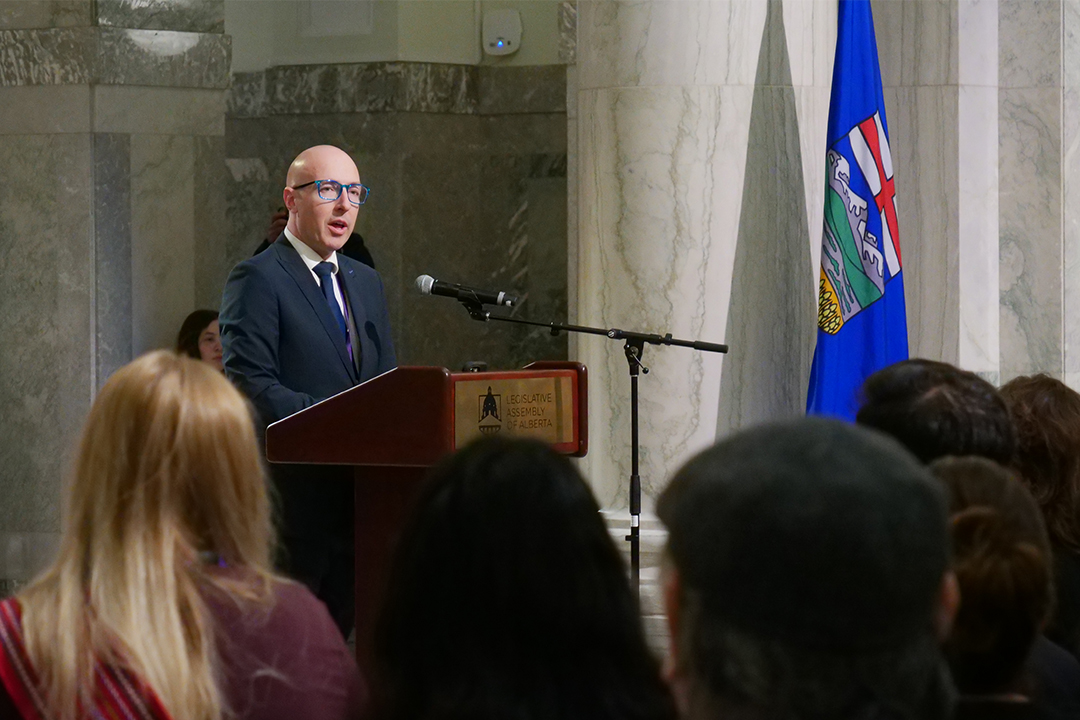
Council will discuss the unlikely and unprecedented scenario in which Edmonton could become a province, as well as other options that could increase its autonomy. (Sara Sheydwasser)
Here are more key items:
- Council will be asked to approve the 2027 council and committee calendar that was developed following council input in September. Executive committee would meet on Monday, urban planning committee would meet on Tuesday, and community and public services committee would meet on Wednesday. Public hearings would remain as one-day meetings but would be scheduled mid-week when possible. Council will also be asked to review the terms for deputy mayor and acting mayor, as well as the council seating arrangement.
- Council will be asked to renew agreements with the boards of Edmonton Public Schools and Edmonton Catholic Schools to conduct joint elections for the next 10 years.
- Council will hold a statutory public hearing to discuss amendments to the neighbourhood renewal program that would remove the direction to accelerate alley renewal in Business Improvement Areas. More than two-thirds of alleys across the city are in poor or very poor condition, a report said. Council voted in 2020 to prioritize alley and road renewal in BIAs by 2030, pushing those projects ahead of other neighbourhoods. But in July, council asked administration to prepare amendments to the policy to generally prioritize alleys in areas that support economic activities and development. The amendments would designate up to 25% of the alley renewal program to BIAs, industrial neighbourhoods, and commercial areas that are identified for renewal.
- Mayor Andrew Knack is set to introduce a motion directing administration to move forward with a competitive procurement process for the redevelopment of the Rossdale Power Plant and to advance opportunities for the interim activation of Pump House 2. The city received submissions for the adaptive reuse of the building earlier this year.
- Coun. Anne Stevenson is set to introduce a motion directing administration to work with Westrich Pacific to provide a report on potential financial and tax incentives to support the redevelopment of Edmonton City Centre into a mixed-use development.
- Council is required to approve the annual reports from advisory boards that made presentations to committees last week.
- Council will meet in private to look ahead to Q4, appoint council members to civic agencies, hear an update about a landfill gas conversion project, and receive an update on intergovernmental relations.
And here are updates on some of the items we told you about last week:
- Edmontonians shared a range of views on a proposed community court program aiming to connect people to supports when they get tickets for breaking bylaws as an alternative to prosecution. The program would cost about $1.17 million annually, which includes $510,000 for a third-party agency to provide legal advice and other social support services. Council will make a decision on whether to move forward with the community court during its four-year budget deliberations beginning in late November.
- City councillors have directed administration to work with Business Improvement Areas to address maintenance, cleaning, and a strategic realignment. Administration is pursuing immediate actions that will be funded under the current budget. These include enhancing efforts to raise internal awareness of BIAs and the impacts of municipal work on businesses; initiating working groups with representatives of BIAs and city administration; assisting businesses to find the right administrative contacts; and including BIAs in appropriate initiatives and policy development. Councillors directed administration to do further analysis on other supports and to return with more information next fall. They also directed administration to develop options for a cost-sharing program to support infrastructure maintenance, and they approved a motion from Mayor Andrew Knack that allows BIAs to use their budgets to hire contractors for enhanced maintenance and beautification of city-owned assets within their boundaries.
- Edmonton city council approved a motion to develop a proposal for a nighttime economy office to coordinate evening and late-night activities. The package will outline staffing and operating costs for a team dedicated to supporting businesses and events after regular business hours. Mayor Andrew Knack said a dedicated staff member working at night could help businesses navigate permits and other municipal requirements when daytime staff are unavailable. The proposal will be discussed during upcoming budget deliberations.
- Urban planning committee directed administration to bring forward an unfunded service package in the 2027-2030 budget for short-term traffic intervention measures in Belgravia. Councillors Michael Janz and Reed Clarke said addressing congestion issues in this area would help conditions in the southeast, southwest, and west of the city. "If there ever was a spot that needs something, this is it in the city," Clarke said.
- Urban planning committee voted 3-2 to recommend that city council allow the creation of a new statutory plan for land in the Winterburn area. Councillors Anne Stevenson and Michael Janz voted against the motion. Administration had advised against the new statutory plan because the district policy generally discourages residential development in industrial areas, and the Winterburn Industrial area structure plan specifically aims to prohibit residential land uses. Further, administration recommended retaining the industrial designation because Edmonton lacks shovel-ready land. Janz said he was not convinced that it would be "the right move right now" to bring more residential land into play in an area that is "not financially self-sustaining."
- Mayor Andrew Knack said he thinks two incentives to attract industrial investment would deliver good returns to the city. "This is going to create a lot of new jobs and a lot of new employment opportunities and that's what's really exciting," he said. Council will debate the incentives as part of the 2027-2030 budget deliberations.
- Community and public services committee approved a new single-source contract with Bent Arrow Traditional Healing Society to continue the Community Outreach Transit Team (COTT) program. The contract is worth $2.1 million and is set to expire at the end of 2030.
- Community and public services committee postponed two items regarding how Edmonton can be a leader in advancing housing and health solutions in the region.
- Community and public services committee directed administration to work with the Edmonton Combative Sport Commission to develop a business case to support amateur events.
- Executive committee recommended that council approve changes to the storefront improvement program policy that increase the maximum grant amount, which is based on 50% of eligible costs, to $50,000 per building. The update also adds a grant covering 50% of permanent landscaping costs up to $10,000 per building. Council approval is required.
- At a four-minute meeting on Oct. 22, council heard from city manager Eddie Robar that administration had not yet received any new information from the province regarding its order that Edmonton must revert its zoning bylaw to parameters that were in place before 2024 and restore parking minimums. Mayor Andrew Knack said he received the order in council shortly afterward from Municipal Affairs Minister Dan Williams. "The minister's infill directive is a significant matter with direct implications to Edmonton's affordability, including negative impacts on construction and housing supply," Knack said in a statement. "I, along with the City of Edmonton administration, will take the time necessary to fully review the order and complete a thorough analysis of its implications for the city and Edmontonians."
Meetings stream live on YouTube on the Chamber channel and River Valley Room channel.
For more on civic affairs, including an interview with the Edmontonian collecting LRT Takes and an update on the Army & Navy building on Whyte Avenue, check out Episode 377 of Speaking Municipally.
Share