
Zoning just one ingredient in infill housing boom
Changes to Edmonton's zoning bylaw are just one factor that led to an infill housing boom in the city's mature neighbourhoods, says an urban planner and developer.
"Zoning can't create outcomes — it is just a tool that allows things to happen or not," Chelsey Jersak, the founder of Situate, told Taproot.
In each of the two years since the city enacted the new zoning bylaw, there were a record number of housing starts in the Edmonton region. But Jersak said two other factors are at play: a financial incentive from the Canada Mortgage and Housing Corporation and record population growth.
MLI Select, introduced in 2022, is a multi-unit mortgage insurance product that scores developments containing five or more units with points based on affordability, accessibility, and climate compatibility. It can allow builders access to financing at reduced premiums and longer amortization periods. For example, a developer can borrow 95% of costs over a 50-year amortization period if it commits to renting a quarter of its units at an affordable rate. That's about $1,600 in Edmonton, which is 30% of the median renter income, according to CMHC. (Jersak told Taproot her development, Wello One, was financed using the program.)
Meanwhile, Edmonton's population has increased by 18.3% in the past five years. Between 2020 and 2025, the population grew by nearly 200,000 people, which is roughly equivalent to adding two Red Deer-sized cities to Edmonton.
So, if you combine the city's new rules that removed red tape for multi-unit developments and the federal government's financial incentive for such developments, and sprinkle in about 200,000 people that need somewhere to live, you've got a recipe for a big housing boom.
Jersak's company helps developers navigate the housing approval process, and she once worked as a planner at the City of Edmonton. The previous bylaw's single-detached residential (RF1) zone and small-scale infill development (RF3) zone both allowed single- and semi-detached housing, duplexes, and secondary suites, and the RF3 zone also allowed multi-unit housing. The 2024 zoning bylaw renewal was more an evolution than a revolution, Jersak said. "You could already do multiplexes under RF3, and RF1 had a lot of density as well, so it wasn't a revolutionary change, but other factors came into play to create the housing starts that we've seen over the last couple of years," Jersak said.
The changes have nonetheless resulted in Edmonton leading the way in housing policy, for better or for worse, said Tegan Martin-Drysdale, the president of RedBrick Real Estate Services and the founder in 2012 of the Infill Development in Edmonton Association.
"Edmonton has leapfrogged so far forward that it's kind of starting to wade into territory where things are being done that might not be done elsewhere — or there's things that are new to the Edmonton context that set it apart from other cities," Martin-Drysdale told Taproot. "When you start to become that big of an innovator and that big of a leader, you have to really innovate and iterate in terms of your changes."
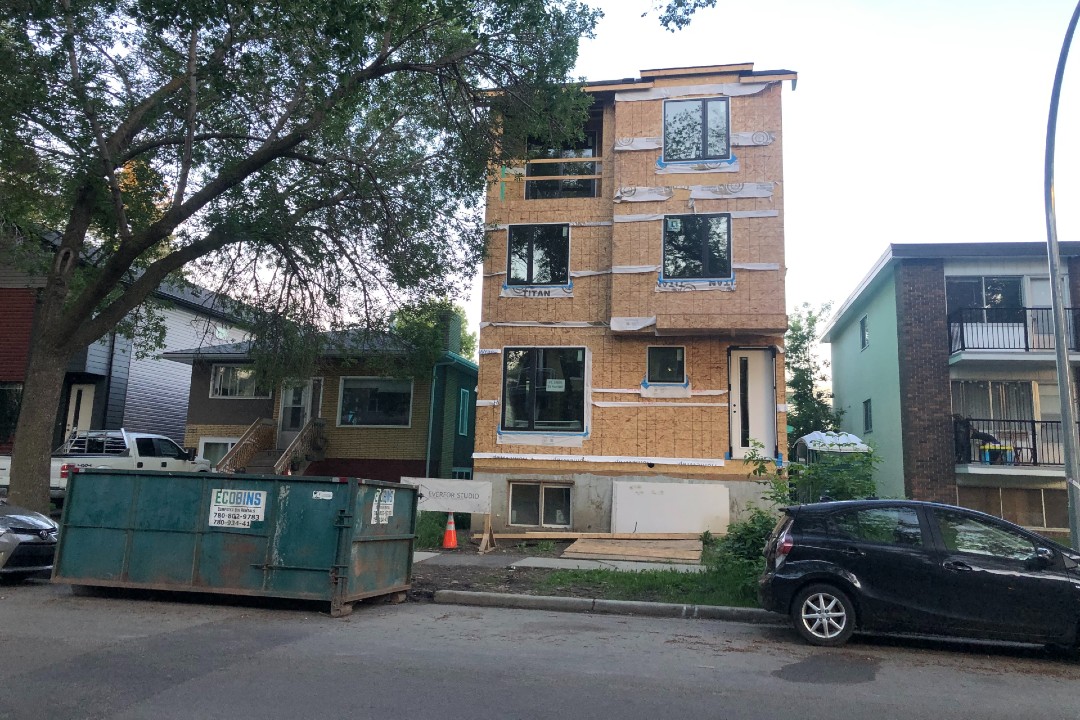
Mid-block infill projects, like this one in south-central Edmonton, have drawn the ire of some residents. (Stephanie Swensrude)
In October, Martin-Drysdale posted that it was time to reevaluate how infill was being developed. Martin-Drysdale wrote that the infill sector had moved away from the "sustainable, appropriate, and well designed housing and commercial developments" that she had imagined when she first started IDEA.
"A lot of the examples that I've seen and some of the frustration that was building up for me over the last couple years was just seeing what appeared to be just really poor designs, code infractions for sure, egress problems, parking problems, obviously dealing with that jump in densification from a single family to — obviously, it's the eightplexes that are causing the biggest reaction," Martin-Drysdale told Taproot.
When she posted about her frustrations, she did not know that Premier Danielle Smith was about to direct Edmonton to revert to the zoning parameters in place before 2024. Martin-Drysdale followed up with a post saying she understood why the province intervened and why Mayor Andrew Knack was upset, and urged the parties to get together and listen to each other, "finding common ground on the issues that matter most."
Jersak said there are many developers trying to get projects approved under the zoning bylaw before it changes. The city said development permit applications that are received by Nov. 8 are expected to get a decision before the rules change. For applications using the City of Edmonton's new standardized designs, the application deadline is Dec. 2.
Situate is advising developers that they could pursue what it calls "lock-in zoning" — a custom, direct-control zone that essentially duplicates the current RS zone, freezing the development rights they have. Or, if the city's policy supports it, a developer could up-zone to the small-medium scale transition residential (RSM) zone or the medium-scale residential (RM) zone, because those zones are not expected to be impacted by the provincial order.
What's next for the provincial directive?
Edmonton city council voted to direct administration and Mayor Andrew Knack to deliver a presentation to Alberta's Ministry of Municipal Affairs about their interpretation of the order. The delegation will also ask for clarification on the wording of the ministry's order in council, as councillors said it was unclear what is meant by "to the satisfaction of the minister." Administration said it will release draft bylaw amendments in mid-November to meet the province's deadline of Jan. 22.
Administration told council that reverting the zoning bylaw to parameters that were in place before 2024 could mean some neighbourhoods would be zoned for larger infill projects. As Jersak mentioned, infill was allowed under the previous RF1 and RF3 zones. Restoring those zones would mean that neighbourhoods outside the mature neighbourhood overlay (MNO) would see an increase in permitted height for infill; any neighbourhoods previously zoned RF3 would have no unit restrictions on mid-block infill; and in mature neighbourhoods zoned RF1, the maximum height would be reduced by 60 centimetres while the overall footprint of developments would be the same.
Taproot holds regular members-only livestreams, where guests such as Jersak and Martin-Drysdale go deep on issues of interest to Edmontonians. Become a member for access to future livestreams.
Share