
The Pulse
Jan. 30, 2026
Here's what you need to know about Edmonton today.
Essentials
- 3°C: Mainly cloudy. Wind up to 15 km/h. High plus 3. Wind chill minus 7 in the morning. UV index 1 or low. (forecast)
- Red/Blue: The High Level Bridge will be lit red and blue for the Flying Canoe Volant Festival and Races. (details)
- 4-3: The Edmonton Oilers (28-19-8) defeated the San Jose Sharks (27-21-4) in overtime on Jan. 29. (details)
- 8pm, Jan. 31: The Oilers (28-19-8) host the Minnesota Wild (31-14-10) at Rogers Place. (details)
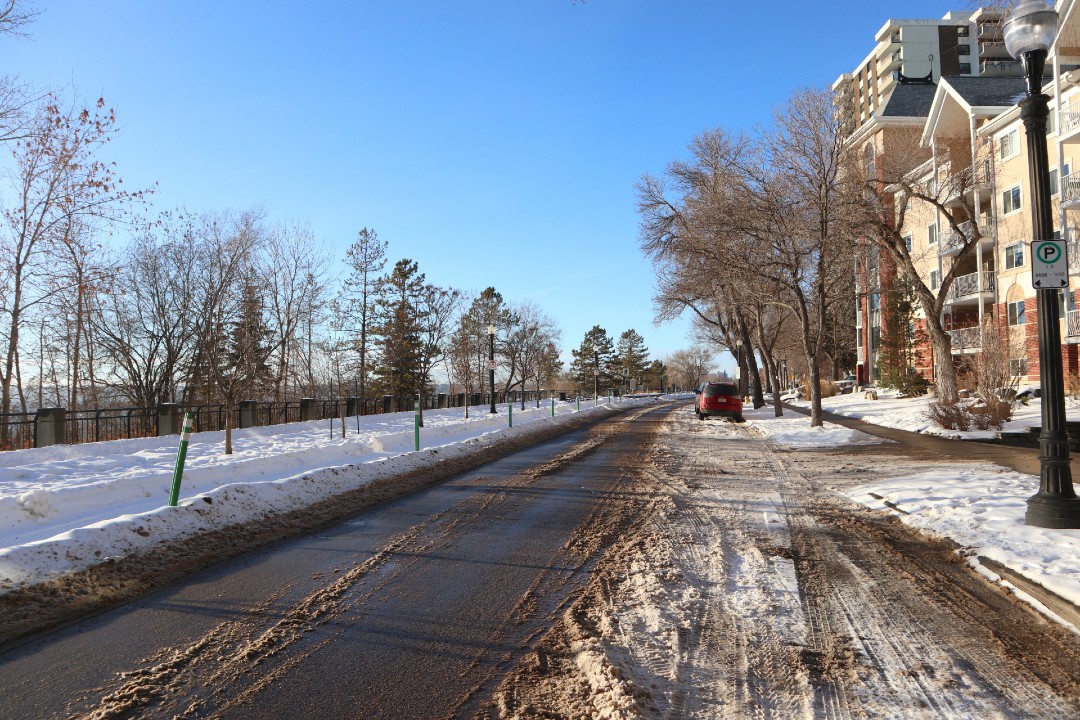
Your turn: Wîhkwêntôwin renewal, child-care zoning, RCMP priorities
The City of Edmonton is inviting feedback until Feb. 8 on the draft design for neighbourhood renewal in Wîhkwêntôwin, which could see several new active transportation routes and changes to make the area more friendly to pedestrians.
The renewal process is intended to bring the infrastructure of a neighbourhood up to current city standards, with the capacity to serve for the next 30 to 50 years. Wîhkwêntôwin is Edmonton's most populous and densest neighbourhood, with a greater than average share of residents who rely on walking or transit to get around. Public engagement has gone through several stages, and the community is now invited to offer feedback to refine the plan.
The proposed changes — which are said to take into account the Valley Line West LRT, Imagine Jasper Avenue, and alley renewal along 124 Street — are intended to "create safe spaces for all modes of transportation," says a video on the draft design. A traffic analysis of the draft design predicts "a potential increase in travel time for people driving of up to 90 seconds, and a reduction in travel time and improved safety for people walking and biking."
Still, the Edmonton Bike Coalition wrote that some of the most ambitious ideas in previous draft designs were watered down or replaced with compromises that prioritize vehicles over active transportation. The group contends the design leans too heavily on local street bikeways, which don't offer protection or separation from vehicles, and shared-use paths, which create conflicts between people walking, rolling, and cycling.
The online survey is open until Feb. 8. There will also be a drop-in event with the project team on Jan. 31 at Wîhkwêntôwin ᐄᐧᐦᑫᐧᐣᑑᐃᐧᐣ School.
Headlines: Jan. 30, 2026
- The Alberta Council of Women's Shelters is urging residents to show support for shelters throughout February with its provincewide Love a Shelter campaign. The initiative aims to make residents of women's shelters feel "seen, valued, and not alone" by encouraging the public to send Valentine's Day cards and make donations.
- Edmonton resident Quinn Marcacinni, who has a spinal disability, was denied Dedicated Accessible Transit Service (DATS) last week because snow windrows outside his west Edmonton home prevented the bus ramp from deploying. Marcacinni filed complaints with the City of Edmonton over the denial. Edmonton Transit Service paratransit manager Paul Schmold said the service did not receive any reports from operators or clients about refusal of service due to conditions, but said in such cases "DATS staff are deployed to assess the safety of the location, and work with clients, caregivers or facility staff to address the safety hazard, so service can resume as quickly as possible."
- Alberta's 9,000 unionized provincial employees are planning a "brown bag protest" as they return to full-time office work this weekend. Bobby-Joe Borodey, vice-president of the Alberta Union of Provincial Employees (AUPE), said workers will place bags with "Hybrid work tastes better" notes on desks, symbolizing pushback against the government's October 2025 decision. AUPE argues the move stems from a desire to revitalize businesses, while the provincial government said the return to office work would strengthen collaboration and service delivery for Albertans.
- The Edmonton Police Service investigated a weapons complaint at West Edmonton Mall on Jan. 29, after reports that a man discharged what appeared to be a firearm at another person in the Bourbon Street area around 12:24pm. The mall was placed on a brief lockdown, which was lifted by 1:45pm, with no injuries reported. Police continue to investigate the incident.
- The Alberta government will introduce new rules on April 1 to curb predatory towing practices. These regulations require tow truck drivers to disclose all towing and storage costs and obtain consent before towing, with penalties up to $300,000 or two years in jail for violations. Additionally, drivers must use the most direct route and provide itemized invoices. The province said these rules aim to hold operators accountable and ensure fairness for Albertans.
- First Nations chiefs from Treaties 6, 7, and 8, during a meeting at the west Edmonton office of Treaty 8 First Nations of Alberta on Jan. 29, rejected claims by separatist lawyer Jeffrey Rath that Indigenous people would be better off in an independent Alberta. During the meeting, several chiefs also spoke about how the effort to collect signatures to trigger a referendum on Alberta's separation is contributing to racial tensions in the province. Sturgeon Lake Cree Nation, the Blackfoot Confederacy, and Athabasca Chipewyan First Nation have launched lawsuits against the petition and the province's Bill 14.
- The Edmonton Elks signed wide receiver Austin Mack to a two-year deal ahead of CFL Free Agency. Mack played a key role in the Montreal Alouettes' 2023 Grey Cup victory over Winnipeg, contributing 103 yards and a touchdown. He previously had stints with the New York Giants and other NFL teams. The Elks also announced they have extended defensive lineman Jared Brinkman through the 2027 season. Brinkman, entering his second season with the Elks, achieved career highs in 2025 with 16 games played, 23 defensive tackles, and two sacks. He previously played three seasons with the Toronto Argonauts, winning two Grey Cups in 2022 and 2024.

Dawn's story: She saved my life!
A message from Accessible Acupuncture:
Edmonton resident Dawn had been living with the painful side effects of peripheral neuropathy for years.
"My feet and legs were extremely painful, and my doctor told me there was nothing they could do — that I would have to take gabapentin for the rest of my life," she recalls.
Then Dawn met Edmonton acupuncturist Dr. Melanie Morrill, Dr. Ac.
Peripheral neuropathy is a condition caused by damage to the peripheral nervous system, often resulting in pain, numbness, tingling, and burning sensations. For Dawn, even the simplest daily tasks became overwhelming. Opening doors, using the washroom, and getting out of bed were excruciating.
"How can you live for the next 30 years when you don't even want to get out of bed to do the simple things?" she asked herself.
Dawn experienced the full range of neuropathy symptoms — burning, numbness, tingling, and sharp, stabbing pain. "The way I would describe it is the equivalent of walking on glass," she says. She hadn't worn socks in five years and wore shoes two sizes too big, so nothing would touch her feet.
Unfortunately, Dawn's story is not unique. More than one million Canadians live with peripheral neuropathy, often after being told to "just live with the pain." Many struggle to sleep due to burning sensations, have difficulty walking or shopping for more than short periods, and live in constant fear of falling due to balance issues. For many, medications provide little relief or come with uncomfortable side effects.
Four months ago, Dawn read an article about Melanie and the work she was doing to help people suffering from peripheral neuropathy — without invasive procedures or medication.
Melanie, the founder of Accessible Acupuncture in Edmonton, uses the time-tested science of acupuncture alongside advanced technology originally developed by NASA to help increase blood flow and support nerve recovery and healing. The results were life-changing.
"Now, when I go to bed at night, I don't have shooting pains. I don't have the burning sensation. I don't have pain coming up my legs," Dawn explains. "I can wear socks and shoes!"
Today, Dawn and her sister run a successful dog-walking business, sometimes covering five kilometres a day. "It's life-altering," she says. "As far as I'm concerned, Melanie saved my life."
Melanie has been serving the Edmonton community for over five years, with a special focus on chronic pain and complex conditions. She is known for helping patients who have been told they are "hopeless" or "untreatable," consistently achieving meaningful, lasting results.
What was once a missing link in care is now accessible to residents of Edmonton, St. Albert, and Sherwood Park. If pain has caused you to miss tee times, skip dancing, or limit the life you want to live, it may be time to explore another option.
It's time to walk without pain. Call 587-879-7122 to schedule your consultation at Accessible Acupuncture today.
![A newspaper clipping with the headline 'Mayor Orders Supply Food For Men Struck Off Relief By Province, Tangle Grows']](https://taprootyeg.blob.core.windows.net/photos/2026/01/29/2026-01-30-history-5715.jpg "A moment in history: Jan. 30, 1935")
A moment in history: Jan. 30, 1935
On this day in 1935, tensions were rising between Edmonton's mayor and the province over food relief during the Great Depression.
The dispute concerned 14 single men who had been cut off from the province's aid program due to "alleged agitation." In response, then-mayor Joseph Clarke stepped in, demanding that the men be fed and housed for the next few days on the city's dime.

This didn't go over well with the chairman of the relief commission, who said it would lead to more single, unemployed men swamping Edmonton.
Officials may have been wary of an influx of needy men because of memories of 1932, when thousands of farmers, industrial workers, and others gathered in Edmonton to demand more relief from the provincial government. The Hunger March, as it was called, began in the city's market square (where Churchill Square now is), with the intent of marching down to the legislature, despite being denied a parade permit by the city. The marchers set out anyway, soon finding themselves in a fierce fight with police armed with truncheons and mounted on horseback. Eventually, representatives of the marchers were able to meet with Premier John Brownlee, who dismissed their demands. Plans for a second strike were crushed when police raided the headquarters of the organizers a few days later. Dozens of the demonstrators were arrested and tried.
It might be odd that the emphasis was on single men, but at the time, that was an important distinction. During the Depression, every level of government invested in make-work projects and relief programs in the face of devastating unemployment. But the need far outweighed the investment — by 1933, an estimated 25% of Edmonton's working population was unemployed, with about 13% on some sort of relief. What resources were available were largely reserved for married men, who were seen as the primary breadwinners for their families. In 1929, the city commission said Edmonton's emergency relief programs were "for unemployed married men who are bona fide residents," adding that "the city is not in a position to consider others."
For those without families, the message was clear: Leave the city. Some left to scratch out subsistence farms outside of the city limits. For others, their best hope was the remote work camps set up by the federal government, which offered room, board, and a meagre wage. Alberta was the site of three major camps, including ones in Elk Island and Jasper national parks. Since Edmonton was a major rail hub at the time, many of the men travelling to the camps would pass through the city, often riding on the tops of trains when they couldn't pay the fare.
Some of those who chose to stay in the city found shelter wherever they could, including among the trash heaps at the Grierson Dump. The small shanty town eventually grew to about 60 residents, many of them unmarried men who were unwilling or unable to take work placements on farms and work camps. City officials were constantly concerned about the public health risks surrounding the settlement, which saw a couple of outbreaks of typhoid fever. The residents were eventually evicted, and the houses were bulldozed.
The Great Depression might be history at this point, but hunger in Edmonton remains a pressing concern. In 1981, Edmonton's Food Bank opened as the first food bank in the country. In recent years, the problem has grown, with the Food Bank seeing increased demand and not enough donations to keep up. The organization announced that it recently hit its monetary fundraising goal for its holiday campaign, but fell about 20% short of its goal for food donations.
This clipping was found on Vintage Edmonton, a daily look at Edmonton's history from armchair archivist Rev Recluse of Vintage Edmonton.

Happenings: Jan. 30 to Feb. 1, 2026
Here are some events happening this weekend in the Edmonton area.
- Jan. 30: A Soirée for Creators and Entrepreneurs starting at 6pm at ArtsHub Ortona
- Jan. 30: Rising Through the Fray starting at 7pm at Garneau Theatre
- Jan. 30: A Taste of Italy starting at 7pm at Cask and Barrel
- Jan. 30: Tamar Ilana & Ventanas starting at 7:30pm at Maclab Centre for the Performing Arts
- Jan. 30: Shoes That Fit starting at 8pm at Westbury Theatre
- Jan. 30-Feb. 1: Global Game Jam at Edmonton Unlimited
- Until Jan. 31: Flying Canoe Volant in Mill Creek Ravine
- Jan. 31: Waffle Bird Drag Brunch Hosted by Gogo Fetch starting at 10:30am at Waffle Bird
- Jan. 31: The Great Housing Debates: Lessons from Calgary City Hall with former Councillor Courtney Walcott starting at 4pm
- Jan. 31: Safe & Sweet: A Celiac Community Night starting at 5:30pm at Sweet Castle Bakery
- Jan. 31: Vibro-Playground Fundraising Party starting at 6pm at Latitude 53 Gallery
- Jan. 31: Annual Hearts Pageant: Love on Mars starting at 7pm at Norwood Legion
- Feb. 1: Central European Gems starting at 3pm at Robertson-Wesley United Church
And here are some upcoming events to keep in mind:
- Feb. 9-13: Nonprofit Week at Edmonton Chamber of Voluntary Organizations
- Feb. 20: Chinese New Year Celebration – Year of the Horse at Northgate Lions Seniors Recreation Centre
- Feb. 28: Get Us Together Presents: Midnight Peg Album Release at The Aviary
Visit the Taproot Edmonton Calendar for many more events in the Edmonton region.

The Taproot Mini - No. 138
Test your crossword prowess and deploy a little of your Edmonton knowledge. Complete the puzzle.
Did you miss a Mini this week? Find them all in the archive.
The Taproot Mini is brought to you by ATB, your homegrown source of good advice to help conquer life's tougher puzzles. Learn how.
