
Updates: What happened next in city-building
Looking back on 2025 in planning, development, infrastructure, and other city matters, we of course saw a municipal election, as well as huge population growth, thoughts on a dying downtown mall, and ongoing debates over bike lanes, among other things. Here's what happened next and what to expect on some of the other city-building stories Taproot brought you:
Warehouse Park, other incentives spur up to 1,800 housing units downtown (Sept. 29, 2025)
The original story: Developers told Taproot that the new downtown park, the Downtown Student Housing Incentive, and the infill infrastructure fund were making it more attractive to build housing on surface parking lots downtown. Several underutilized lots were set to be turned into buildings of around six storeys, a shorter and more financially viable design than the skyscrapers that had been proposed for the lots years ago. The five projects with development permits — Westrich Pacific's Lotus Park and Lilac Park, Maclab Development's The Parks, Autograph's The Shift, and BLVD from MHA Properties — were set to add up to 1,800 new units near the park.
Then what? O'day-min Park, as it was officially named, opened to the public in November. The Downtown Student Housing Incentive was oversubscribed, and the city has tentatively allocated all available funding for the program. In December, Josan Properties acquired the Intact Building at 108 Street and Jasper Avenue, just a block away from O'day-min Park. CEO Raka Josan said the new park and future residential developments enrich the neighbourhood. "We are committed to investing in the city and being part of the momentum that is rising in our downtown core, and we couldn't be more excited to be contributing to that momentum."
What's next? The city is reviewing a development permit application from the developer of the Massey Ferguson site at 10616 103 Avenue NW to construct four buildings with a total of 696 units. If the permit is approved, that would bring the total new units near O'day-min Park to nearly 2,300.
City starts phasing in pedestrian takeover of 83 Ave (July 23, 2025)
The original story: The street in front of the Old Strathcona Farmers' Market was closed to vehicles for several summer weekends as the city started to phase in a complete pedestrianization of 83 Avenue, as is called for in the Old Strathcona Public Realm Strategy. The activation was funded in part through a reserve fund of revenue from the parking lot east of the farmers' market.
Then what? The city said the events led to an estimated 10% increase in market attendance on the weekends that the avenue was closed to vehicles. City council voted in the fall operating budget adjustment to axe the reserve fund and revert to putting the revenue from the parking lot — estimated at $438,000 in 2026 — into general coffers.
What's next? Some councillors indicated they might support reinstating the reserve fund in the four-year budget cycle, which is set for debate in the fourth quarter of 2026. In May, council is scheduled to discuss a report about parking benefit districts across the city, where parking revenues would be reinvested into the communities in which they are received. City administration said it will apply what it learned during the summer closures to future activations on 83 Avenue.
As McBryan announces EDBA exit, she sketches out a hopeful future for downtown (June 23, 2025)
The original story: Puneeta McBryan told Taproot she was leaving her role leading the Edmonton Downtown Business Association to spend more time with her family. "The decision was a long time coming," McBryan said. "My kid is growing up really fast, and I want to be home more. This is very much a personal decision, just as much as it is a career decision." McBryan was hired in December 2020 and led the EDBA through challenging times, including the COVID-19 pandemic, the resultant reduction in downtown workers, and an increase in social disorder. She also fought for stable funding for the Downtown Core Patrol.
Then what? The EDBA hired James Robinson as its executive director starting on Oct. 20. Robinson founded Toronto's first business improvement area on the famous Yonge Street, and then worked at the Heart of London Business Alliance in England. Most recently, Robinson worked at the City of Edmonton as its corporate BIA infrastructure specialist. There were changes at a BIA south of the river, too; Cherie Klassen stepped down as the executive director of the Old Strathcona Business Association in October.
What's next? The Core Patrol will resume operating during the day thanks in part to funding from National Bank of Canada, which strengthened its presence in downtown Edmonton after acquiring Canadian Western Bank. The program employs Hiregood staff to respond to and prevent social challenges on downtown streets. In 2026, both day and night shifts will see two staff in two Hiregood vehicles. The EDBA also said it plans to bring back Downtown Dining Week in March.
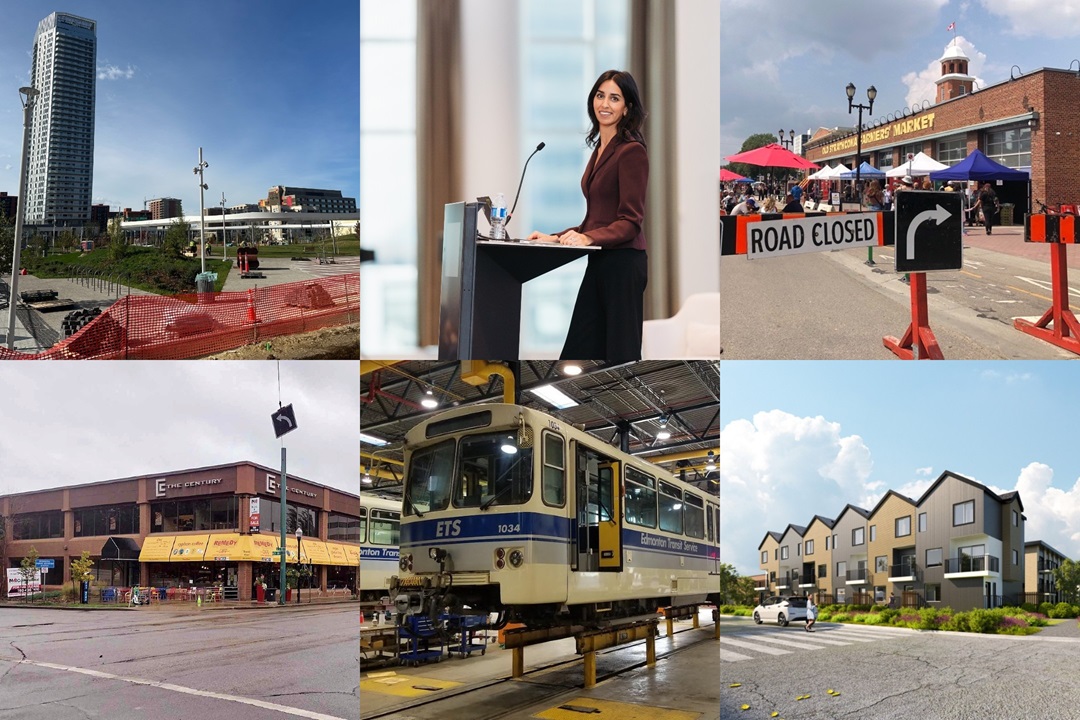
Clockwise from top left: Warehouse Park (now O-day'min Park) under construction; Puneeta McBryan; 83 Avenue in front of the Old Strathcona Farmers' Market; a rendering of a six-plex in Strathcona; a high-floor LRT vehicle; 124 Street, where upzoning took place.
Council to vote on upzoning more than 1,200 properties (May 20, 2025)
The original story: To help reach the city's goal of adding 50% of new housing through infill, administration had proposed proactively upzoning hundreds of properties to cut a layer of red tape for developers and encourage more dense housing. Parts of the Wîhkwêntôwin and Garneau areas, as well as some properties near 124 Street, 156 Street, and Stony Plain Road, were identified as priority growth areas, where the most housing growth should be expected. The initiative was enabled by the new zoning bylaw, which took effect in 2024 and became a major talking point during the municipal election campaign.
Then what? Council voted 9-3 to pass the priority growth area rezoning project. In May, city officials said the new zoning bylaw contributed to record-breaking numbers of housing starts and building permits. "We've been able to accommodate all of these new Edmontonians, and for the future, that's what we would like to achieve through this zoning bylaw — to accommodate and facilitate that future growth to maintain Edmonton as an affordable city, a livable city, and a fiscally sustainable city," said Travis Pawlyk, branch manager of development services at the City of Edmonton. However, some residents are organizing to stop, slow, or change infill because they want new housing in mature neighbourhoods to be smaller, the pace of developments to calm, and for neighbours to have more say in what gets built. Starting in late June, council held a marathon public hearing to consider changes to the zoning bylaw, one of which would have changed the maximum number of units that could be built on mid-block infill sites in the small-scale residential (RS) zone from eight to six. The status quo of eight prevailed. Council did approve several other design changes for mid-block infill, including reducing maximum building size, limiting the number of building entrances facing neighbouring properties, and revising facade design requirements.
What next? The newly elected city council, which saw the return of all of the incumbent councillors who generally support infill, is scheduled to return to the mid-block unit cap discussion on Feb. 10. Administration is preparing a report with recommendations and implications on reducing the maximum units on mid-block sites in the RS zone. The report will also include options to reduce the impact of height on adjacent properties and options to support the retention of trees on private property.
Tariff threat colours city's train-replacement options, transit watcher says (March 19, 2025)
The original story: Transit-watcher Reece Martin weighed in on the City of Edmonton's shortlist of vendors for new low-floor LRT vehicles — Siemens Mobility Limited from Germany, the Hyundai Rotem Corporation from South Korea, and Construcciones y Auxiliar de Ferrocarriles S.A. from Spain. His comments were in response to an update from the city that it would choose one of the three to supply at least 37 and up to 53 high-floor trains to replace aged vehicles and expand the fleet for extensions to the Capital and Metro LRT lines. The February announcement said the city hoped to award the contract for up to $240 million by late 2025, with delivery expected for 2028 and 2029. Martin named Hyundai Rotem as his pick of the three, in part because Siemens manufactures its light rail vehicles in the tariff-happy United States, while the Spanish SAF has less prestige in the industry than Hyundai Rotem, he said. Martin also noted Edmonton has used Hyundai Rotem as a supplier for low-floor LRVs for the Valley Line.
Then what? The city announced Hyundai Rotem as its preferred vendor for the new trains on Dec. 19. It then said it hopes to award the contract in 2026 for 40 trains to be delivered in 2029 and 2030. In adjacent news, all ETS vehicles now accept fares by credit card, Interac, and digital wallet, in addition to the Arc card.
What's next? As the city extends its delivery expectations for the trains, it continues work on the Capital and Metro line extensions. Construction on the Capital Line's south extension began in 2025, with major construction expected to take four to five years, before testing and commissioning begin. The city has yet to share concrete projections for the Metro line's extension to the northwest.
Edmonton Design Committee could review more developments in future (Feb. 5, 2025)
The original story: The Edmonton Design Committee was reviewing its mandate and considered expanding its oversight to include corridors such as Alberta Avenue, Stony Plain Road, and major freeways, while refining its design principles.
Then what? The committee's mission statement now reads that it's committed to working with applicants to enhance the city's urban form, strengthening neighbourhoods and local character; shaping new districts; and creating vibrant, dynamic, and appealing places to live and work. Representatives in the design, building, and development industries told the committee they supported expanding the committee's geographical boundaries, but are concerned about adding to the committee's workload. Representatives said the new evaluation criteria need to encourage developments that are welcoming to pedestrians, particularly in winter.
What next? City administration is working with the committee to implement the new standards and procedures and submission guide. The committee is set to finalize changes to its geographical boundaries in 2026.
Curious about the sequel to other city-building stories Taproot has covered? Send us a note at hello@taprootedmonton.ca and we'll look into it.
Share